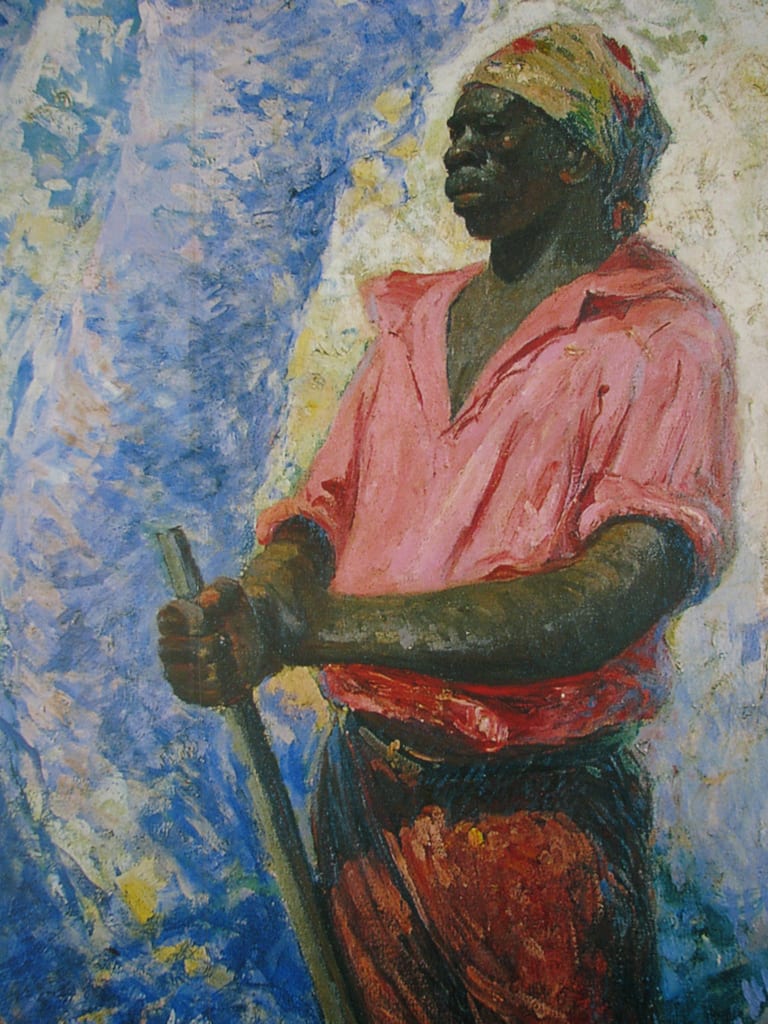
Zumbi and Palmares Challenge a Slaveholding Order
A community’s resistance and destruction became central to later struggles over freedom and memory in Brazil.
During the seventeenth century, enslaved people in colonial Brazil established autonomous communities known as quilombos by fleeing Portuguese plantations. The largest and most resilient of these settlements was the Quilombo dos Palmares, formed around 1605 in the forested, mountainous hinterlands of Pernambuco, in territory that forms part of modern Alagoas. Palmares grew into a confederation of eleven towns spanning rugged frontier terrain. Sustained by hunting, fishing, gathering, agriculture, and selective trade and raids on nearby Portuguese settlements, the territory had reached an estimated population of more than twenty thousand by the middle of the seventeenth century, with some estimates higher.
Internal social rules within Palmares were distinct from colonial law. Sources describe distinctions between people who arrived as fugitives and captives brought into the settlements. Historians debate the extent and nature of coercive labor within Palmares, whose internal life is largely reconstructed from the records of its enemies. The settlement incorporated men and women of African, Indigenous, and European ancestry, including deserters from the Portuguese military and women who fled abusive masters or spouses, creating an organized society that sustained defiance against colonial rule for decades.

Keep reading in Yester
Coming soon to the App Store
Keep following the story

Sources
- Palmares, Encyclopedia of African-American Culture and History (Encyclopedia.com)
- Lei nº 12.519, de 10 de novembro de 2011: Institui o Dia Nacional de Zumbi e da Consciência Negra (Presidência da República, Brazil)
- Lei nº 14.759, de 21 de dezembro de 2023 (Presidência da República, Brazil)
- Parque Memorial Quilombo dos Palmares (Fundação Cultural Palmares, Government of Brazil)
- Zumbi
Image: Antônio Parreiras