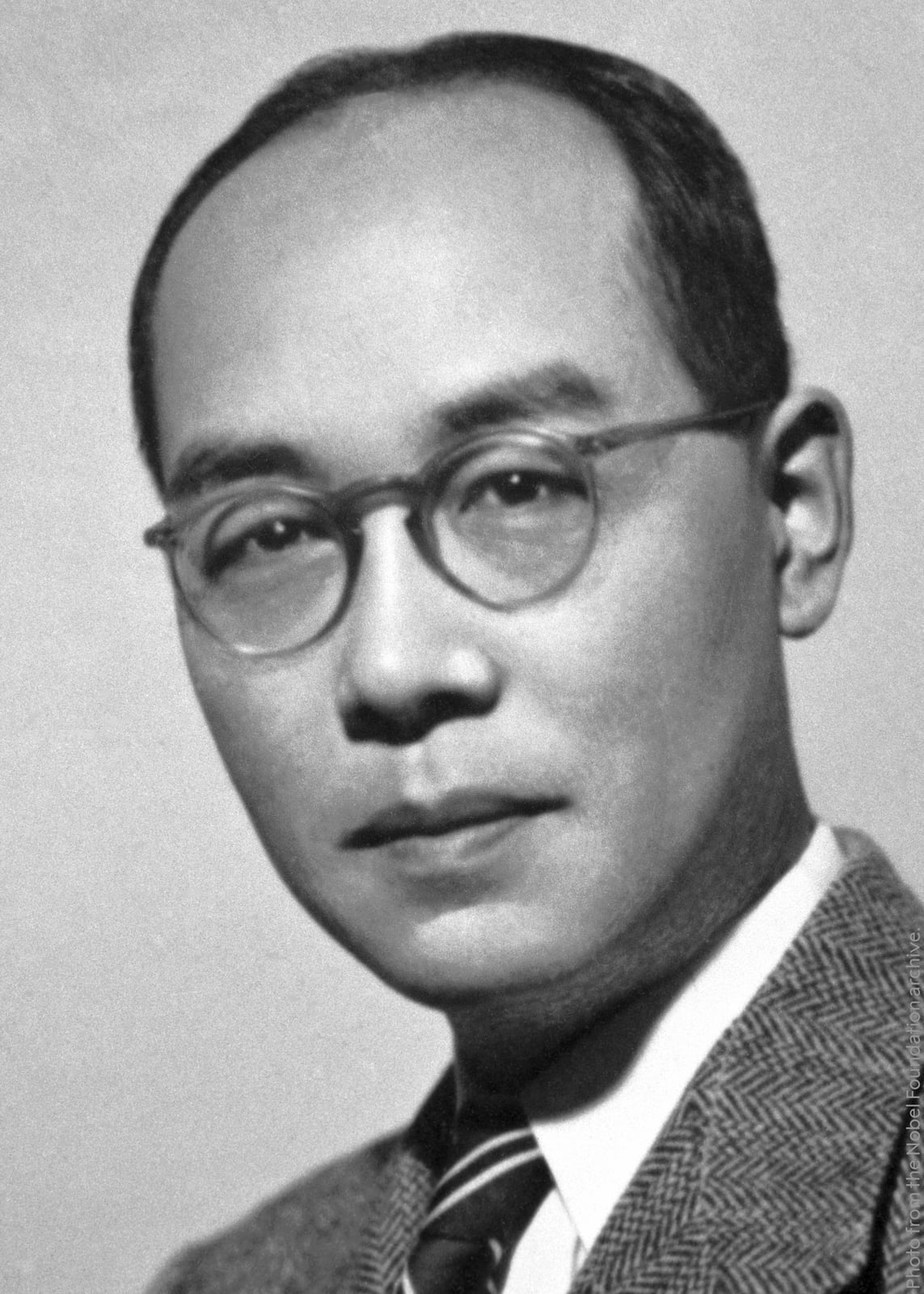
Hideki Yukawa Becomes Japan’s First Nobel Laureate
A theory of the force binding the atomic nucleus won the physics prize.
In 1949, the Royal Swedish Academy of Sciences awarded the Nobel Prize in Physics to theoretical physicist Hideki Yukawa. The award recognized his theoretical prediction of the existence of mesons, an idea he formulated to describe the fundamental forces operating within the atomic nucleus. This recognition marked the first time that a Japanese citizen received a Nobel Prize, highlighting the international significance of Japan's emerging contributions to twentieth-century quantum and subatomic physics.
Born Hideki Ogawa in Tokyo in 1907, he moved at an early age to Kyoto, where his father served as a professor of geology at Kyoto Imperial University. During his formative years, his intellectual interests were shaped both by classical philosophical texts, including works attributed to Lao-Tzu and Chuang-Tzu, and by mathematical studies. After finishing secondary school, he entered Kyoto Imperial University and completed his degree in 1929. Although he briefly contemplated experimental work, practical challenges during laboratory sessions prompted him to focus entirely on theoretical physics, with a primary concentration on the nature of elementary particles.

Keep reading in Yester
Coming soon to the App Store
Keep following the story
Sources
Image: Nobel Foundation archive