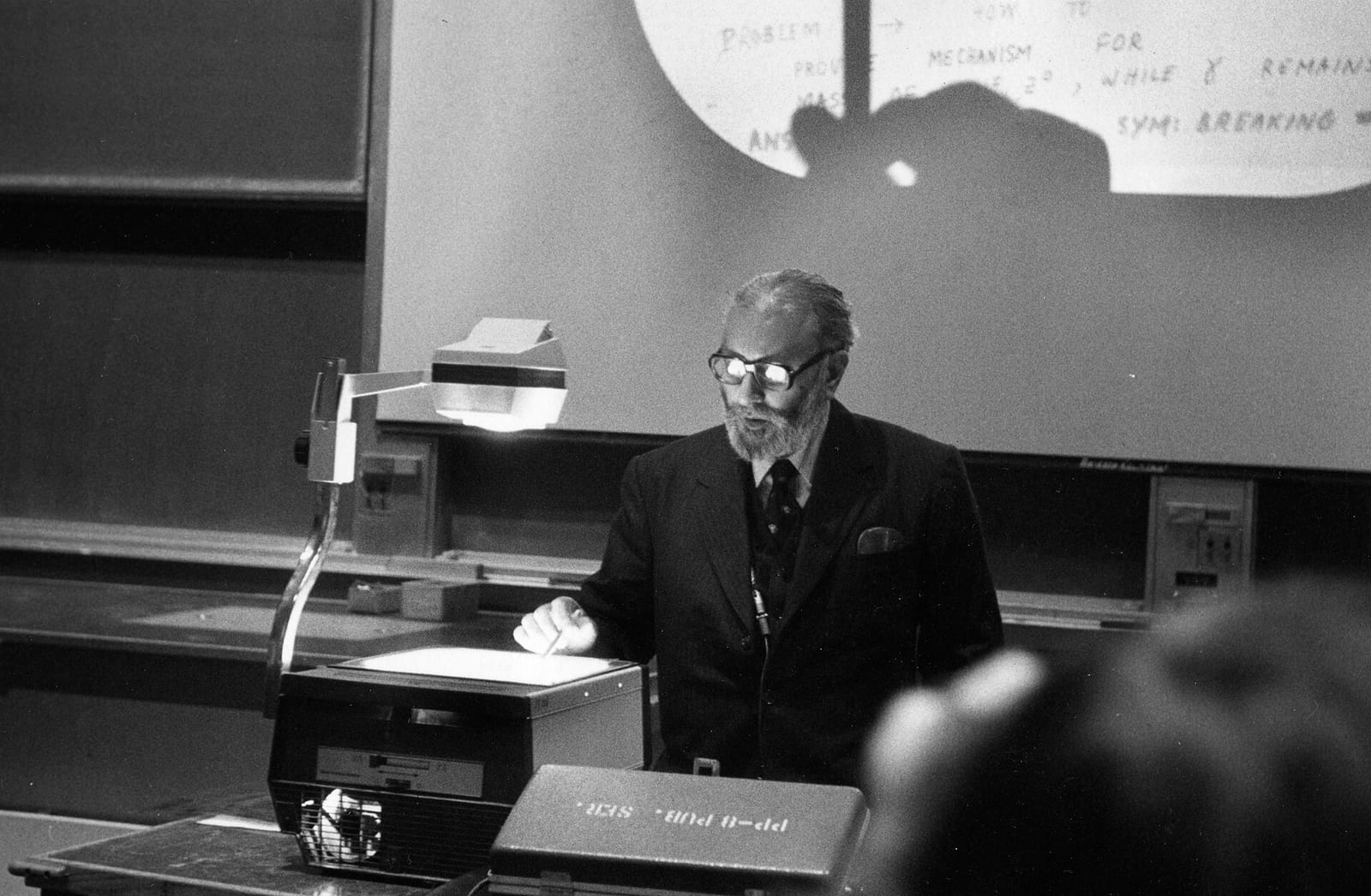
Abdus Salam Shares the Nobel Prize in Physics
A Pakistani physicist helped unify two of nature’s forces.
In December 1979 in Stockholm, theoretical physicist Abdus Salam accepted the Nobel Prize in Physics, sharing the honour with Steven Weinberg and Sheldon Glashow. The award recognized their joint formulation of electroweak theory, an intellectual framework that demonstrated the underlying mathematical unity between electromagnetism and the weak nuclear force. Salam became the first Pakistani recipient of a Nobel Prize, establishing a major milestone for scientific scholarship emerging from the Global South.
Born in 1926 in Jhang in the Punjab Province of British India, Salam exhibited extraordinary mathematical talent from an early age. After setting a record score in the University of the Punjab's matriculation examination at 14 and earning a master's degree at Government College in Lahore, he secured a scholarship to St John's College, Cambridge, in 1946. There he took double first-class honours in mathematics and physics in 1949 before completing a doctoral thesis on quantum electrodynamics at the Cavendish Laboratory. His solution for the renormalization of meson theories quickly brought him international recognition within the theoretical physics community.

Keep reading in Yester
Coming soon to the App Store
Keep following the story
Sources
Image: Credit Line: Photograph by Emilio Segrè, courtesy of AIP Emilio Segrè Visual Archives, Segrè Collection