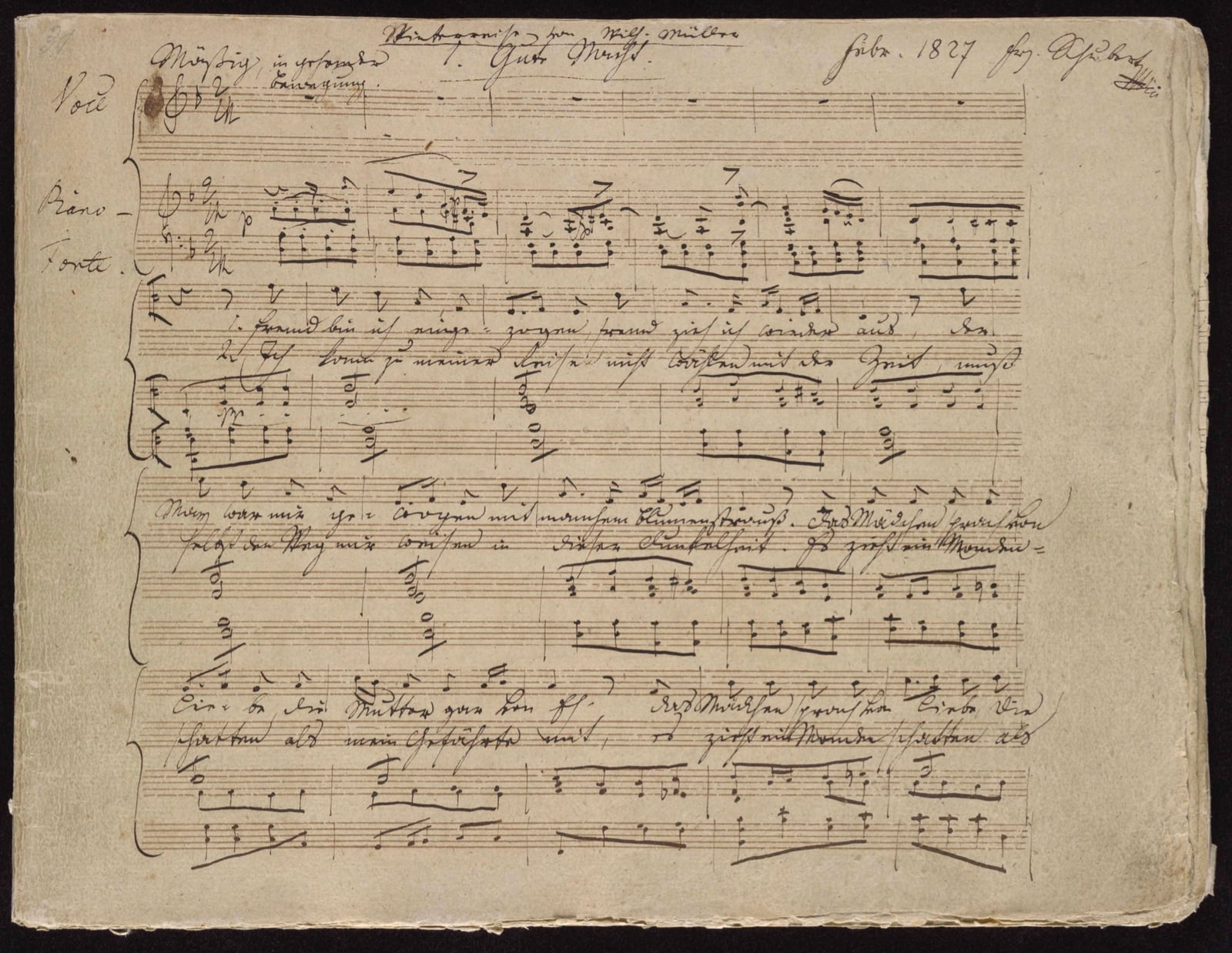
Schubert Completes Winterreise
Twenty-four songs followed a rejected lover through a winter landscape.
Franz Schubert completed his song cycle Winterreise across two distinct periods of composition in 1827. In February of that year, the Austrian composer set an initial sequence of twelve poems by the German writer Wilhelm Müller, which he had discovered in the Leipzig almanac Urania for 1823. Müller had originally published these verses under the title Wanderlieder von Wilhelm Müller: Die Winterreise. Only after Schubert set the opening dozen songs did he encounter Müller's expanded 1824 collection, which added twelve further poems to the cycle. In October 1827, Schubert set the remaining texts, preserving his original sequence while appending the newer verses as a continuation.
The poetic text, arranged as a monodrama, traces the winter wanderings of an unnamed protagonist who slips away from a town at night following his beloved's rejection. Passing through bleak landscapes, past a charcoal burner's hut, a village, and a cemetery where he finds no rest, the grief-stricken wanderer confronts isolation and existential despair. Concrete narrative events remain ambiguous, shifting inward as emotional agony replaces worldly hope. The cycle concludes not with a dramatic resolution, but with an encounter outside a village with an impoverished hurdy-gurdy player, whose relentless playing and solitary presence leave the wanderer's ultimate fate unresolved.

Keep reading in Yester
Coming soon to the App Store
Keep following the story
Sources
- Schubert, Franz: Winterreise, autograph manuscript, Cary 215 (The Morgan Library & Museum, Music Manuscripts Online, archived)
- Winterreise D 911 Op. 89 (PTNA Piano Music Encyclopedia)
- Franz Schubert: Winterreise (Smithsonian Chamber Music Society)
- Schubert: Winterreise D 911, Stephan Genz and Michel Dalberto, liner notes (Claves Records)
- Schubert D. 911 Winterreise, first edition, Haslinger (Schubertiade Music and Arts, citing Deutsch)
- Winterreise
Image: Franz Schubert