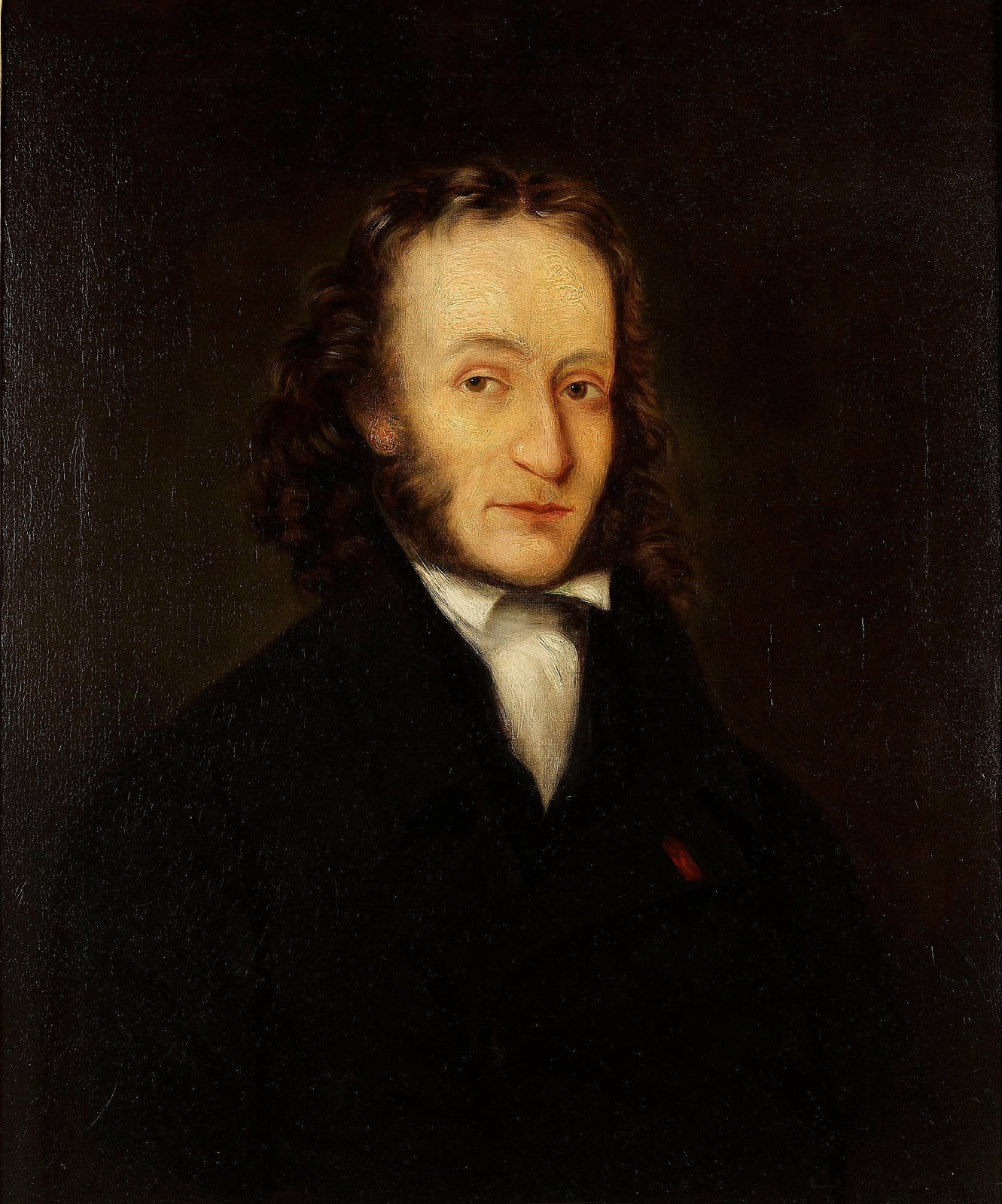
Paganini Takes Vienna by Storm
A violin virtuoso’s concerts set off a craze.
In March 1828, the Italian violinist Niccolo Paganini arrived in Vienna to begin his first extensive concert tour outside the Italian peninsula. Though he was already forty-five years old and widely celebrated in his homeland, audiences north of the Alps had never heard him in person. Having received the papal Order of the Golden Spur the preceding year, Paganini opened in the Austrian capital with performances of his own demanding works and modified concertos by contemporaries such as Giovanni Battista Viotti and Rodolphe Kreutzer. The Austrian public responded with immense enthusiasm, launching a continental craze that established him as the preeminent instrumental virtuoso of the era.
Paganini's technical proficiency had been cultivated across decades of rigorous training and unconventional development. Born in Genoa in 1782, he studied under local musicians before seeking out Alessandro Rolla, Ferdinando Paer, and Gasparo Ghiretti in Parma. Early exposure to the neglected Caprices of Pietro Locatelli and the innovations of violinist August Duranowski led Paganini to revive forgotten techniques and integrate complex left-hand pizzicato with both natural and artificial harmonics. Combined with unusual flexibility in his hands, these abilities enabled him to execute rapid shifts and novel timbres that rival performers of his day could not match.

Keep reading in Yester
Coming soon to the App Store
Keep following the story
Sources
- Paganini, Niccolò (Encyclopedia.com, from Baker's Biographical Dictionary of Musicians, Europe 1789-1914 and The Oxford Dictionary of Music)
- The hidden method of Paganini: Paganini in Vienna (Thomastik-Infeld)
- Paganini's 'Il Cannone' brought from Genova to Grenoble for X-ray synchrotron analysis (ESRF)
- Souvenir de Paganini, work overview (PTNA Piano Music Encyclopedia)
- Niccolò Paganini
Image: John Whittle (active in Preston, early 19th century)