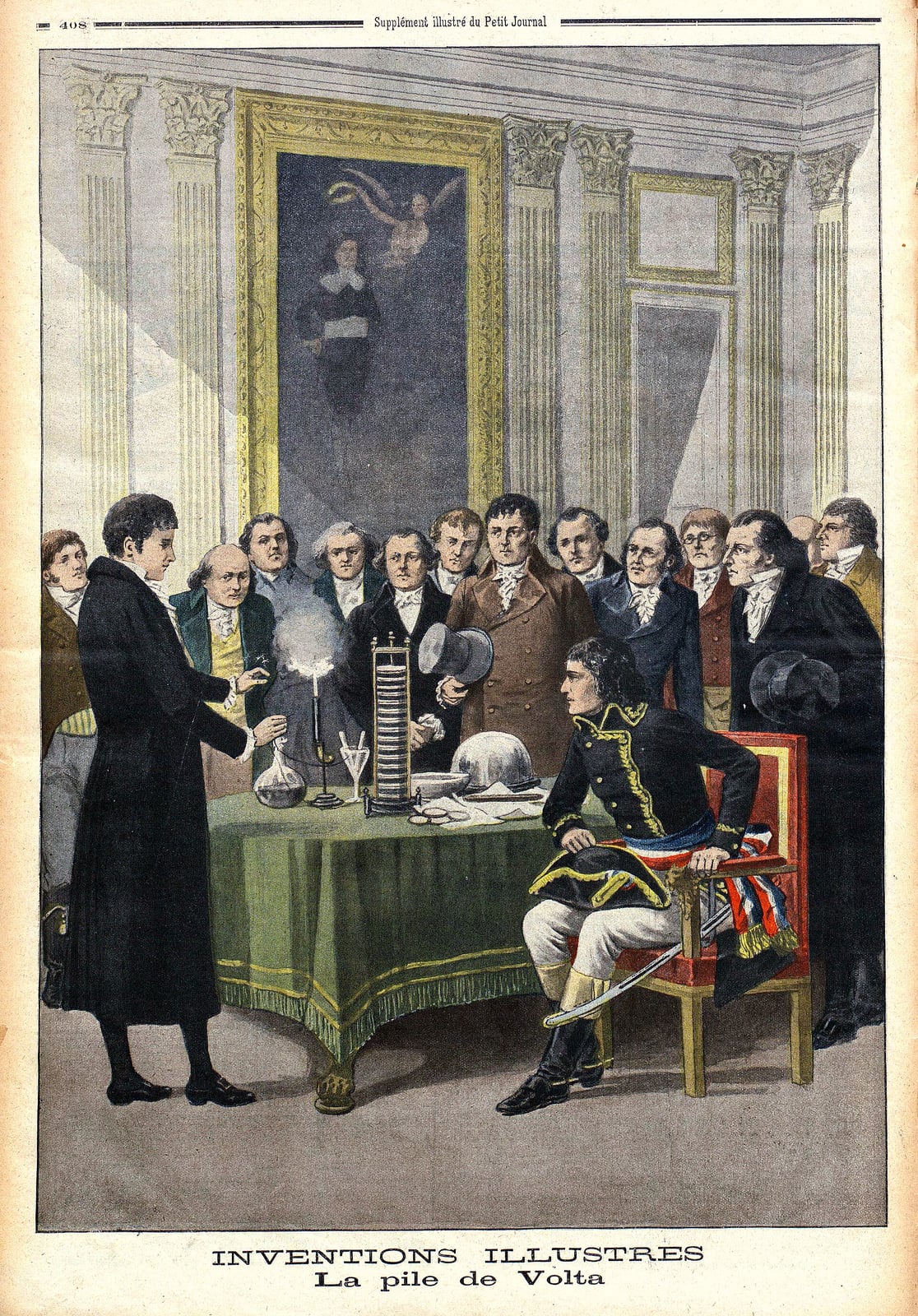
Volta Builds a Source of Continuous Electric Current
Stacked metals and moist separators transformed electrical experiments by making a sustained current available.
In 1800, Italian physicist Alessandro Volta reported an apparatus that produced an ongoing electrical current through a closed circuit. Volta had previously observed during the 1790s that placing two distinct metals alongside moist cardboard or cloth created electrical activity. Seeking to clarify disputed observations made by Luigi Galvani regarding frog muscles and metallic contacts, Volta arranged alternating discs of copper or silver and zinc, interspersing them with pieces of cardboard or cloth soaked in brine. When conductors joined the top and bottom of this column, an uninterrupted flow of electricity was achieved.
Volta announced his findings to the Royal Society of London in a communication dated 20 March 1800. The device, soon known as the voltaic pile, marked a substantial departure from earlier instruments such as electrostatic machines, which produced brief static discharges rather than a sustained flow. News of the arrangement spread quickly across European scientific circles, providing experimenters with their first steady laboratory current. Within months, William Nicholson and Anthony Carlisle utilized the apparatus to decompose water into hydrogen and oxygen through electrolysis.

Keep reading in Yester
Coming soon to the App Store
Keep following the story


Sources
Image: Le Petit Journal