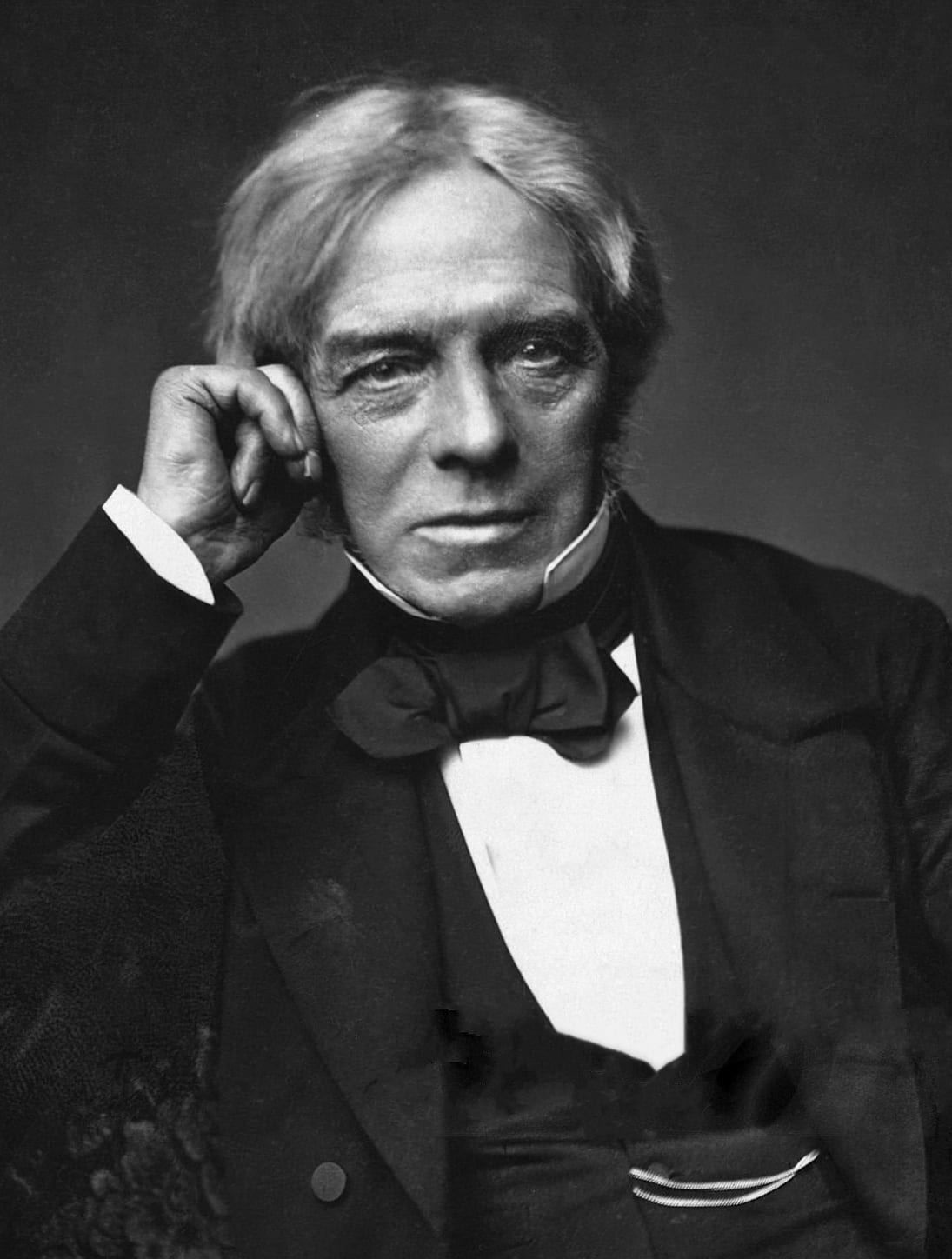
Faraday Finds Electricity in a Changing Magnetic Field
Experiments in 1831 showed a way to produce an electric current through magnetic change. The discovery helped establish the principle behind electrical generators.
In 1831, Michael Faraday began an intensive series of experiments at the Royal Institution in London that transformed understanding of electricity and magnetism. A decade earlier, he had demonstrated continuous electromagnetic rotation, constructing a rudimentary apparatus that laid early ground for electric motors. Yet his attempts in 1824 to determine whether an active magnetic field could induce an electric current in an adjoining wire had yielded nothing. Determined to revisit the problem after years occupied by chemical research and optics, Faraday began the decisive series in August and continued testing different arrangements over the following months.
His breakthrough relied on an apparatus constructed from two insulated coils of wire wrapped around an iron ring. When Faraday connected one coil to a battery, he detected a momentary surge of current in the second coil, and another brief surge occurred when the initial circuit was disconnected. This transient phenomenon demonstrated mutual inductance. Subsequent experiments confirmed that moving a magnet through a coil produced a current in the wire, as did moving the coil over a fixed magnet. The essential factor was not the mere presence of a magnetic field, but its variation over time.

Keep reading in Yester
Coming soon to the App Store
Keep following the story
Sources
Image: Unknown author Unknown author