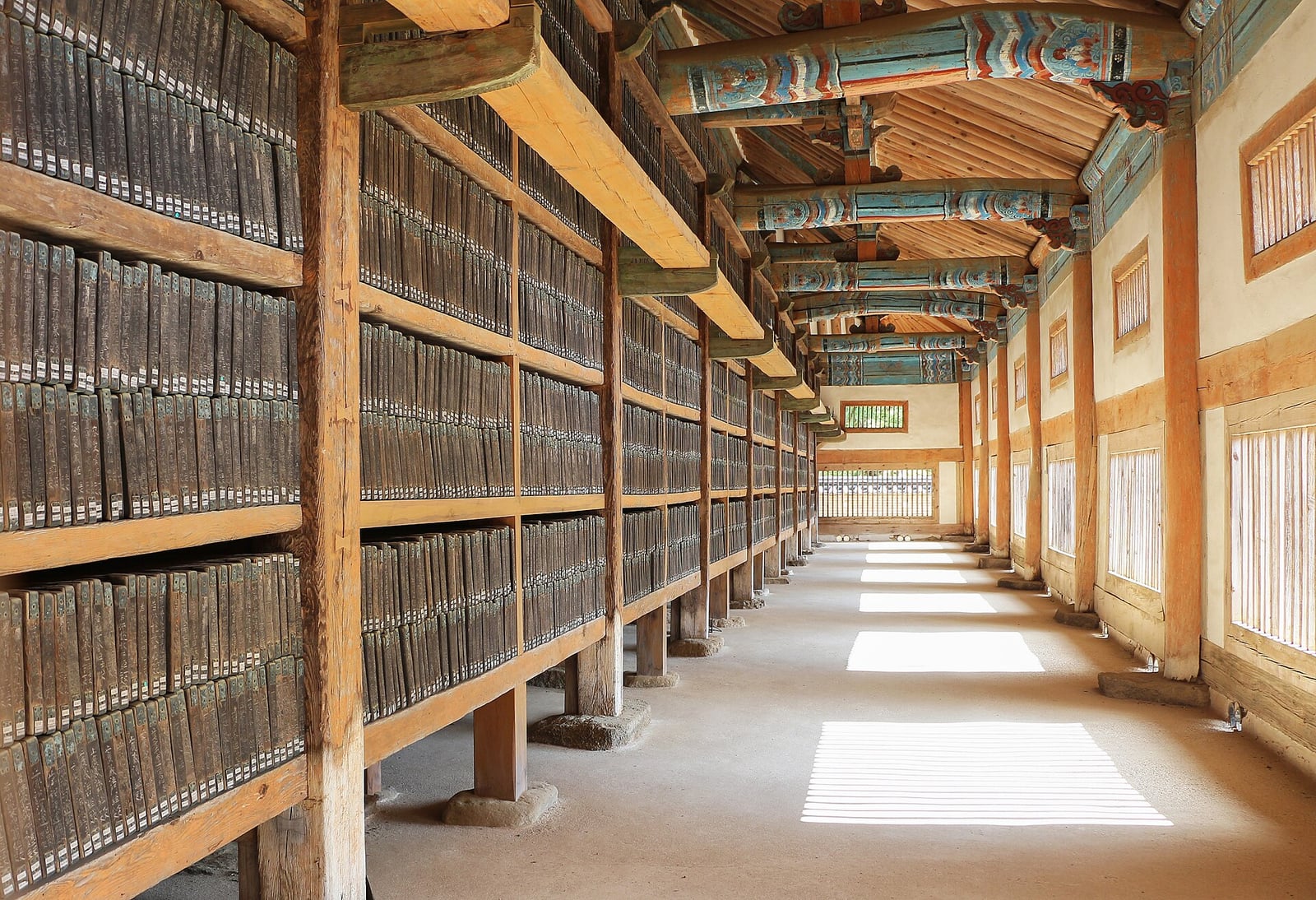
Korea Completes the Tripitaka Koreana
More than 80,000 woodblocks preserved the Buddhist canon.
During the thirteenth century, the Korean kingdom of Goryeo faced catastrophic invasions by the Mongol Empire. After the court evacuated the mainland to establish a wartime redoubt on Ganghwa Island, the military regime led by Ch'oe U confronted not only territorial devastation but also the loss of sacred cultural foundations. In 1232, invading forces burned the monastery housing the realm's first imperial Buddhist canon, a set of woodblocks carved over several decades in the eleventh century. Believing that re-creating these sacred scriptures would invoke divine assistance to protect the nation from foreign conquest, King Gojong ordered the entire canon to be compiled and carved anew.
Carving commenced in 1237 under a dedicated state office known as the Daejang Dogam, backed by Ch'oe U and his son Ch'oe Hang. The undertaking brought together monastics from both the Seon and Gyo traditions along with thousands of artisans and scholars. Preparing the printing plates required an elaborate multi-year curing procedure to ensure structural resilience. According to traditional accounts, timber harvested from southern islands was submerged in sea water for three years, cut into planks, boiled in salt water, and air-dried in shaded breezes for another three years. Modern wood analyses show that cherry wood was used most often, followed by pear, birch and other hardwoods. Once carved, the plates were brushed with a lacquer finish to deter wood-boring insects and reinforced along the edges with metal framing to prevent distortion.

Keep reading in Yester
Coming soon to the App Store
Keep following the story
Sources
- Haeinsa Temple Janggyeong Panjeon, the Depositories for the Tripitaka Koreana Woodblocks (UNESCO World Heritage Centre)
- The Tripitaka Koreana and Uigwe: What to Do with Traces of Japan (Kyunghyang Shinmun)
- New revelations shine light on the ancient Goryeo era (Korea JoongAng Daily)
- National museum marks millennial anniversary of ancient Buddhist printing blocks (The Korea Herald)
- Texture analysis of stereograms of diffuse-porous hardwood: identification of wood species used in Tripitaka Koreana (Journal of Wood Science)
- Wood Quality of Column in Storage Halls of Tripitaka Koreana Woodblock (Journal of the Korean Wood Science and Technology, via KoreaScience)
- Buswell and Sugi's editorial work, 2013 Goryeo Daejanggyeong conference (Kyunghyang Shinmun)
- Tripitaka Koreana
Image: Bernard Gagnon