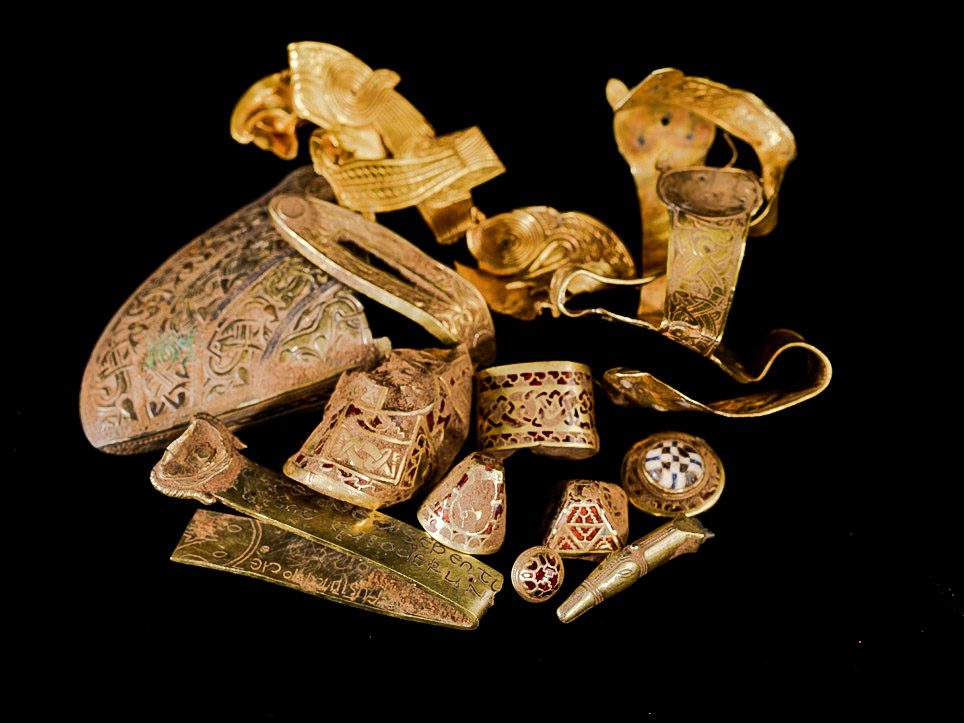
A Metal Detectorist Finds the Staffordshire Hoard
A farm field yielded thousands of Anglo-Saxon gold and garnet fittings, mostly from weapons.
On 5 July 2009, Terry Herbert searched recently ploughed farmland near Hammerwich, Staffordshire, using a metal detector. Over five days he retrieved 244 gold items from the earth, prompting him to report the find to a regional Portable Antiquities Scheme liaison officer. The landowner, Fred Johnson, allowed an emergency excavation funded by English Heritage and managed by Birmingham Archaeology. Working across a 9 by 13 metre zone to recover items scattered by agricultural activity, excavators collected thousands of pieces. A coroner subsequently designated the assemblage treasure, and in 2012 an additional 91 items were recovered from the same field.
Comprising nearly 4,600 pieces and fragments, the find remains the largest cache of Anglo-Saxon gold and silver metalwork recorded. Its metallic weight amounts to roughly 5.1 kilograms of gold and 1.4 kilograms of silver, accompanied by approximately 3,500 garnet cloisonne stones. Its gold alone is about three times the amount found in the ship burial at Sutton Hoo in 1939. Scientific analysis revealed sophisticated smithing methods, including depletion gilding, an unexpected technique in which craftsmen stripped base metals from alloy surfaces to create an exterior with the lustre of higher-purity gold.

Keep reading in Yester
Coming soon to the App Store
Keep following the story

Sources
Image: David Rowan, Birmingham Museum and Art Gallery