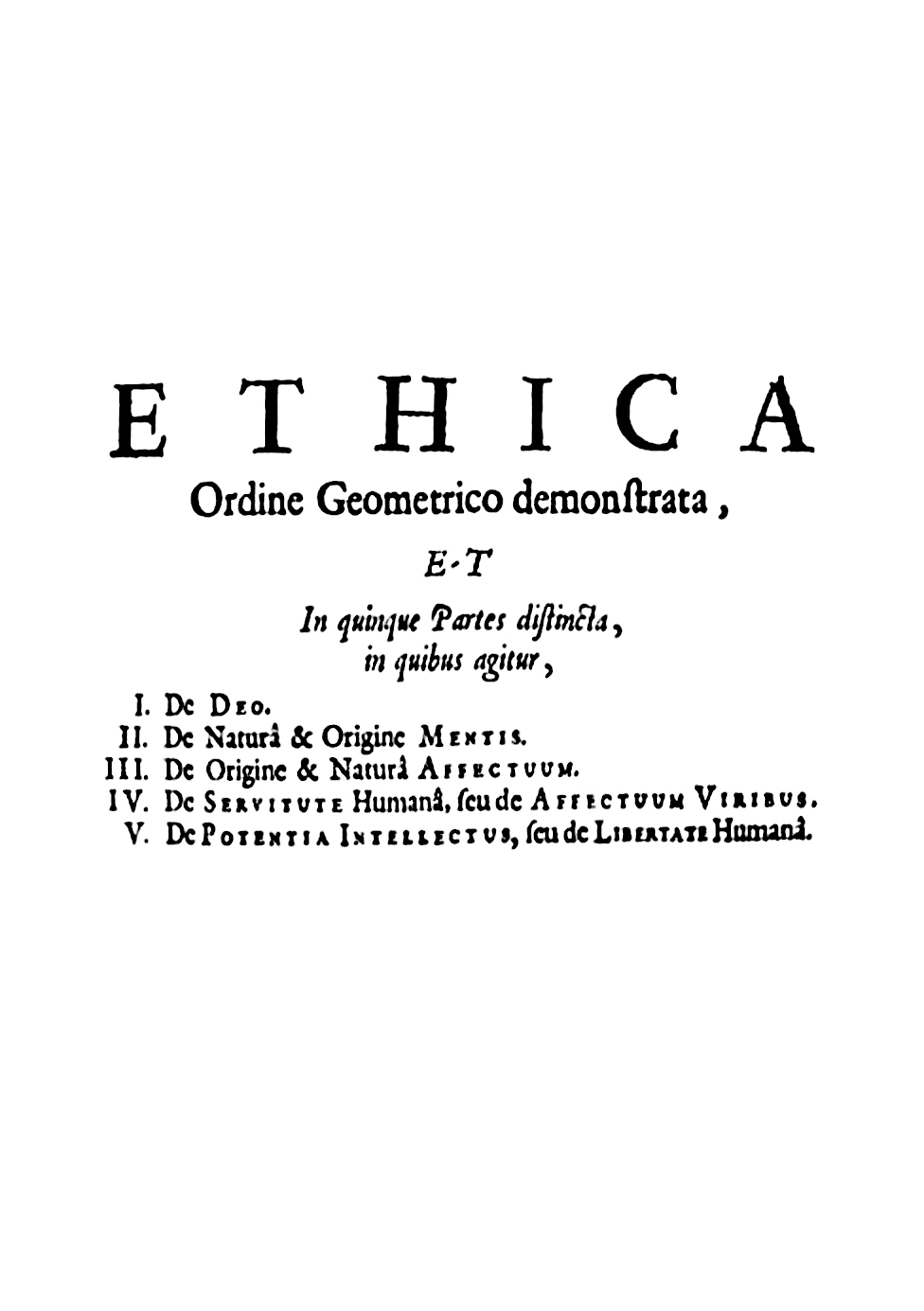
Spinoza’s Ethics Appears After His Death
A philosophy written like geometry identified God with nature.
Baruch Spinoza composed his masterwork, Ethics, Demonstrated in Geometrical Order, in Latin from the early 1660s until about 1675. Having decided in 1675 against publishing it, Spinoza left behind a manuscript that appeared in print only in 1677, among the posthumous works his friends issued shortly after his death. The book adopted an uncompromising structure modeled on Euclid's geometry. Spinoza set out a sequence of basic definitions and axioms, using them to derive hundreds of successive propositions, demonstrations, and corollaries designed to present philosophy with mathematical certainty.
Central to the work was an identification of God with the natural universe, summarized in the phrase God or Nature. Spinoza rejected the established theological view of an external creator possessing human passions, goals, or free choice, who brought the world into being out of nothing. Instead, he maintained that only one substance could exist, which was infinite, eternal, and identical with the totality of nature itself. In this metaphysical architecture, all individual items, bodies, and minds are not separate creations, but dependent modes or modifications of this singular reality, unfolding according to necessary, universal laws.

Keep reading in Yester
Coming soon to the App Store
Keep following the story

Sources
- Baruch Spinoza (Stanford Encyclopedia of Philosophy)
- Benedict De Spinoza (Internet Encyclopedia of Philosophy)
- Supreme Court of Holland, Zeeland and West-Friesland (SpinozaWeb)
- Index Librorum Prohibitorum (Encyclopaedia Judaica, Jewish Virtual Library)
- Friedrich Heinrich Jacobi (Stanford Encyclopedia of Philosophy)
- Spinoza's Ethics, translated by George Eliot, edited by Clare Carlisle (Fabula, reproducing the Princeton University Press description)
- Spinoza's Ethics