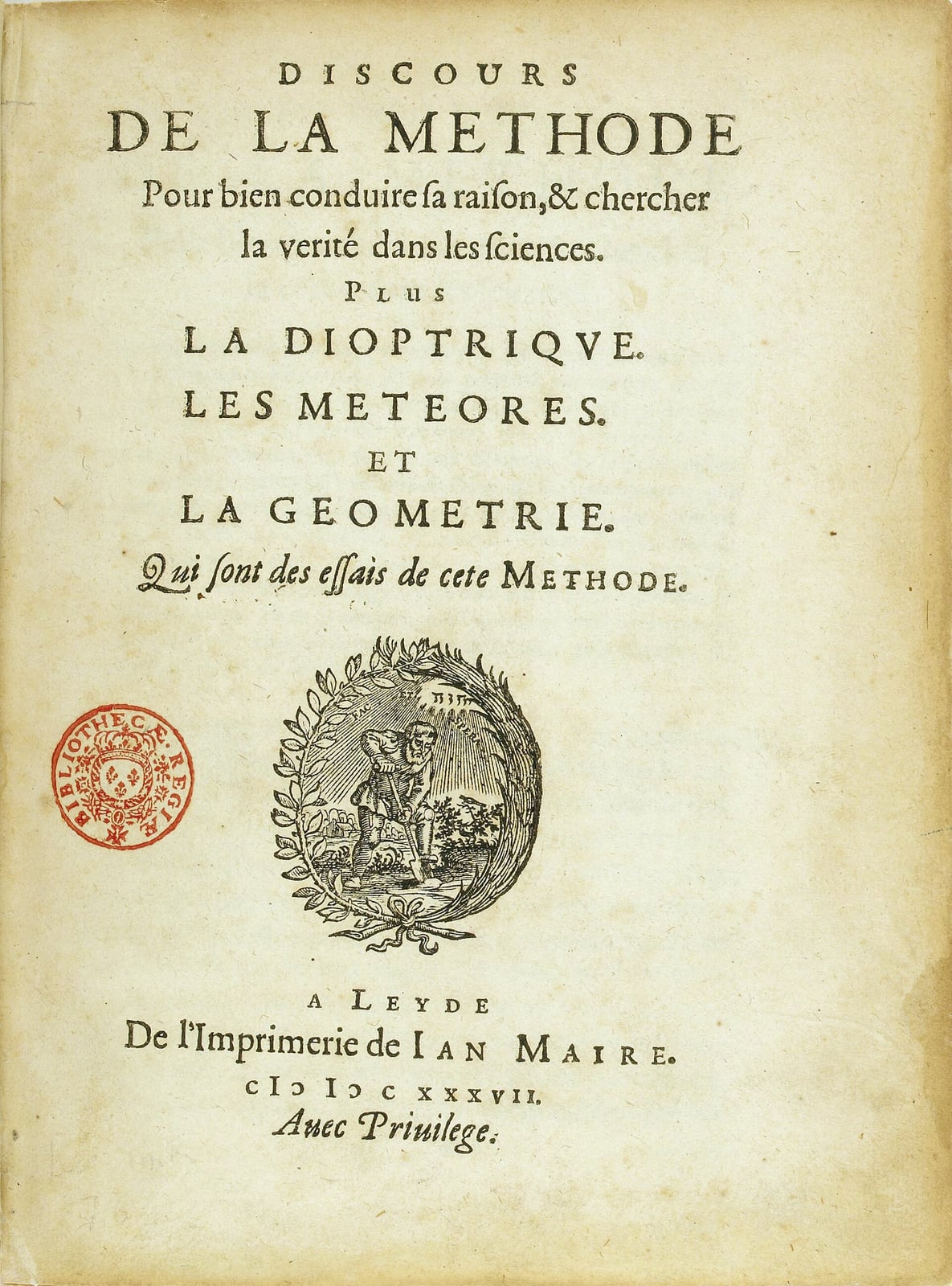
Descartes Publishes the Discourse on the Method
A short book in French began with doubting everything.
In 1637, René Descartes published Discourse on the Method of Rightly Conducting One's Reason and of Seeking Truth in the Sciences in Leiden, located in the Netherlands. Rather than adopting Latin, which was the established language for scholarly and scientific communication across early modern Europe, Descartes composed the treatise in French. His intention was to address a broader reading public, breaking away from standard academic presentation while preparing readers for three scientific essays published alongside it: Dioptrique, Météores, and Géométrie.
The volume opened with an autobiographical critique of his formal education, which had left him acutely conscious of his own ignorance. While noting his admiration for mathematics because of its solid foundations, he expressed deep skepticism toward the received traditions of previous philosophers. Observing that single architects design more coherent structures than organic urban growth produces, Descartes resolved to abandon inherited assumptions. He introduced four operational maxims, demanding that he accept only what presented itself clearly and distinctly beyond all doubt, divide problems into smaller components, think sequentially from the simplest concepts to the complex, and maintain complete enumerations to prevent omissions.

Keep reading in Yester
Coming soon to the App Store
Keep following the story
Sources
Image: Unknown author Unknown author