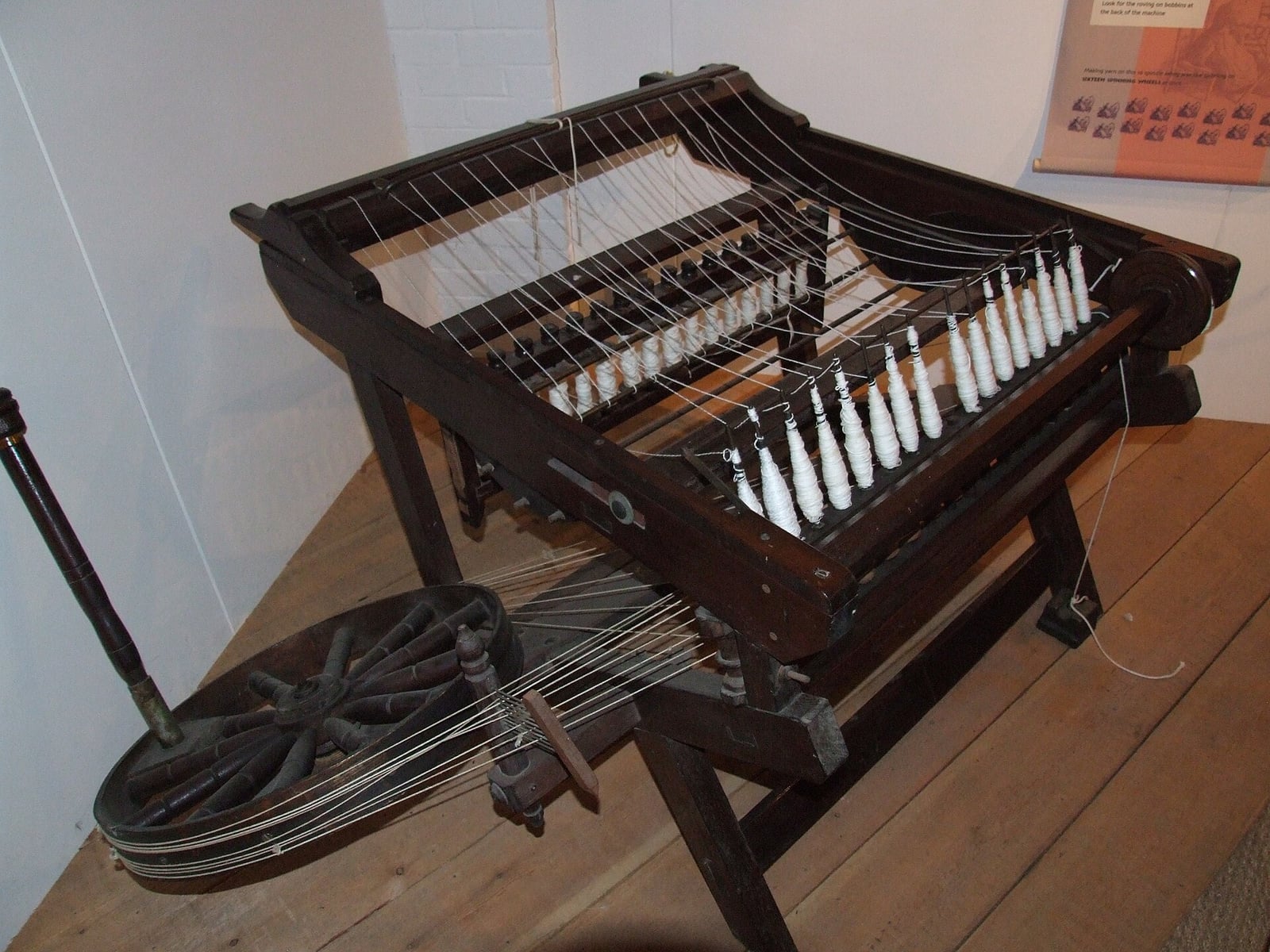
The Spinning Jenny Multiplies the Spinner’s Work
A hand-cranked frame let one worker spin many threads at once.
During the middle of the eighteenth century, the textile economy of Lancashire operated under a persistent mechanical bottleneck. Handloom weavers relied on a domestic network of rural households to obtain spun yarn, but traditional methods could not satisfy growing commercial needs. John Kay had patented the flying shuttle in 1733, an invention that allowed a single weaver to double their typical production of cloth. Because preparing raw fibre and spinning it into thread remained slow manual tasks, a single weaver often required the yarn output of up to three individual spinners, who in turn depended on several carders. This discrepancy created an acute shortage of yarn across northern England, encouraging local artisans to devise ways to spin multiple threads simultaneously.
Around 1764 or 1765, James Hargreaves, a craftsman born near Blackburn around 1720, constructed a working multi-spindle spinning frame in Stanhill. The machine soon became known as the spinning jenny. A persistent domestic legend suggested that Hargreaves was inspired after a female family member knocked over a conventional spinning wheel, causing him to notice that a vertically oriented spindle continued to turn. Parish records from Church Kirk reveal that neither his wife nor any of his daughters was named Jenny, casting doubt on this anecdote. A more grounded explanation indicates that the term was simply an informal local abbreviation of engine.

Keep reading in Yester
Coming soon to the App Store
Keep following the story
Sources
- James Hargreaves (1721-78) biography (European Route of Industrial Heritage, ERIH)
- John Kay (1704-80) biography (European Route of Industrial Heritage, ERIH)
- John Kay of Bury, lithograph record noting fly-shuttle patent 542, 26 May 1733 (Science Museum Group Collection)
- Replica of Hargreaves' Spinning Jenny (Science Museum Group Collection)
- James Hargreaves 1720-1778 (Science Museum Group Collection)
- Early cotton spinners (Knitting Together, Nottinghamshire framework knitting heritage)
- Spinning jenny
Image: Clem Rutter, Rochester, Kent.