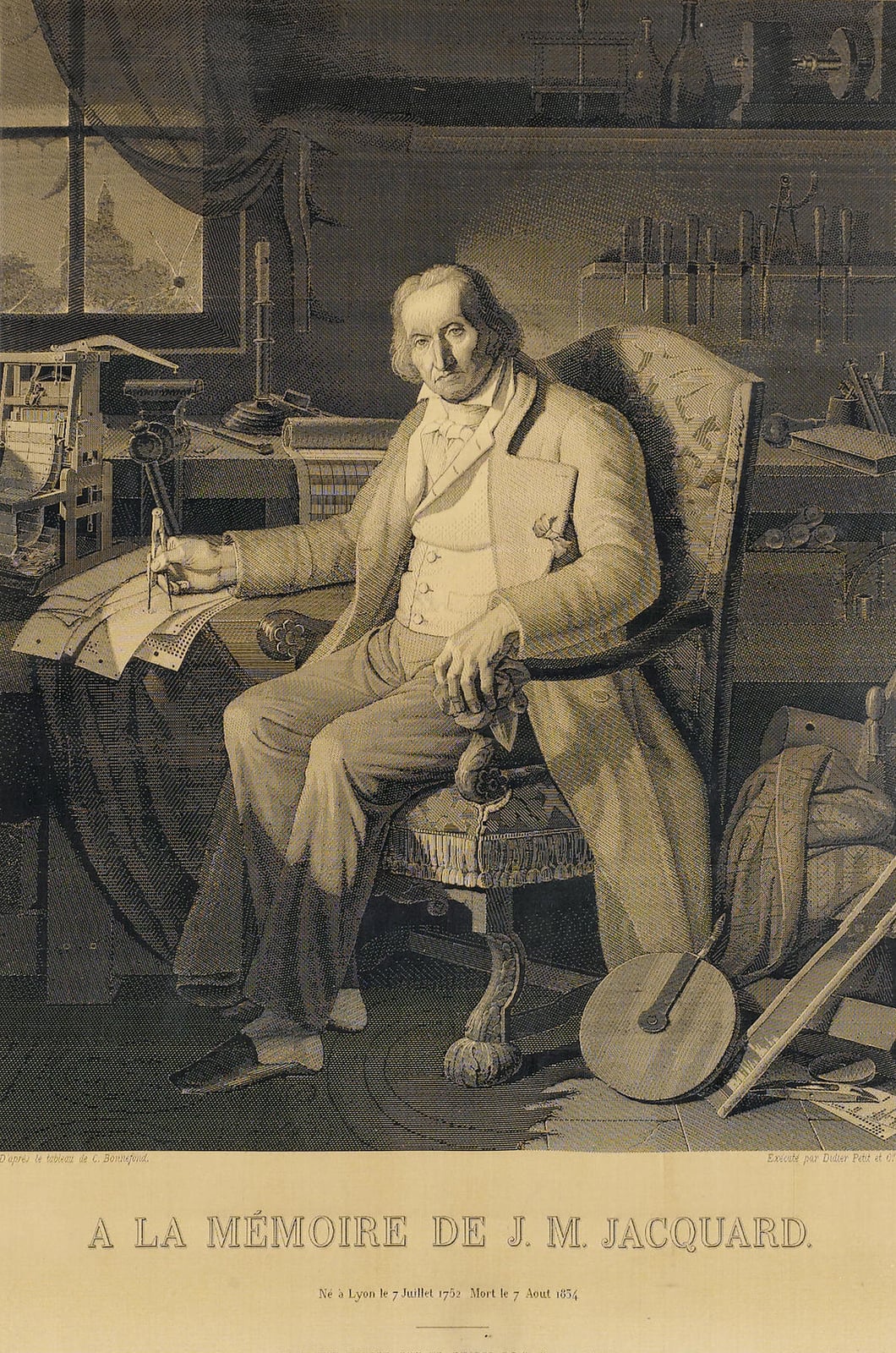
Jacquard’s Mechanism Encodes Patterns in Punched Cards
A weaving mechanism automated complex patterns and later became a reference point for programmable machines.
In 1804, the French inventor Joseph Marie Jacquard received a patent for an automated attachment designed to mount upon traditional textile looms. The device transformed the production of intricate figured fabrics such as damask, brocade, and matelasse, which previously demanded slow and physically exhausting manual labour. On earlier drawlooms, a separate assistant known as a draw boy had to select and pull the warp threads by hand for every single passage of the shuttle. Jacquard's apparatus removed this manual intervention by coordinating the lifting of threads through an automated mechanical sequence.
The core of Jacquard's breakthrough relied on a continuous chain of perforated pasteboard cards laced together in order. As this chain rotated around a square prism, each individual card corresponded to a single pick of the weft thread across the fabric. A series of sensing rods pressed against the card; wherever a hole had been punched, the rod passed straight through without obstruction, leaving its associated lifting hook in place. Solid sections of the card pushed the rods back, displacing the corresponding hooks so that an elevating beam lifted only the chosen warp threads. Changing the complete pattern required only switching the set of cards, rather than manually reconfiguring the entire loom.

Keep reading in Yester
Coming soon to the App Store
Keep following the story
Sources
Image: Michel Marie Carquillat (tisseur) d'après Claude Bonnefond