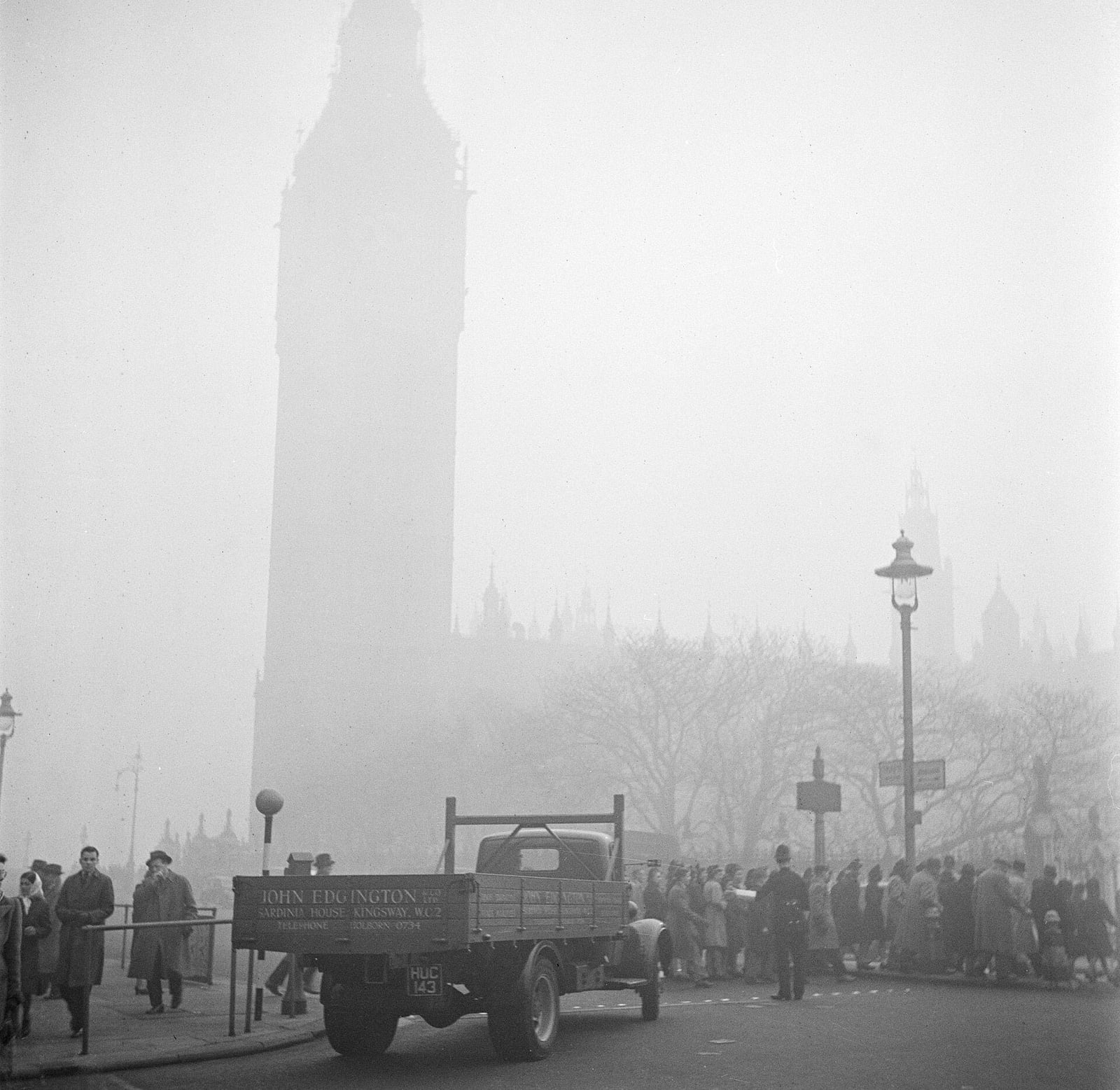
The Great Smog Smothers London
Five days of coal smoke and fog led to clean air laws.
On 4 December 1952, a high-pressure anticyclone settled over London, bringing motionless air and cold temperatures across the Thames Valley. As households burnt extra quantities of coal to keep warm, an atmospheric temperature inversion trapped a layer of cold air beneath a ceiling of warmer air. By the following morning, smoke escaping from domestic grates, industrial plants, and power stations could not rise into the atmosphere. The accumulating soot and gases combined with the natural fog to produce a dense, yellowish-green haze that darkened the capital and persisted for five days.
The severity of the air contamination stemmed from particular economic and industrial circumstances of the post-war era. While higher-quality hard coals were exported to help settle wartime financial obligations, British households largely burnt low-grade, highly sulphurous coal known as nutty slack. Multiple coal-fired generating facilities, including Battersea, Bankside, and Fulham, operated within the metropolitan area. The UK Met Office subsequently calculated that each day of the episode added roughly 1,000 tonnes of smoke particles, 370 tonnes of sulphur dioxide, 140 tonnes of hydrochloric acid, and 14 tonnes of fluorine compounds into the stagnant air mass.

Keep reading in Yester
Coming soon to the App Store
Keep following the story
Sources
- The Great Smog of 1952 (Met Office)
- Seventy years on from the Great Smog (Mayor of London, Greater London Authority)
- A reassessment of the lethal London fog of 1952 (Bell and Davis, Environmental Health Perspectives, 2001, PMC)
- A retrospective assessment of mortality from the London smog episode of 1952: the role of influenza and pollution (Bell, Davis and Fletcher, Environmental Health Perspectives, 2004, PMC)
- Great Smog of London
Image: Willem van de Poll