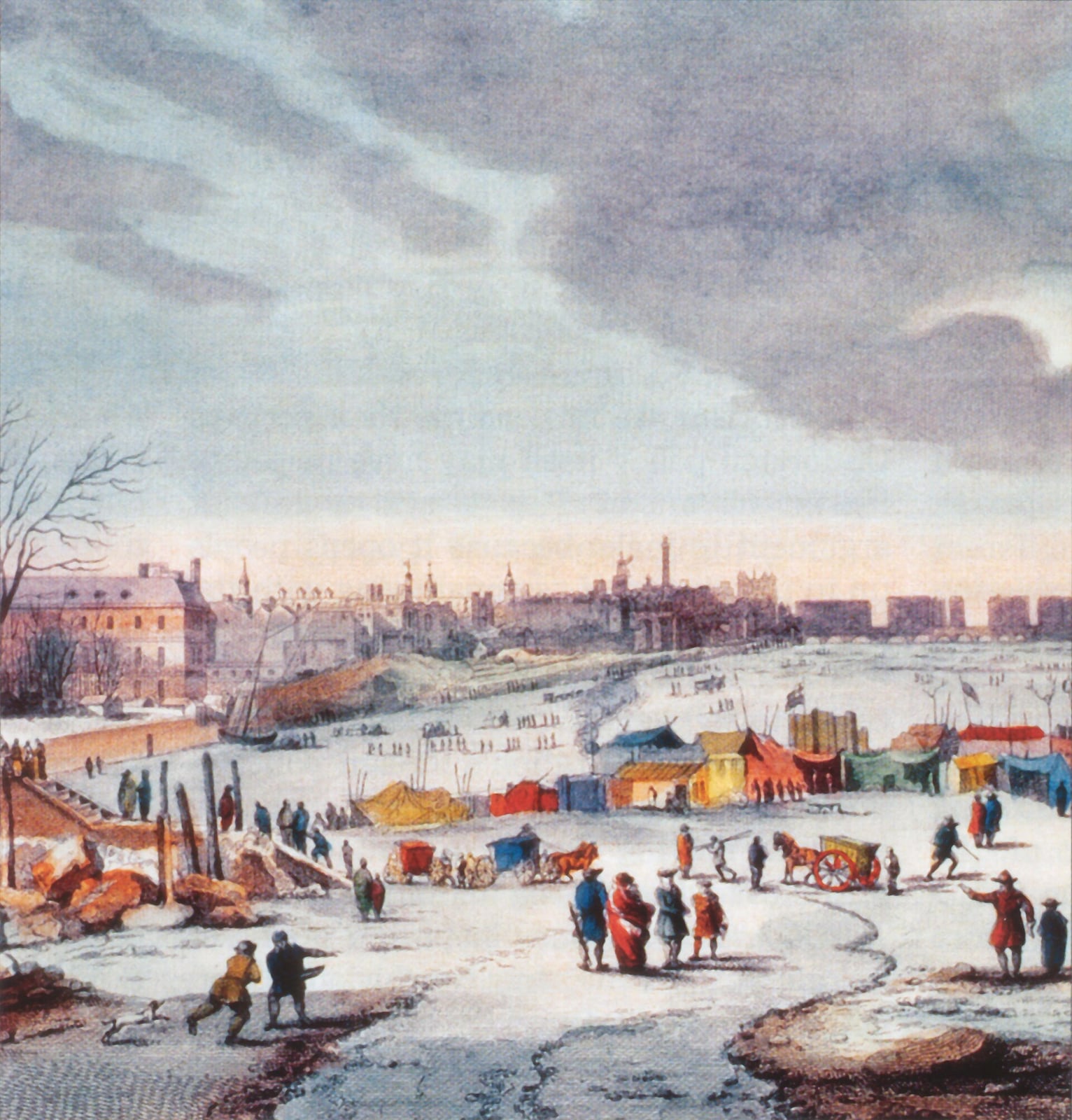
A Frost Fair Opens on the Frozen Thames
Londoners set up booths on the ice during one of the coldest winters.
In the harsh winter of 1683 to 1684, the River Thames in London froze solid for two months during what is recorded as England's most severe freeze. Thick ice transformed the city's primary waterway into an expanse of solid ground, reportedly reaching nearly a foot thick in the capital. The freeze was not confined to inland waters, as extensive sheets of ice reached miles into the southern North Sea, crippling coastal harbours and halting trade across England, France, and the Low Countries. In London, the frozen river offered an unexpected public venue, prompting citizens to establish a bustling temporary town over the water.
The freezing of the tideway was aided by both the broader climate of the Little Ice Age and the architectural state of the river itself. Prior to modern embanking, the medieval Thames flowed wider and far more sluggishly than it does today. Old London Bridge posed a formidable obstacle to the water's flow, resting upon nineteen closely spaced piers heavily protected by timber casings. These structures narrowed the arches and gathered large drifting sheets of ice during prolonged cold spells, effectively creating a barrier that hastened the river's freezing over at ebb tide.

Keep reading in Yester
Coming soon to the App Store
Keep following the story
Sources
- Frost fairs: Festivities on a frozen River Thames (London Museum)
- Souvenir, frost-fair keepsake printed by G. Croom, 1684 (London Museum)
- Frost fairs, sunspots and the Little Ice Age, Lockwood et al., Astronomy & Geophysics 2017 (University of Reading CentAUR)
- The Diary of John Evelyn, Volume 2, ed. William Bray (Project Gutenberg)
- A Most Faire Frost: Frost Fairs of the River Thames (Lilly Library, Indiana University)
- River Thames frost fairs
Image: Thomas Wyke