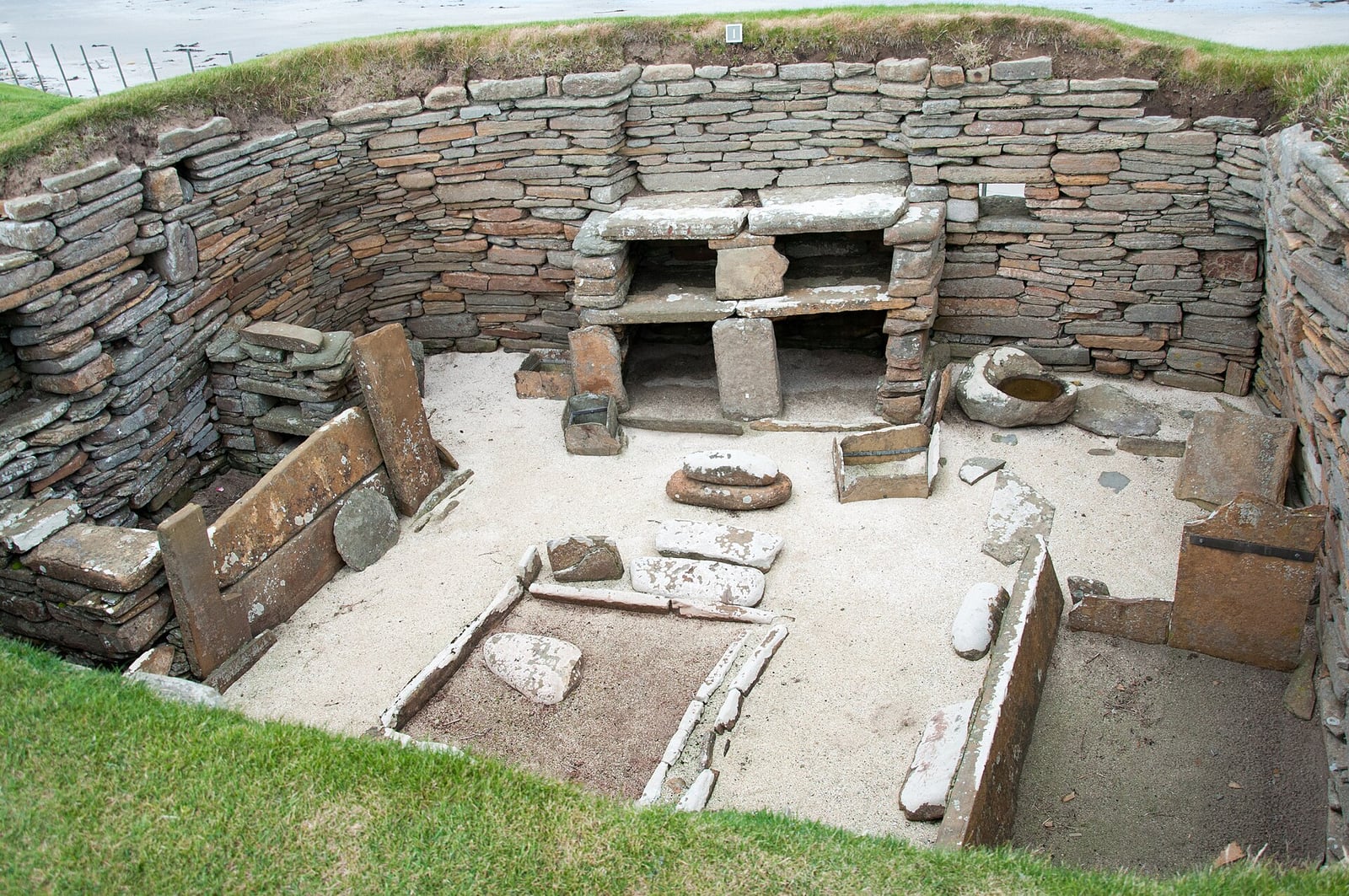
Skara Brae’s Stone Houses Keep Their Furniture
A storm in 1850 uncovered a Neolithic village with stone beds, dressers and hearths.
In the winter of 1850, a violent storm battering the western coast of Mainland Orkney stripped away the dunes at the Bay of Skaill, uncovering the stone walls of an ancient settlement. The grassy knoll had long been known locally under names like Skerrabra, but the gale revealed a group of roofless dwellings embedded within the sand. William Watt, who lived at Skaill, initiated excavations that cleared four houses before halting work in 1868. Decades later, following illicit looting in 1913 and further storm damage in the mid-1920s, systematic archaeological investigations were entrusted to Professor V. Gordon Childe of the University of Edinburgh, whose excavations ran from 1927 until 1930.
Initial assessments of the antiquity of the site varied wildly, with Childe originally believing it to be far younger, an Iron Age settlement. Radiocarbon testing during excavations in 1972 and 1973 radically altered this timeline, demonstrating that Skara Brae had been inhabited from roughly 3180 BC until about 2500 BC. These revisions established it as Europe's most complete Neolithic village. Rather than subterranean shelters, the buildings were free-standing stone houses banked into domestic refuse, known as midden, which insulated the walls against the harsh coastal elements. Ten structures and four connecting passageways remain visible today.

Keep reading in Yester
Coming soon to the App Store
Keep following the story
Sources
Image: larsjuh