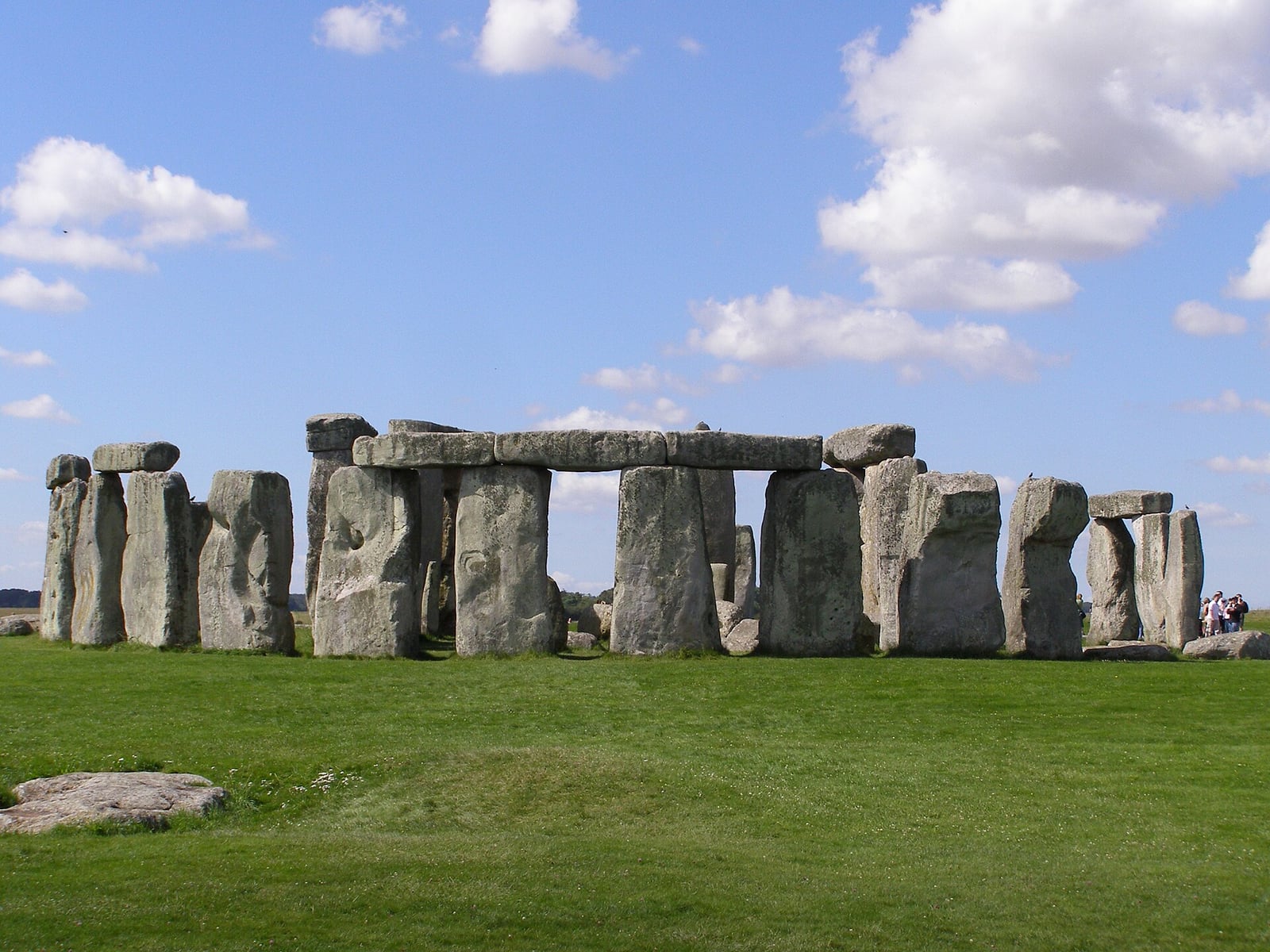
Builders Raise the Great Sarsens of Stonehenge
Huge stones were set up on Salisbury Plain in line with the solstice sun.
Between 2600 BC and 2400 BC, builders on Salisbury Plain transformed an older circular earthwork into an extraordinary monument of megalithic architecture. Thirty massive sarsen stones, quarried roughly sixteen miles to the north in West Woods, were transported across the Wiltshire landscape to form a continuous circle ninety-eight feet across. The upright monoliths, each averaging about twenty-five tons and reaching over thirteen feet high, were crowned by thirty horizontal lintels. Inside this perimeter, workers raised five free-standing trilithons in an open horseshoe layout, with the tallest sarsens standing almost twenty-five feet above the ground.
The engineering of the sarsen circle displays sophisticated stoneworking techniques adapted from carpentry. Builders carved mortise and tenon joints into the tops of the vertical stones to secure the horizontal lintels, while adjacent lintels were slotted together using tongue and groove joints. The surfaces of the megaliths were carefully dressed, with the inner faces smoothed to a higher finish than the exteriors. Visual adjustments were built directly into the design, including uprights that widen toward their tops to counteract foreshortening and lintels gently curved along their lengths to preserve the circle's curvature.

Keep reading in Yester
Coming soon to the App Store
Keep following the story
Sources
Image: garethwiscombe