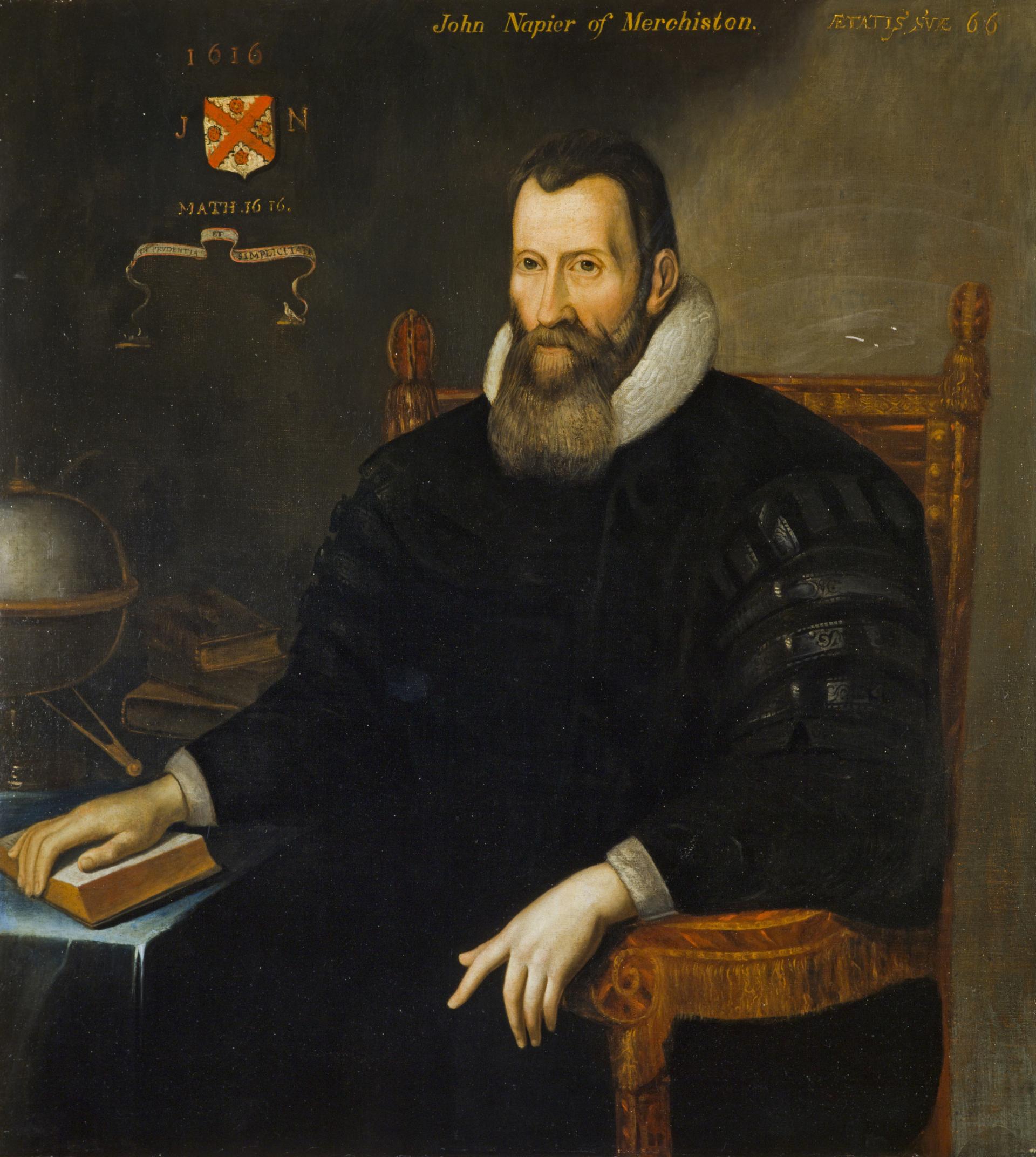
John Napier Publishes Logarithms
A Scottish laird turned multiplication into addition and sped up astronomy.
In 1614, John Napier, the eighth Laird of Merchiston, published Mirifici Logarithmorum Canonis Descriptio in Edinburgh. The volume contained fifty-seven pages of explanation and ninety pages of numerical tables. For decades, mathematicians, navigators, and astronomers had spent weeks performing tedious hand calculations involving long strings of digits. Napier recognized that computational labor in his era was concentrated primarily in trigonometry. To ease this burden, he devised an operational relation that converted the laborious processes of multiplication and division into simple addition and subtraction.
Napier came from an influential Scottish family. Born in 1550 at Merchiston Castle to Sir Archibald Napier and Janet Bothwell, he was enrolled at St Salvator's College, St Andrews, at the age of thirteen. Disruptions tied to the Scottish Reformation undermined university instruction, and records indicate that he left without completing a degree. Acting on family advice to study abroad, Napier traveled to mainland Europe, returning to Scotland in 1571 equipped with a fluency in Greek that was uncommon for university students of the era. He acquired an estate at Gartness, later succeeding his father at Merchiston Castle.

Keep reading in Yester
Coming soon to the App Store
Keep following the story
Sources
Image: Unknown author Unknown author