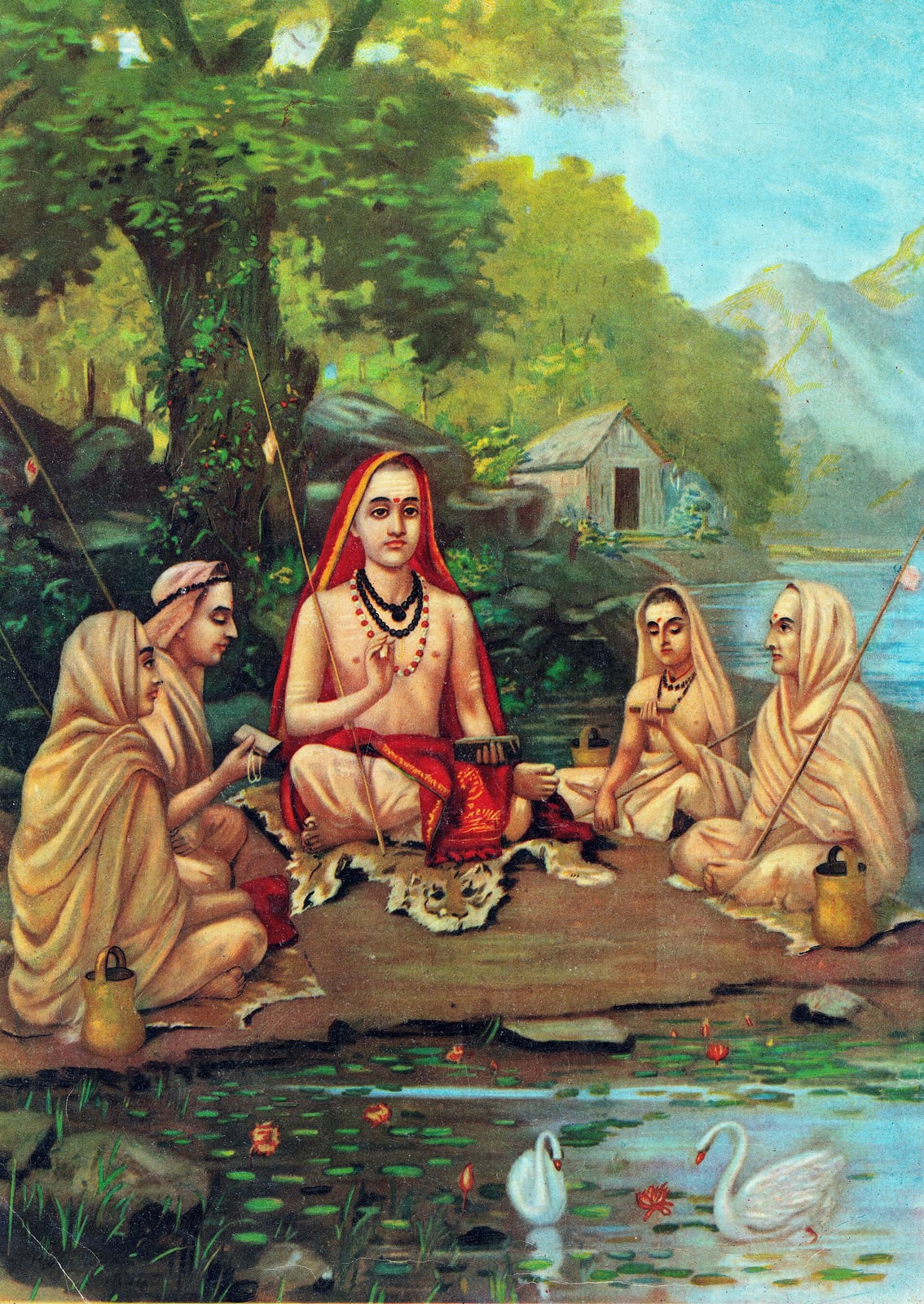
Shankara Teaches the Philosophy of Advaita
A young teacher argued that the self and ultimate reality are one.
During the eighth century, the Vedic scholar-monk Adi Shankara formulated an uncompromising interpretation of Advaita Vedanta that identified the innermost human self with ultimate reality. His dates have long been debated: it was once customary to place his life between 788 and 820, but modern scholarship generally puts him in the eighth century, with about 700 to 750 now often preferred. He functioned within an intellectual landscape that drew heavily upon the Upanishads, reading their statements not as ritual formulas, but as direct paths to liberation.
Shankara's central philosophical position was that the individual self, or jivatman, is fundamentally identical to Brahman, the single nondual reality. The apparent separation between individual consciousness and the cosmos was an illusion produced by ignorance. To bridge this divide, Shankara turned to scriptural statements known as mahavakyas, most notably the phrase that you are from the Chandogya Upanishad. He maintained that valid, liberating knowledge could dawn instantaneously upon hearing these declarations with proper discernment, without relying on continuous meditative contemplation.

Keep reading in Yester
Coming soon to the App Store
Keep following the story
Sources
Image: Raja Ravi Varma