Munch Gives Anxiety a Face in The Scream
A painted figure on a fjord road became a lasting image of modern unease.
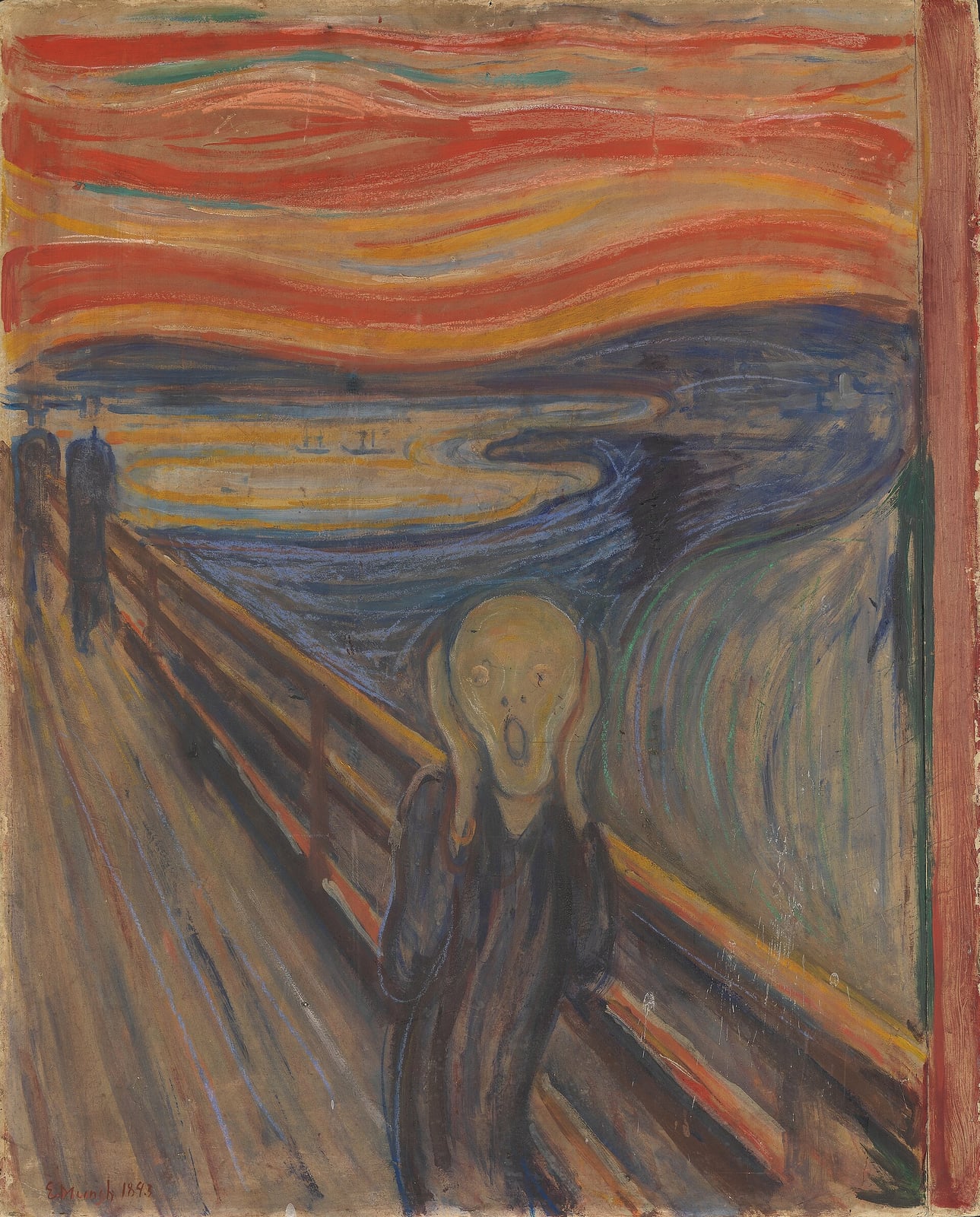
In 1893, Norwegian artist Edvard Munch completed the first version of an artwork that came to define modern perceptions of anxiety. First exhibited in Berlin that same year under the title Verzweiflung, meaning Despair, the work depicted an agonized figure clasping its face upon a road along the Oslofjord. Munch derived the composition from an experience recorded in his journal, in which he felt ill and exhausted during an evening stroll as the setting sun turned the sky into fiery, blood-red bands. He felt an overwhelming scream passing across nature, a sensory rupture that he subsequently transposed into paint and pastels.
Scholars have connected Munch's written accounts to specific geography and historical context. The path where he experienced this sensory upheaval was located on the hill of Ekeberg, offering an elevated view over the Oslo fjord and the city. Researchers have debated the environmental source of the vivid red clouds. In 2004 three American astronomers proposed that the red sky reflected volcanic dust from the 1883 eruption of Krakatoa, but Norwegian meteorologists argued in 2017 that such sunsets would have been common for years afterward rather than a single shocking experience. They suggested instead that Munch saw nacreous, or mother-of-pearl, clouds, which form high in the stratosphere in winter at high latitudes.

Keep reading in Yester
Coming soon to the App Store
Keep following the story
Sources
- The Scream, 1893 (Nasjonalmuseet, National Museum of Norway)
- The Scream (Encyclopaedia Britannica)
- 1994: Art thieves snatch Scream (BBC On This Day)
- Munch paintings 'can be repaired' (BBC News)
- The Scream that set the auction on fire (The Hindu / PTI)
- Was it mother-of-pearl clouds Edvard Munch painted in Scream? (University of Oslo, Department of Geosciences)
- The Scream
Image: Edvard Munch