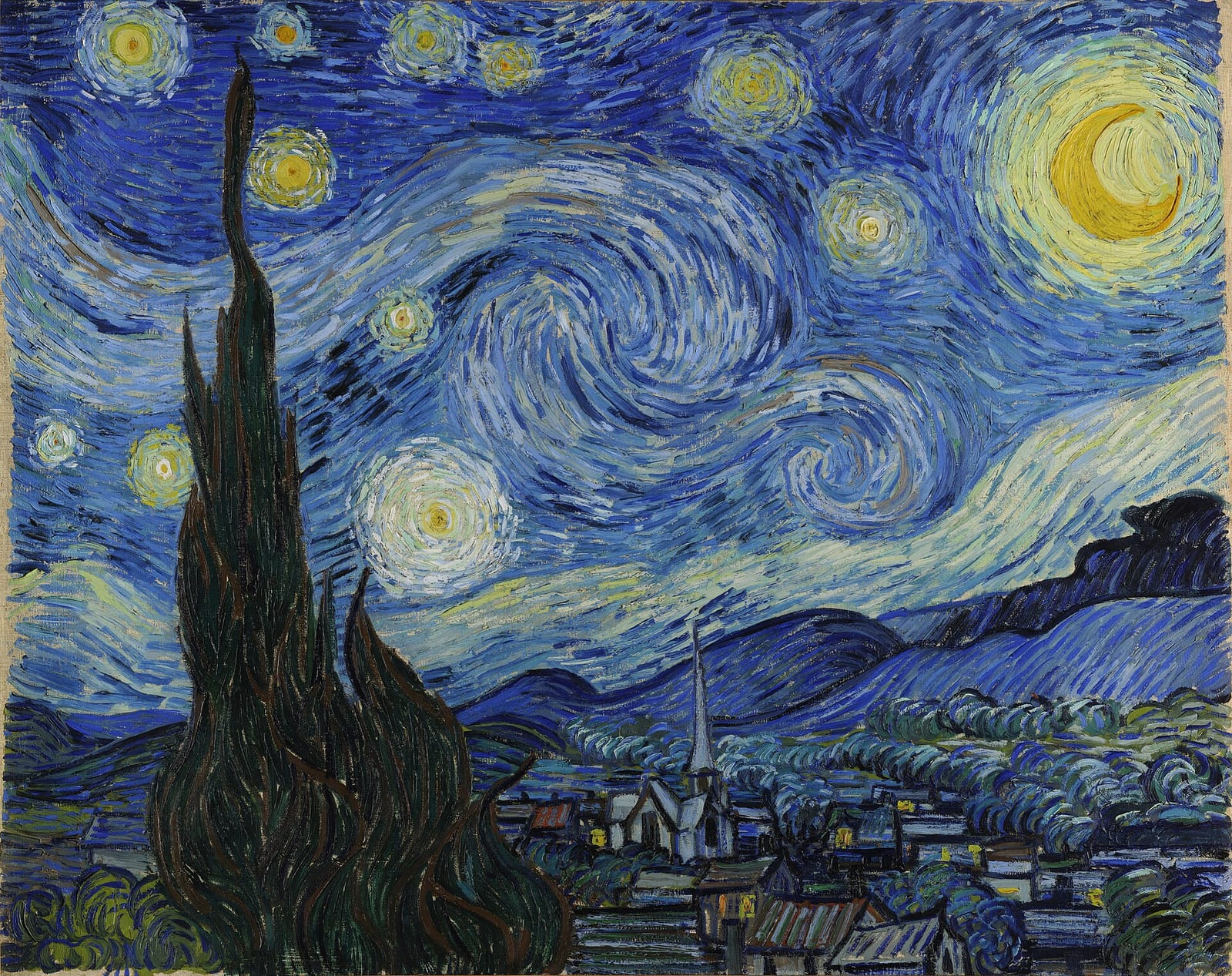
The Night Van Gogh Rebuilt in Paint
The Starry Night began with a view from a hospital but did not simply reproduce it. Van Gogh combined observation, memory and invention to give a landscape its own movement.
The village looks quiet, but the sky refuses to stay still. In The Starry Night, curves and rings carry the eye across a landscape where darkness has become something active rather than empty. Vincent van Gogh painted the work in June 1889 while staying at the hospital of Saint-Paul-de-Mausole near Saint-Rémy-de-Provence. The familiar image was not simply a night copied directly from a window. It was a landscape reconstructed through looking, remembering and deciding what a painting could do.
Van Gogh had entered the hospital voluntarily the previous month after periods of serious illness. Work continued during his stay, though not without interruptions. That context belongs to the painting’s history, but it does not provide a shortcut for explaining every brushstroke as a symptom. The canvas contains deliberate choices about arrangement, color and rhythm. Reducing it to an uncontrolled vision overlooks an artist actively developing a language and considering how one part of an image should answer another.

Keep reading in Yester
Coming soon to the App Store
Keep following the story
Sources
Image: Vincent van Gogh