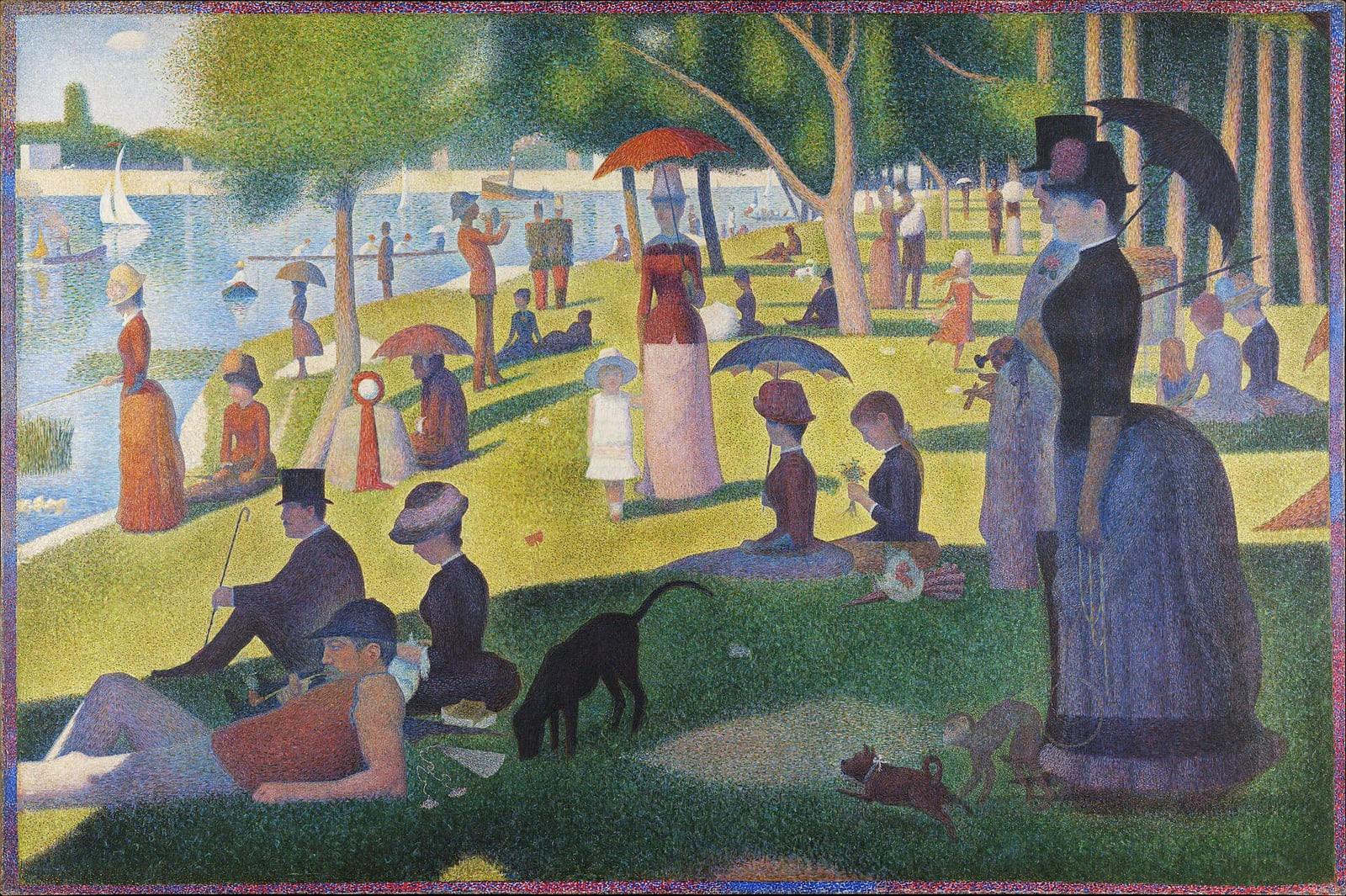
Seurat Builds a Sunday Afternoon from Dots of Color
A large painting tested a new method of placing color on canvas.
Between May 1884 and May 1886, French painter Georges Seurat worked on a massive canvas measuring roughly two by three meters. Titled A Sunday Afternoon on the Island of La Grande Jatte, the work captured a bucolic park setting located on an island in the Seine just outside the gates of Paris. Seurat embarked on the project after finishing Bathers at Asnieres, creating numerous preliminary oil sketches and drawings to plan the intricate arrangement of figures relaxing in the shade and light alongside the riverbank.
Seurat developed the composition through distinct technical stages. When he began the painting in 1884, he mixed several individual pigments on his palette, including earth pigments such as iron oxides, along with blacks. By the time he resumed work in October 1885, he had eliminated those pigments and reduced the number of components he mixed to create a color. Drawing on the color theory of Michel Eugene Chevreul, Seurat sought to place small strokes and miniature dots of pure color side by side so that they would blend directly in the viewer's eye.

Keep reading in Yester
Coming soon to the App Store
Keep following the story
Sources
- A Sunday on La Grande Jatte, 1884 (Art Institute of Chicago)
- Seurat and the Making of La Grande Jatte (Art Institute of Chicago)
- La Grande Jatte, Frame by Frame (Art Institute of Chicago)
- Fiedler, Materials used in Seurat's La Grande Jatte (Smithsonian Museum Conservation Institute)
- Museum of Modern Art will re-open Seurat exhibition, press release, 25 April 1958 (MoMA)
- A Sunday Afternoon on the Island of La Grande Jatte
Image: Georges Seurat