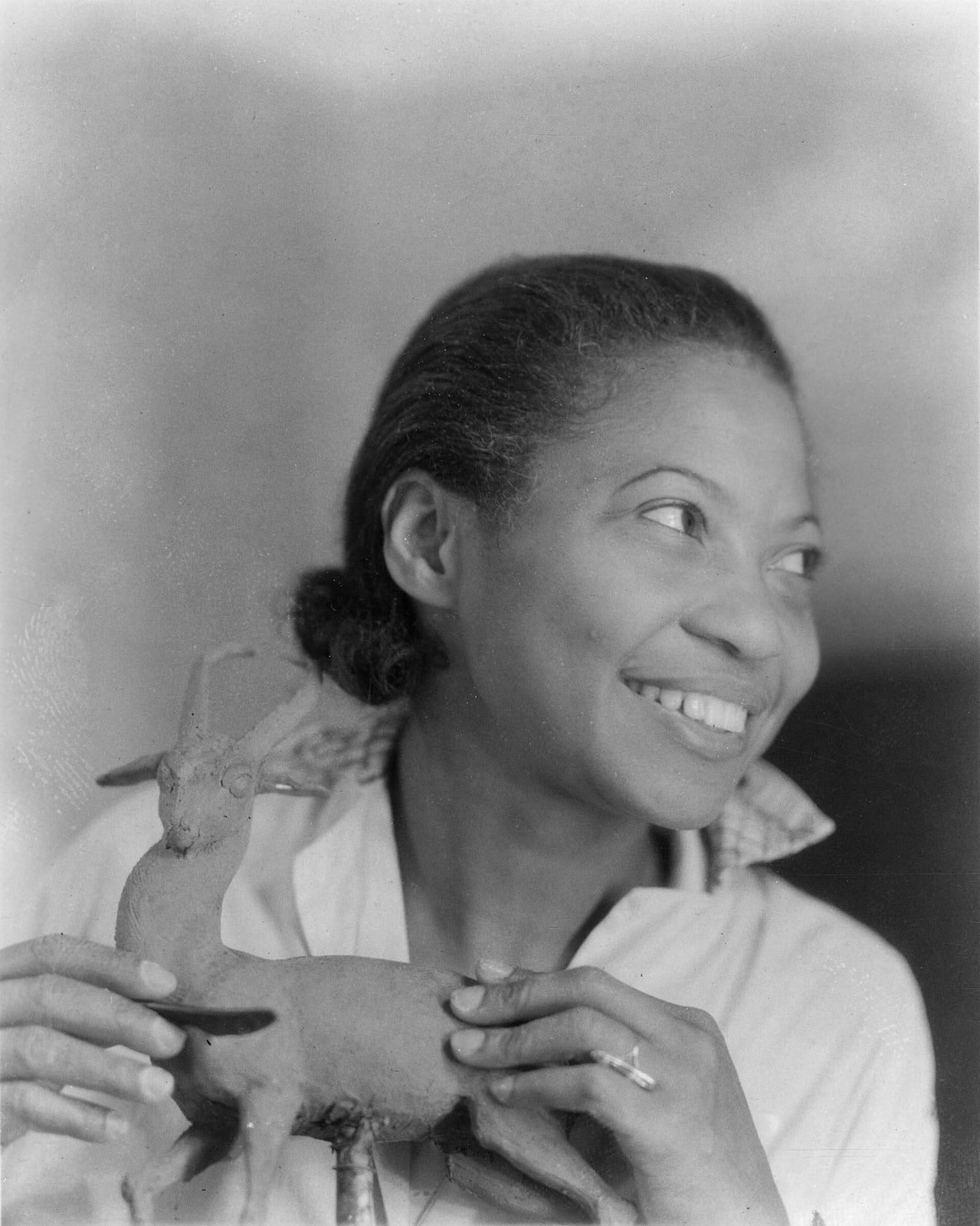
Augusta Savage Builds a Monument to a Song
A World’s Fair commission brought Black musical culture into monumental sculpture while exposing unequal artistic opportunities.
In 1939, visitors approaching the Contemporary Arts Building at the New York World's Fair encountered a towering sixteen-foot plaster sculpture entitled Lift Every Voice and Sing, widely known as The Harp. Created by Augusta Savage, one of only four women and two African Americans granted a professional commission by the fair's Board of Design, the artwork translated the famous hymn by James Weldon Johnson and J. Rosamond Johnson into a visual monument. The composition rendered twelve African American youth of ascending heights as strings forming the body of a harp, supported by a sounding board shaped as a stylized arm and hand, while a kneeling young man offered musical notation at the front.
The sculpture swiftly emerged as one of the fair's most celebrated exhibits, reproduced on countless tourist postcards and sold in miniature souvenir copies. Savage had secured the commission specifically to depict the impact of Black culture on music, a subject directly aligned with her standing in the Harlem Renaissance. Yet the celebration surrounding the piece exposed the persistent economic disparities confronting African American sculptors. Unable to raise the necessary funds to cast the massive work in permanent bronze or finance its removal and storage, Savage was forced to witness its demolition by bulldozers when the fair concluded, alongside other temporary installations.

Keep reading in Yester
Coming soon to the App Store
Keep following the story
Sources
Image: US Gov.