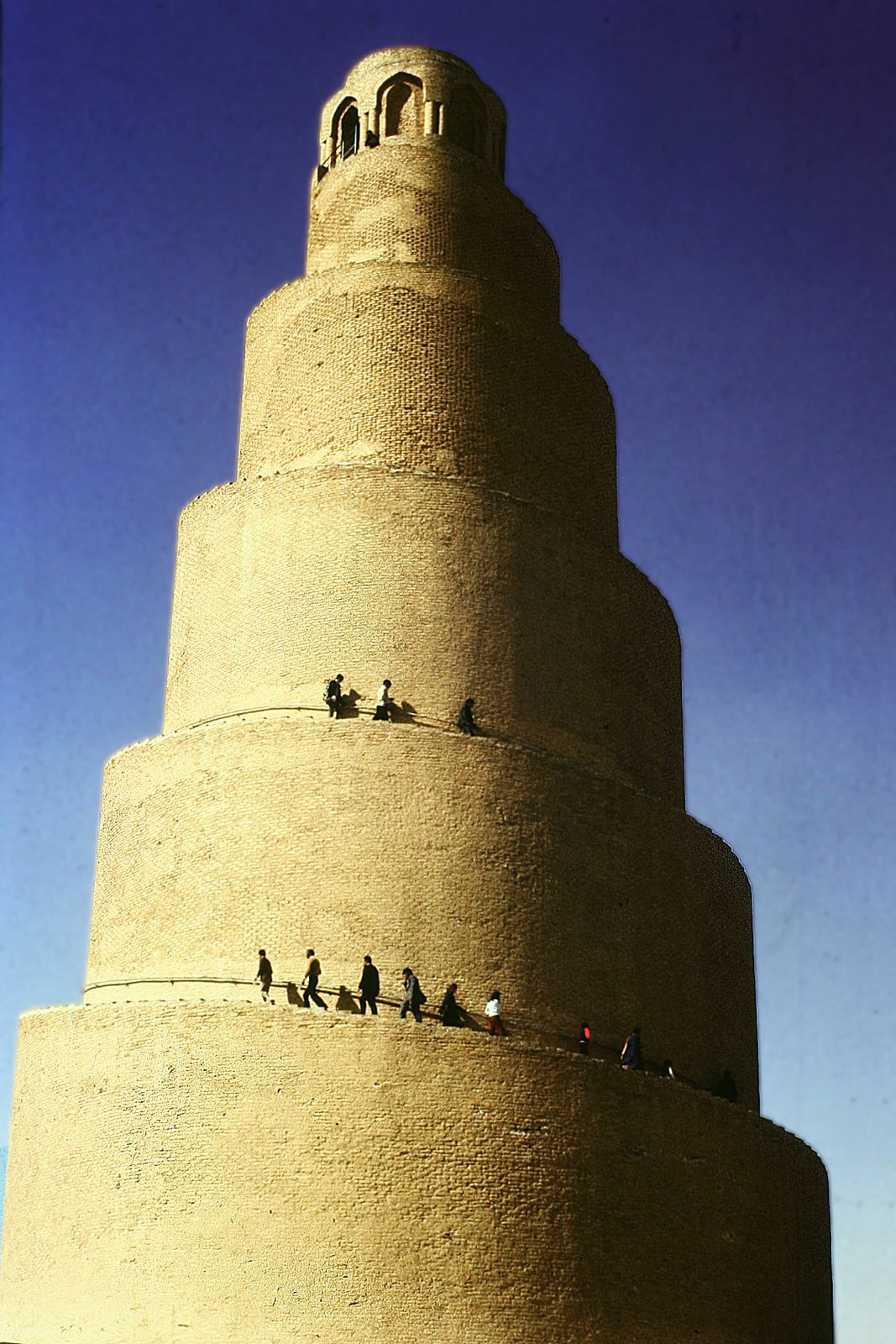
Samarra Raises a Monumental Mosque and Spiral Minaret
Abbasid patronage reshaped a new imperial capital.
Around 848, the Abbasid caliph Al-Mutawakkil commissioned a vast congregational mosque for his capital at Samarra. The city, on the banks of the Tigris about 130 kilometers north of Baghdad, served as the Abbasid capital from 836 to 892, and the new mosque rose just outside the built-up city, beside a large hunting enclosure known as al-Hayr. Al-Mutawakkil's reign transformed the urban center on a massive scale, adding new palaces alongside the house of worship. When laborers and craftsmen assembled from across the empire completed the structure around 852, it was the largest mosque in the world at that time.
The monumental perimeter wall was constructed from baked brick and reinforced by forty-four semicircular towers. Access was provided through sixteen entrances, while twenty-eight windows pierced the outer walls, including twenty-four along the southeastern qiblah side, matching the interior aisles except at the prayer niche. Inside, the design diverged from the customary square format by adopting a rectangular courtyard enclosed by covered arcades on all four sides.

Keep reading in Yester
Coming soon to the App Store
Keep following the story
Sources
- Samarra Archaeological City (UNESCO World Heritage Centre)
- Jami' al-Mutawakkil (Samarra) (Archnet, Aga Khan Documentation Center at MIT)
- The Art of the Abbasid Period (750-1258) (The Metropolitan Museum of Art, Heilbrunn Timeline of Art History)
- Jami' ibn Tulun (Archnet)
- Top of ancient Iraq minaret blown up (Al Jazeera / AFP, 2005)
- UNESCO and Iraq launch project for conservation of World Heritage site of Samarra (UNESCO World Heritage Centre, 2015)
- Great Mosque of Samarra
Image: J.Merena