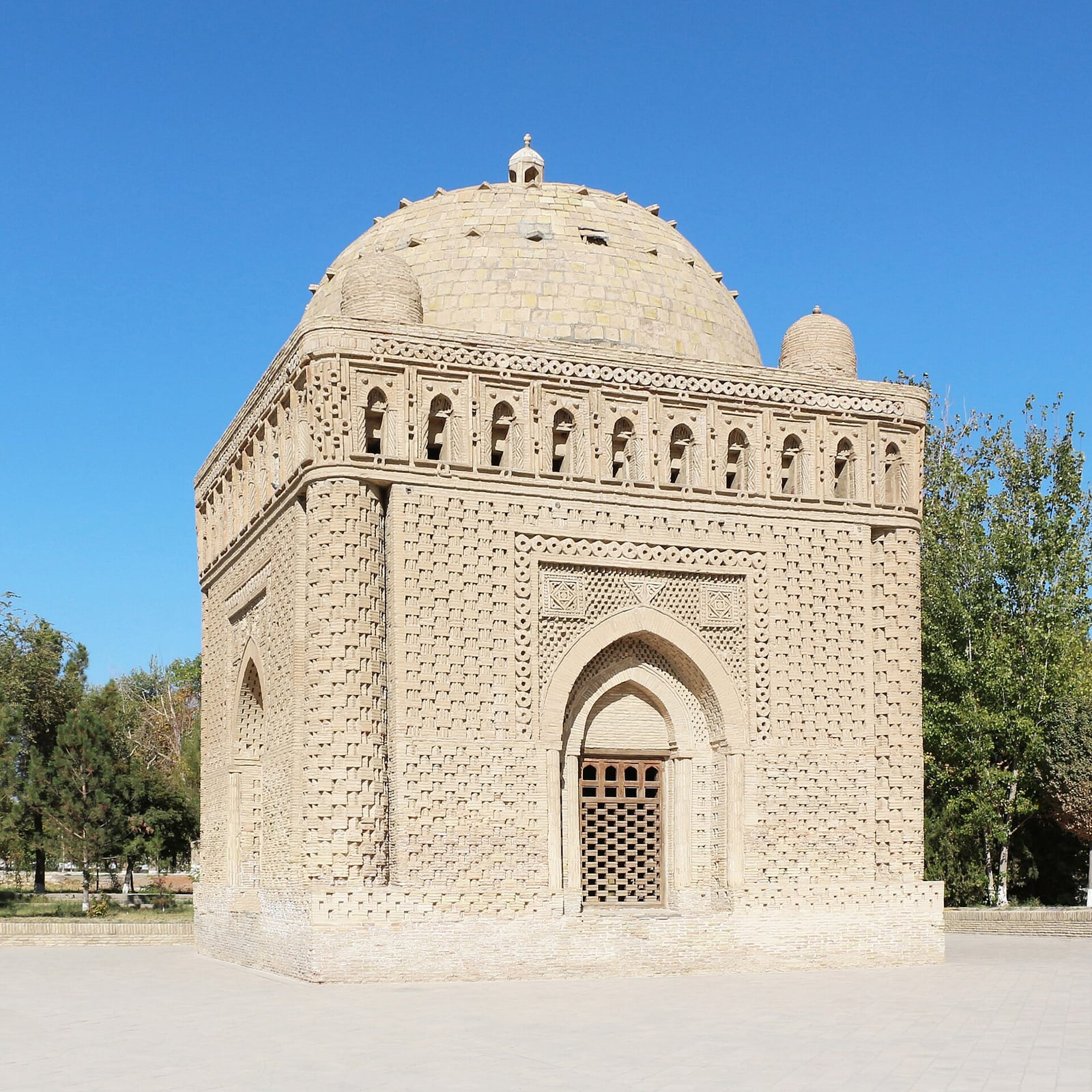
The Samanid Mausoleum Is Built of Patterned Brick
A small tomb in Bukhara is a masterpiece of early Islamic architecture.
In the northwestern district of Bukhara, just beyond the perimeter of the historic city center, stands the Samanid Mausoleum. Constructed during the tenth century under the rule of the Samanid dynasty, this compact monument is regarded as the oldest surviving funerary building in Central Asian architecture. At the time of its construction, the Samanid state exercised autonomous authority across substantial swathes of Central Asia and Persia while nominally acknowledging the Abbasid Caliphate in Baghdad. As the best-preserved building from the Samanid period, the tomb provides rare physical evidence of the artistic and engineering practices that developed in Bukhara during an era of significant intellectual and economic expansion.
The dating of the monument and the identities of those interred within it remain subjects of scholarly investigation. Historical documentation, specifically a sixteenth-century copy of a tenth-century waqf charter discovered in the 1930s, records that Ismail Samani allocated land in Bukhara's Naukanda cemetery for a tomb dedicated to his father, Ahmad. Subsequent architectural investigations in the late 1930s uncovered three male burials beneath the floor, along with an eastern lintel bearing an inscription in Kufic script naming Nasr II, who ruled from 914 to 943. While older regional traditions frequently attributed the tomb exclusively to Ismail Samani, archaeological findings confirm that the structure functioned as a family necropolis spanning multiple generations.

Keep reading in Yester
Coming soon to the App Store
Keep following the story
Sources
Image: Bgag