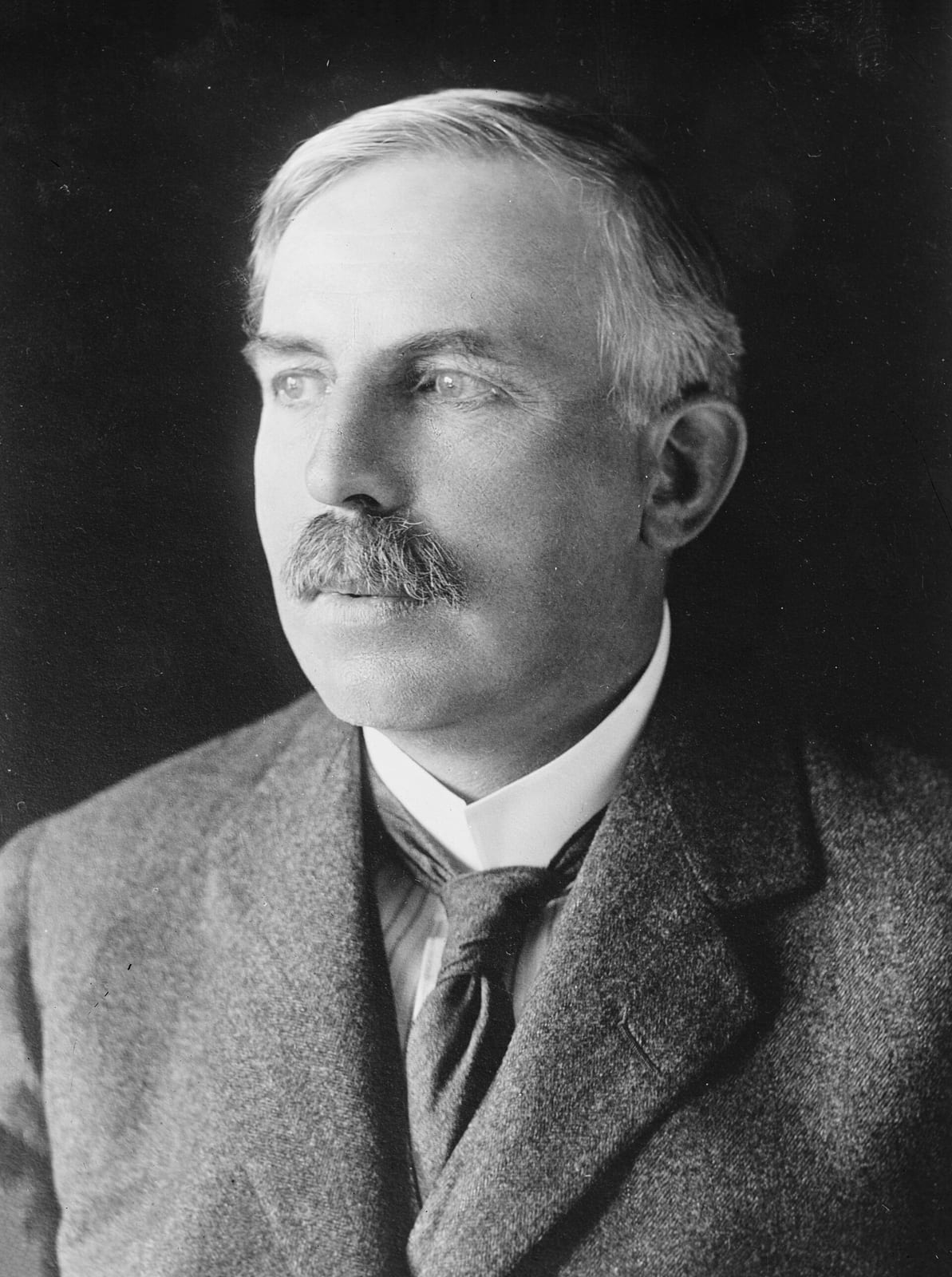
Rutherford Puts a Nucleus at the Center of the Atom
Scattering experiments challenged a comfortable picture of atomic structure. Rutherford’s 1911 model concentrated positive charge in a tiny region and opened new questions rather than settling them all.
In 1909 at the Victoria University of Manchester, Hans Geiger and Ernest Marsden directed streams of alpha particles at extremely thin sheets of gold foil under the guidance of Ernest Rutherford. Prevailing models treated the atom as a diffuse sphere of matter with electric charge distributed evenly throughout. Rutherford asked his assistants to look for deflections at unexpectedly wide angles. To their surprise, a tiny fraction of the fast-moving particles rebounded sharply backwards, an outcome Rutherford later compared to firing an artillery shell at tissue paper only to have it bounce back.
Rutherford spent months analyzing these deflection patterns before publishing his interpretation in 1911. He concluded that an alpha particle could only be turned around if it encountered an intense concentration of electric charge and mass. This deduction led him to propose a nuclear structure for the atom, in which almost all of its mass and positive charge resided within a compact central core, surrounded by largely empty space.

Keep reading in Yester
Coming soon to the App Store
Keep following the story
Sources
Image: George Grantham Bain Collection (Library of Congress)