Physicists Announce the Higgs Boson
The Large Hadron Collider found the particle linked to how others gain mass.
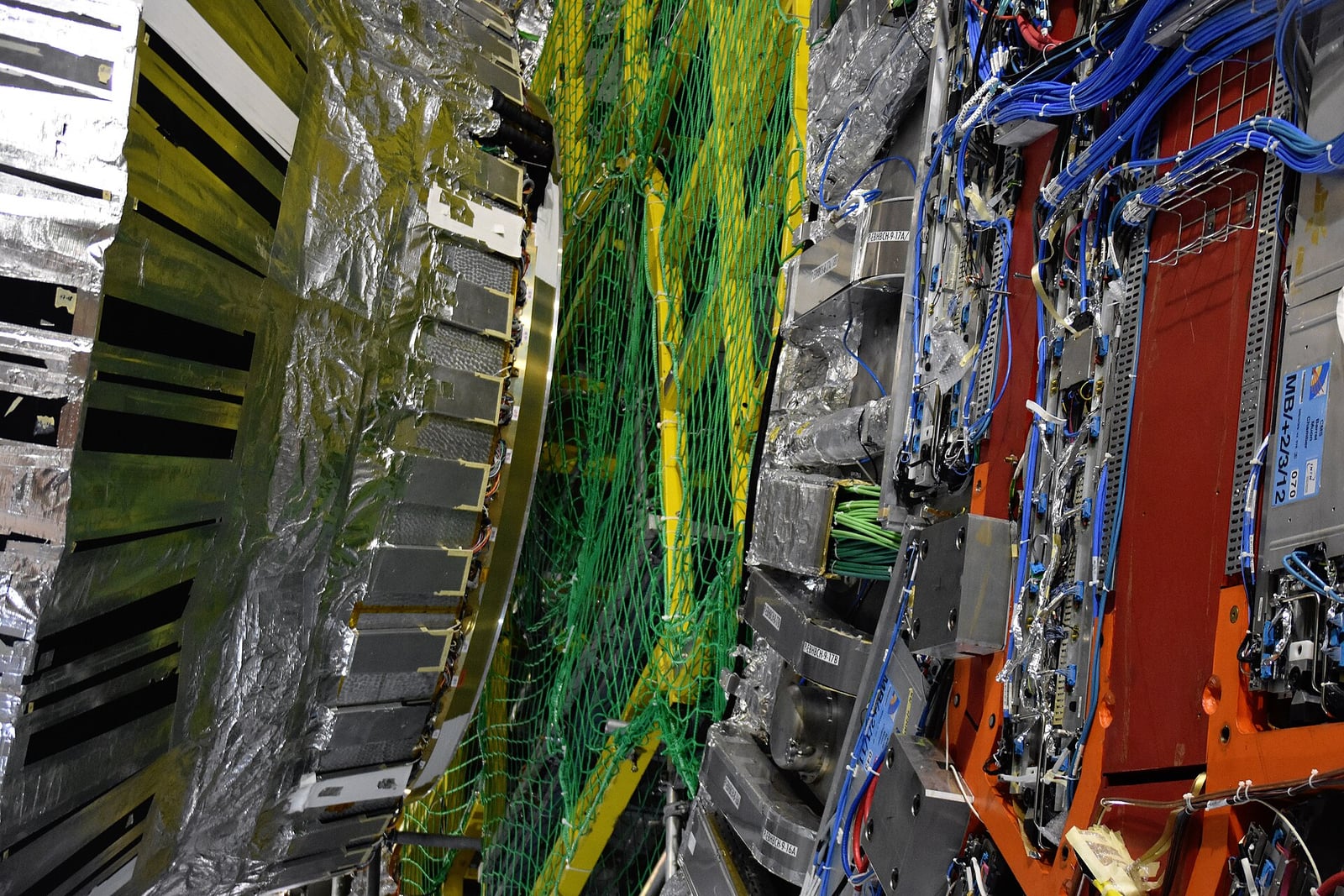
On July 4, 2012, researchers at CERN near Geneva, Switzerland, announced the discovery of a previously unseen subatomic particle at the Large Hadron Collider. Detected independently by the facility's ATLAS and CMS experiments, the new entity had a mass in the region of about 125 to 126 gigaelectronvolts, and physicists suspected it was the Higgs boson. The identification represented the culmination of an experimental quest spanning several decades to confirm the presence of the Higgs field, a scalar field theorized to permeate the universe.
The theoretical foundation for the particle arose during the early 1960s. At that time, physicists struggled to reconcile the governing gauge symmetries of particle interactions with the physical masses of force carriers. Gauge theories for the electromagnetic and strong forces operated cleanly, but applying gauge invariance to the weak interaction incorrectly required the W and Z gauge bosons to possess zero rest mass. Standard attempts to resolve the issue generated hypothetical Goldstone bosons that ran counter to physical observations, leaving the emerging framework in doubt.

Keep reading in Yester
Coming soon to the App Store
Keep following the story

Sources
- The Higgs boson (CERN)
- CERN: Experiments Observe Particle Consistent with Long-sought Higgs Boson (CERN press release, via SLAC)
- New results indicate that particle discovered at CERN is a Higgs boson (CERN)
- The Nobel Prize in Physics 2013: Press release (Nobel Prize)
- The Nobel Prize in Physics 2013: Popular information (Nobel Prize)
- Higgs boson
Image: SimonWaldherr