The Royal Society Is Founded in London
Natural philosophers began meeting to share experiments.
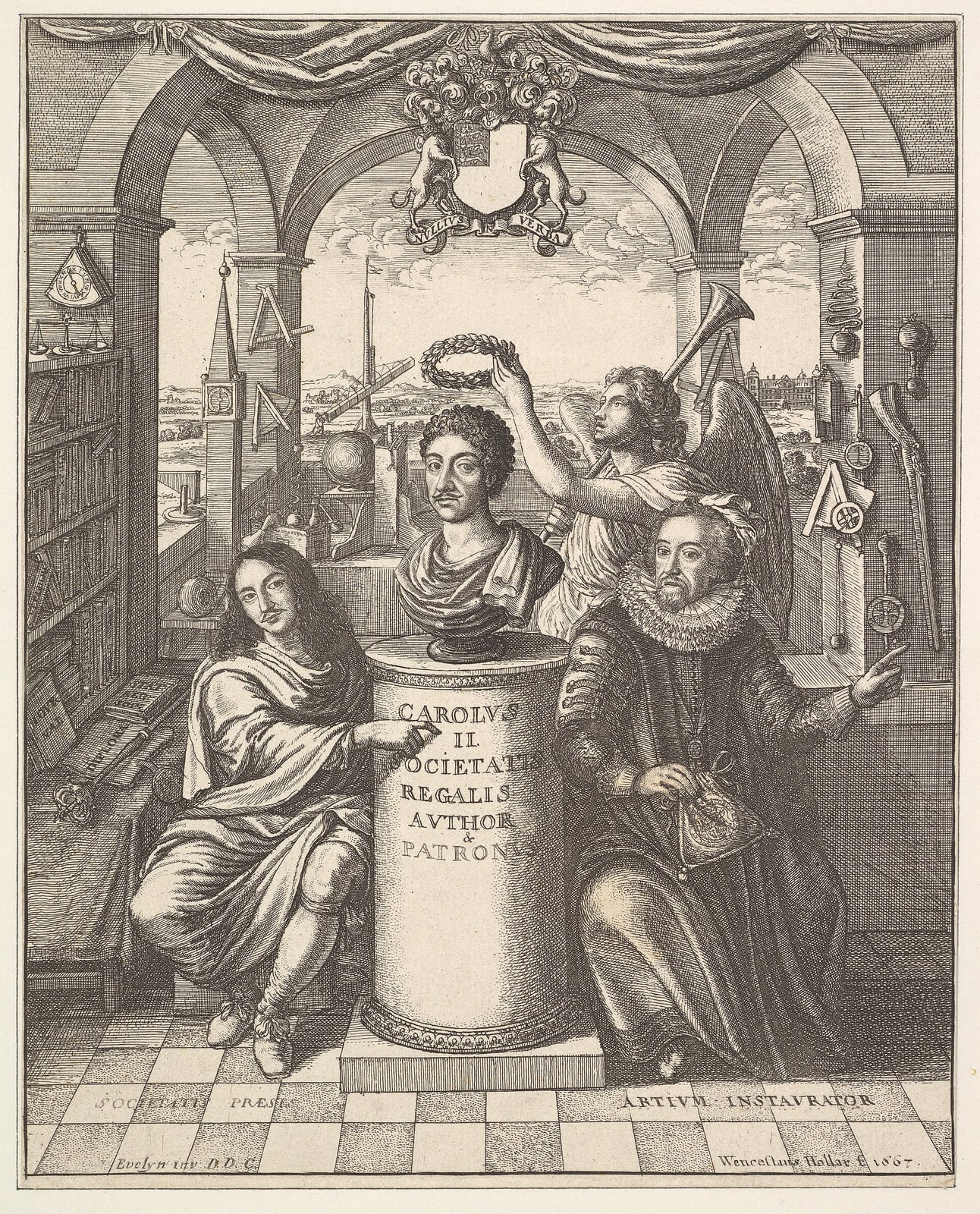
On 28 November 1660, a gathering of twelve natural philosophers met at Gresham College in London following a lecture by Christopher Wren. Seeking to promote experimental learning through collaborative inquiry, the group resolved to establish a dedicated institution. Among the early organizers were prominent figures such as Robert Boyle, John Wilkins, William Brouncker, and Sir Robert Moray. These men drew inspiration from earlier informal assemblies, including mid-seventeenth-century gatherings in London and Oxford influenced by Francis Bacon's vision of cooperative natural science. Some seventeenth-century commentators alternatively attributed the idea to the influence of French scientific assemblies, though contemporaries like Robert Hooke strongly disputed that English investigators had merely copied foreign models.
Royal encouragement soon followed the initial gathering. Sir Robert Moray informed the members that King Charles II approved of their venture, leading to a royal charter signed on 15 July 1662 that formally established the Royal Society of London. A second charter, which passed the Great Seal on 22 April 1663, named the king as founder and gave the body a fuller title; today its formal name is the Royal Society of London for Improving Natural Knowledge. The fellowship selected William Brouncker as its first president and adopted the Latin motto Nullius in verba, meaning to take nobody's word for it, expressing their commitment to verifying claims through physical demonstration rather than relying on authority.

Keep reading in Yester
Coming soon to the App Store
Keep following the story
Sources
- History of the Royal Society (The Royal Society)
- Second Charter of the Royal Society, DC/1/2 (Royal Society Archive catalogue)
- Philosophical Transactions: history of the journal (Royal Society Publishing)
- The Royal Society (MacTutor History of Mathematics, University of St Andrews)
- Isaac Newton biography (MacTutor History of Mathematics, University of St Andrews)
- Lands and liberties (The Royal Society blog)
- Minutes of a meeting of the Council, 14 January 1740/1741, CMO/3/89 (Royal Society Archive catalogue)
- Royal Society
Image: Wenceslaus Hollar / John Evelyn