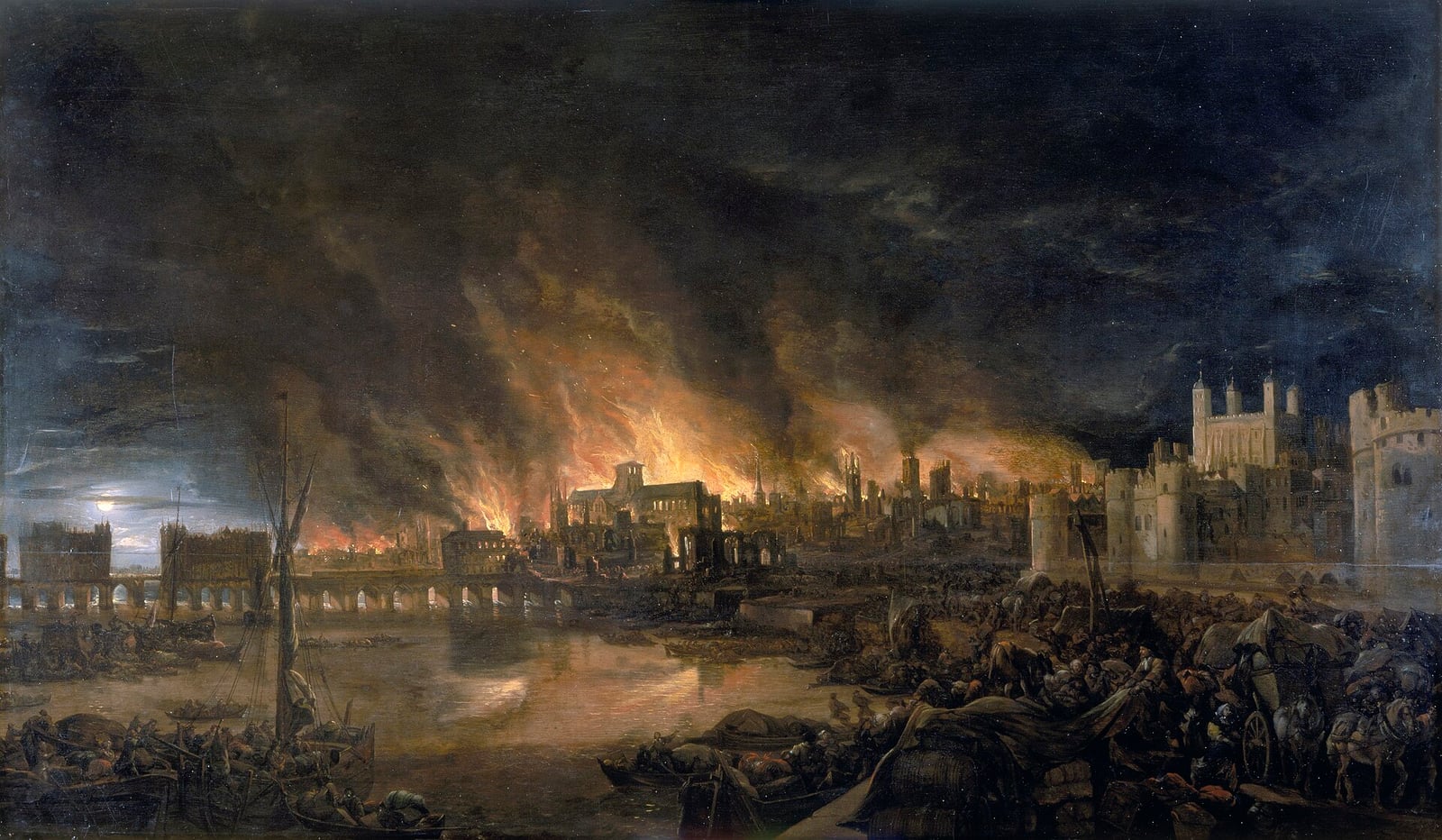
The Great Fire of London Burns for Four Days
A fire from a bakery destroyed much of the medieval city.
Shortly after midnight on Sunday, 2 September 1666, a blaze broke out inside Thomas Farriner's bakery on Pudding Lane in the City of London. Strong easterly winds rapidly drove the flames into adjacent properties packed with combustible goods along the River Thames. The primary firefighting technique of the seventeenth century relied on clearing structures to establish firebreaks, but the Lord Mayor, Sir Thomas Bloodworth, hesitated to authorise large-scale demolitions, largely because most of the threatened buildings were rented and the owners could not be consulted. By the time demolitions were officially attempted later that day, the fire had grown into a self-sustaining firestorm that outstripped local containment efforts.
The physical fabric of seventeenth-century London exacerbated the speed of the catastrophe. Much of the urban core within the ancient Roman defensive wall consisted of dense, multi-storey timber residences featuring jettied upper storeys that leaned closely over narrow cobbled streets. The city had experienced an outbreak of bubonic plague only the previous year, and its cramped geography restricted movement as fleeing inhabitants attempted to escape through the eight gates in the city wall. Equipment intended to suppress fires proved ineffective: communal water wheels beneath London Bridge were consumed by flames, while heavy, wheeled fire engines lacked flexible delivery hoses and frequently became trapped or damaged along the waterfront.

Keep reading in Yester
Coming soon to the App Store
Keep following the story
Sources
Image: Unknown artist Unknown artist