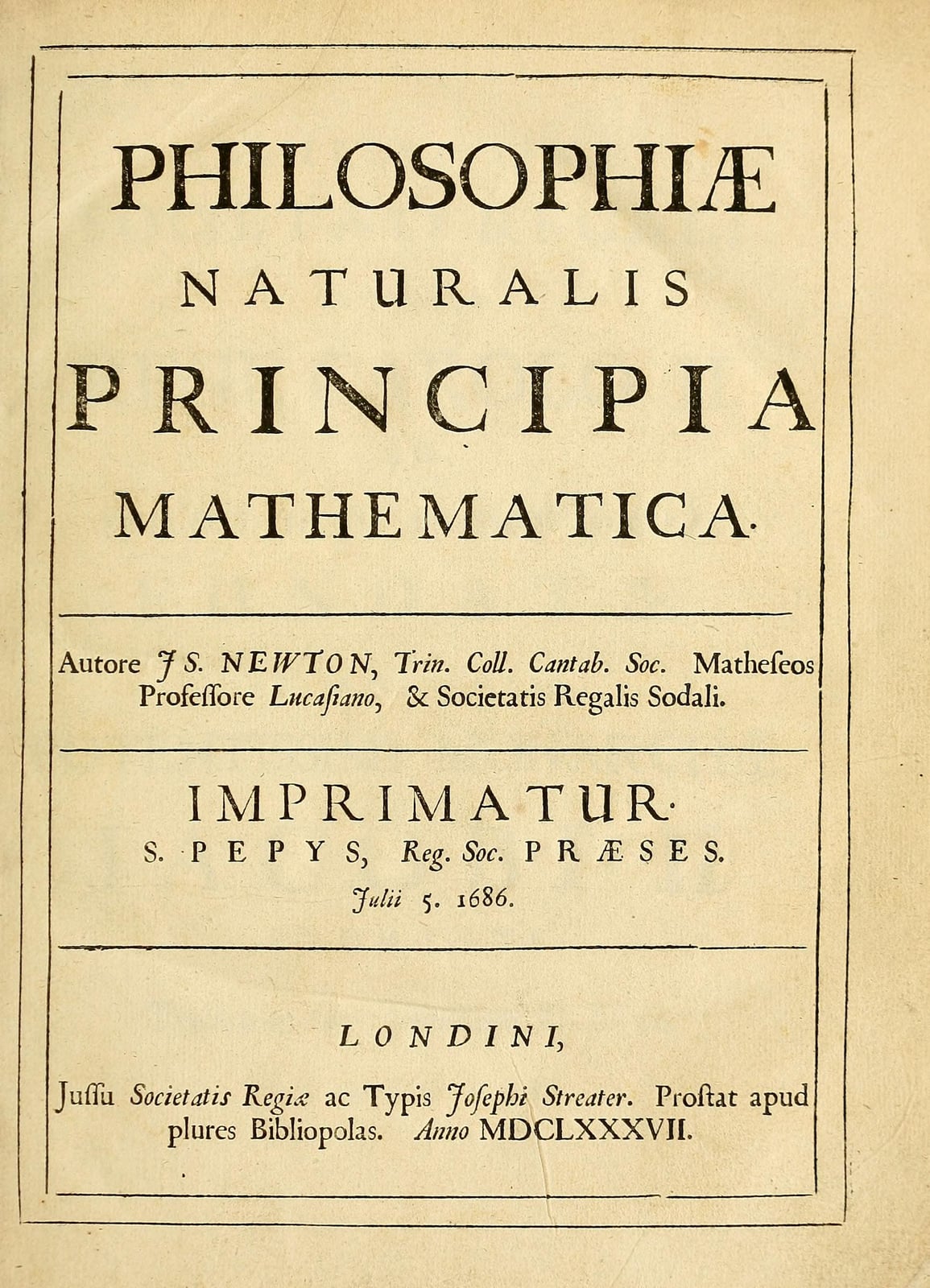
Newton’s Principia Links Motion on Earth and in the Heavens
Mathematical laws gave terrestrial and celestial motion a common framework.
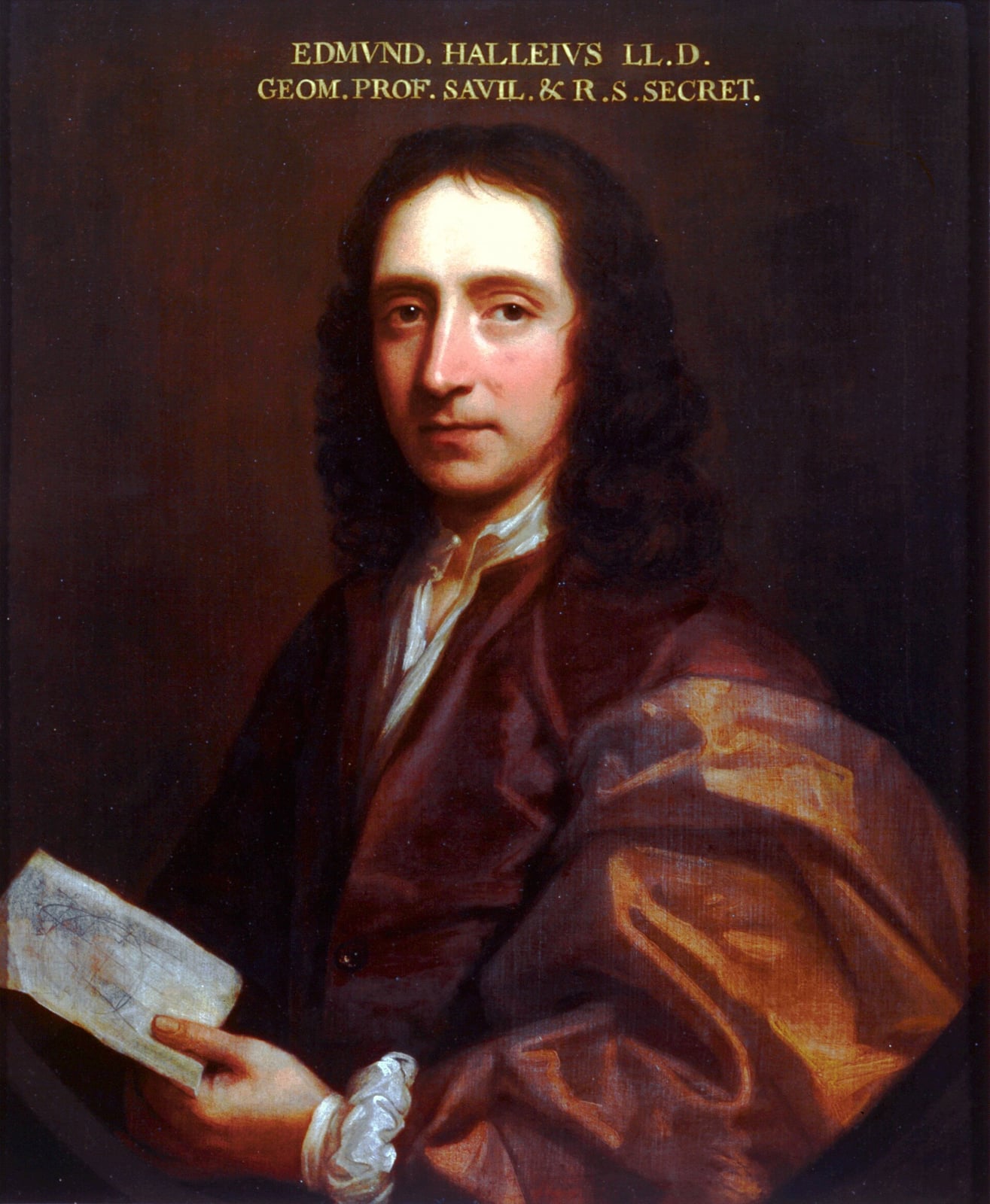
In July 1687, the Royal Society oversaw the publication in London of Isaac Newton's three-volume Latin treatise, Philosophiae Naturalis Principia Mathematica. The catalyst for the work had arrived three years earlier, when astronomer Edmond Halley visited Cambridge to ask Newton about planetary motions following unresolved debates with Christopher Wren and Robert Hooke. Newton reported that he had already calculated the paths, and later in 1684 he forwarded Halley a short manuscript titled De motu corporum in gyrum. Recognizing its profound implications, Halley urged Newton to pursue the research further, leading Newton into an intense period of composition that occupied him through mid-1686, with Halley ultimately financing the printing of the completed text at his own expense.
The Principia began by establishing foundational physical concepts and axioms, formalizing definitions of mass and quantity of motion while framing absolute space and time as distinct from perceptible measures. Newton set out to investigate natural forces through observed motions, demonstrating how these forces explained observed physical phenomena without relying on scholastic substantial forms. His mathematical apparatus applied geometric lemmas involving vanishingly small quantities, deploying methods now recognized as infinitesimal calculus to address dynamics in both resisting and non-resisting environments.

Keep reading in Yester
Coming soon to the App Store
Keep following the story
Sources
Image: The original uploader was Zhaladshar at English Wikisource .