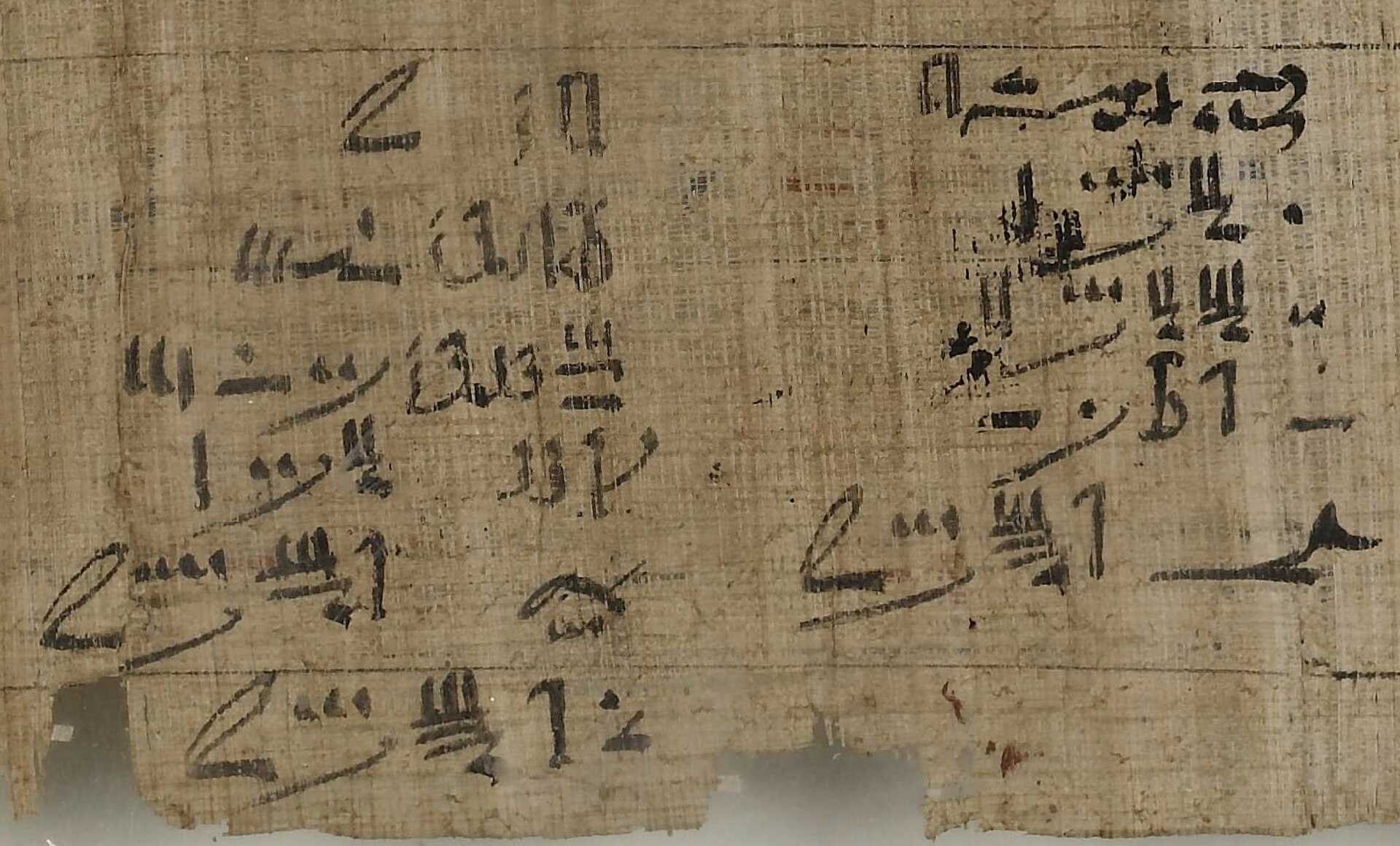
A Scribe Copies Egypt’s Book of Mathematical Problems
The scribe Ahmes set out fractions, areas and pyramid slopes as worked examples.
Around 1550 BCE, during the Second Intermediate Period of ancient Egypt, a scribe named Ahmes set down a comprehensive manual of applied mathematics. In his opening lines, Ahmes recorded that he copied the work in the thirty-third regnal year of Awserre, the prenomen of the Hyksos king Apepi. He credited his source material to an earlier text compiled centuries before, during the reign of Twelfth Dynasty pharaoh Amenemhat III. The resulting document, now recognized as the Rhind Mathematical Papyrus, serves alongside the older Moscow Mathematical Papyrus as one of the most substantial surviving records of early Egyptian calculation.
The manuscript opens with extensive calculation tables designed to facilitate fraction arithmetic. Because ancient Egyptian scribes routinely manipulated fractions as sums of distinct unit fractions, with numerators of one, the text begins with a reference table converting fractions of the form two divided by odd numbers from three up to one hundred and one. None of these decompositions required more than four terms. This reference is followed by a smaller conversion list for single digits divided by ten, providing the practical foundations necessary for the worked exercises that occupy the remainder of the roll.

Keep reading in Yester
Coming soon to the App Store
Keep following the story
Sources
Image: Ahmes