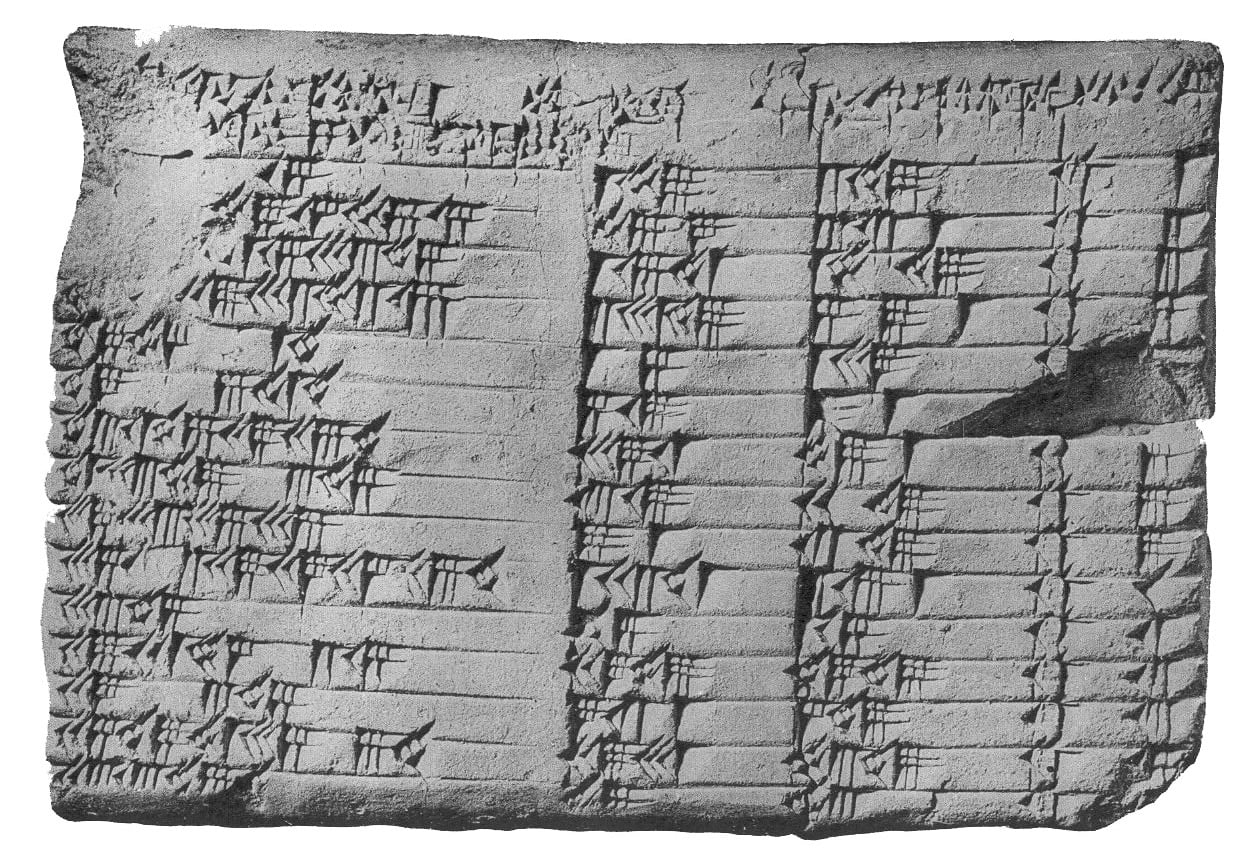
A Babylonian Tablet Lists Pythagorean Triples
A clay tablet recorded number patterns more than a thousand years before Pythagoras.
Around 1922, the American publisher George Arthur Plimpton bought a modest, damaged clay tablet from the antiquities dealer Edgar J. Banks. Banks stated that the artifact originated from Senkereh, the southern Iraqi site corresponding to the ancient city of Larsa. Roughly thirteen centimeters wide, nine centimeters tall, and two centimeters thick, the tablet was bequeathed to Columbia University in the mid-1930s. Bearing columns of numbers inscribed in cuneiform script, it entered the academic catalog under the designation Plimpton 322. Historians date the object using the middle chronology to approximately 1800 BCE, with palaeographic analysis and administrative formatting pointing toward a window of roughly 1820 to 1762 BCE.
The mathematical significance of the artifact emerged in the 1940s through the analysis of Otto Neugebauer and Abraham Sachs. Scholars recognized that the tablet recorded a table of numbers in the Babylonian base-sixty sexagesimal system, arranged in four visible columns across fifteen rows. The fourth column lists line numbers running from one to fifteen, while the second and third columns preserve pairs of large integers. Neugebauer and Sachs demonstrated that these integer pairs correspond to the short sides and hypotenuses of right-angled triangles. Each row represents a Pythagorean triple, where the sum of the squares of the two shorter legs equals the square of the long diagonal.

Keep reading in Yester
Coming soon to the App Store
Keep following the story
Sources
- 158. Cuneiform Tablet, Plimpton 322 (Columbia University Libraries exhibition)
- Plimpton 322 (Before Pythagoras exhibition, Institute for the Study of the Ancient World, New York University)
- MCT 038, Plimpton 322 (P254790) (Cuneiform Digital Library Initiative)
- Pythagoras's theorem in Babylonian mathematics (MacTutor History of Mathematics, University of St Andrews)
- Plimpton 322
Image: photo author unknown