Fermat Claims a Proof Too Large for the Margin
A note in a copy of Diophantus set a puzzle that took 358 years to solve.
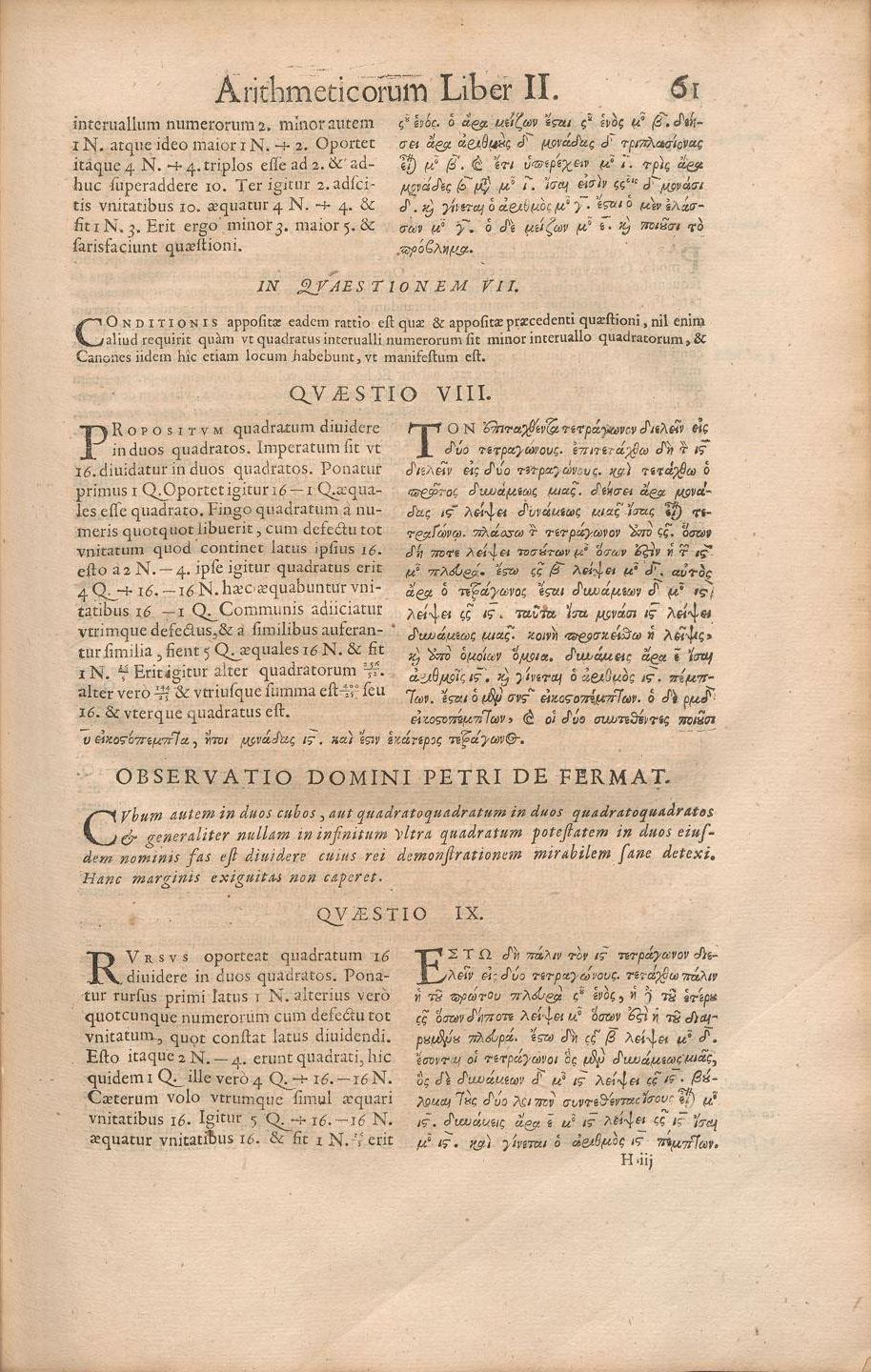
Around 1637, the French magistrate and mathematician Pierre de Fermat examined an edition of the Arithmetica, an ancient treatise composed by the Alexandrian mathematician Diophantus. The Greek text concerned the decomposition of a square into two other squares, an exploration rooted in ancient knowledge of Pythagorean triples where side lengths satisfy the equation of two squares summing to a third. Beside this discussion, Fermat jotted a statement asserting that no three positive integers can satisfy the relation where two numbers raised to an exponent greater than two sum to a third number raised to the same power. He famously noted in Latin that he had discovered a truly marvelous proof, yet the margin was too narrow to hold it.
Fermat never published this general statement, nor did he ever mention possessing a comprehensive proof in his surviving correspondence across the remaining three decades of his life. He challenged fellow scholars such as Blaise Pascal, Marin Mersenne, and John Wallis only with specific instances involving exponents of three and four. The surviving record preserves his demonstration only for the case of exponent four, where he utilized his method of infinite descent. When his son Clement-Samuel published an annotated edition of the Arithmetica in 1670, five years after Fermat's death, the marginal note became public. As other unproven claims left by Fermat were steadily resolved or verified, this stubborn proposition stood alone as the final unresolved assertion, becoming known as Fermat's Last Theorem.

Keep reading in Yester
Coming soon to the App Store