Euclid Organizes Geometry into a Lasting System
Definitions, propositions and proofs shaped mathematical teaching across centuries.
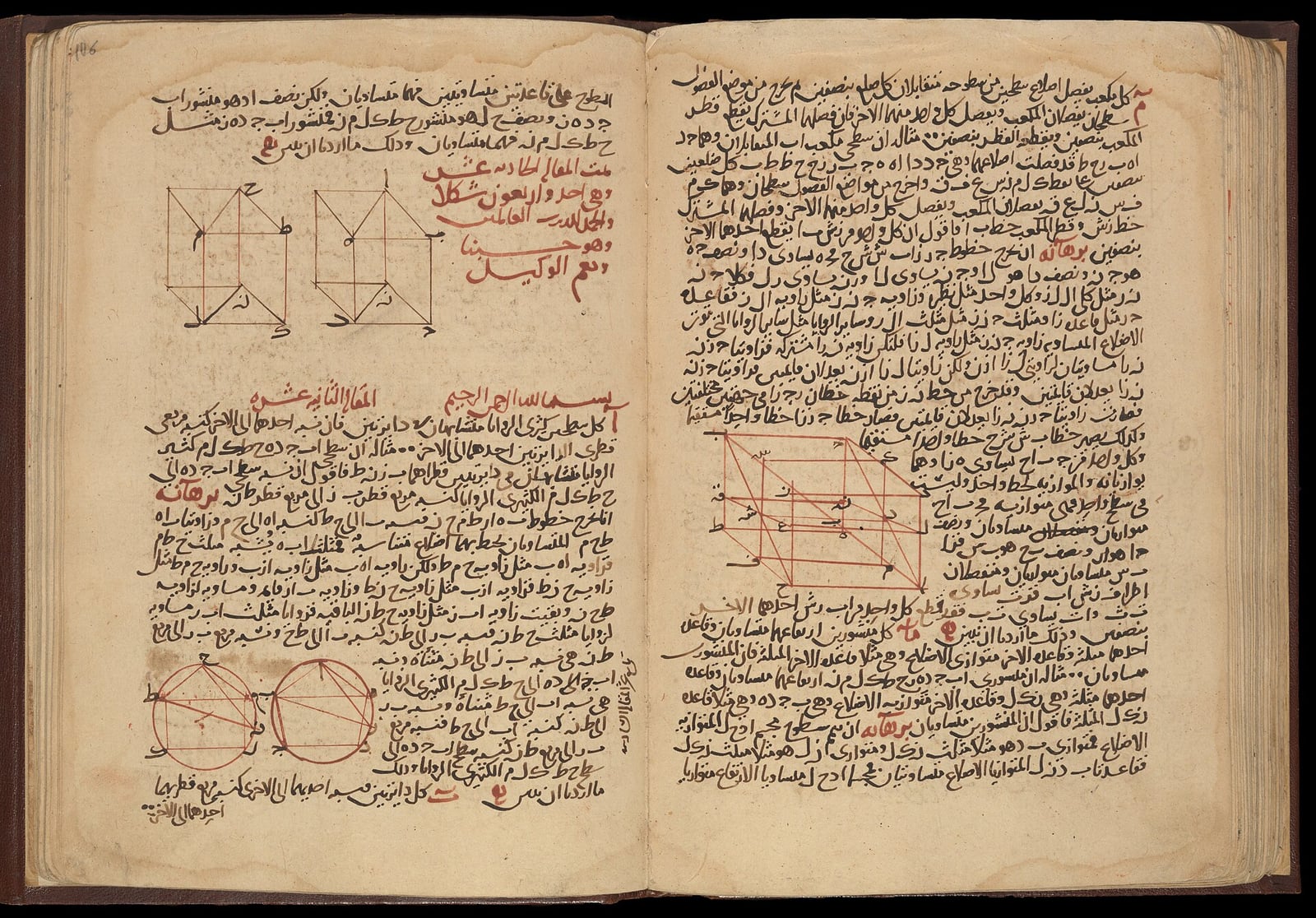
Around 300 BCE in Alexandria, Euclid organized mathematical principles into a thirteen-book compilation known as the Elements. It stands as the oldest surviving large-scale deductive treatment of mathematics. The work brought together material from earlier Greek thinkers, including Eudoxus of Cnidus, Hippocrates of Chios, and Theaetetus. Later commentators, such as the fifth-century philosopher Proclus, observed that Euclid brought tighter demonstrations to findings previously proved with less rigor. Modern historians continue to debate the exact division between Euclid's original contributions and inherited material, with some scholars highlighting his synthesis of accepted results and others emphasizing the tight overall architecture of the text.
The treatise is traditionally grouped into plane geometry across the first six books, number theory in books seven through ten, and solid geometry in the final three books. Euclid opened Book I with definitions of fundamental concepts such as points, lines, and angles, followed by five postulates and five common notions. These assumptions established an axiomatic foundation for all succeeding proofs. Rather than treating geometric sizes as modern numerical measurements, Euclid compared magnitudes directly through geometric procedures. The first book concluded with forty-eight propositions, including the earliest surviving proof of the Pythagorean theorem.

Keep reading in Yester
Coming soon to the App Store
Keep following the story

Sources
Image: Unknown author Unknown author