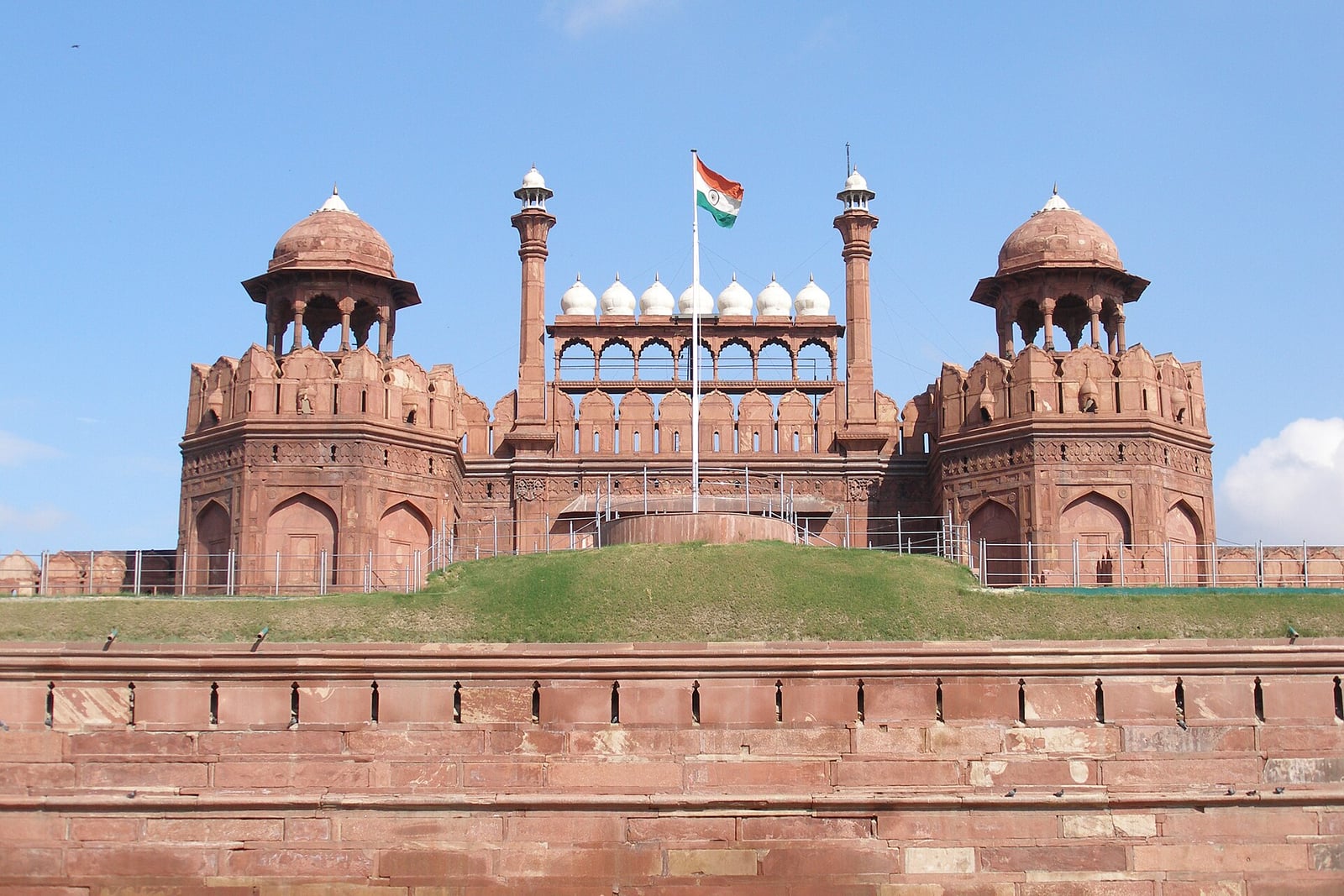
Shah Jahan Completes the Red Fort in Delhi
The sandstone palace-fortress anchored his new capital, Shahjahanabad.
In the spring of 1648, the Mughal emperor Shah Jahan celebrated the completion of his monumental palace-fortress along the banks of the Yamuna River. Begun in 1638 or 1639 (sources differ), the fortress was designed to serve as the political and ceremonial anchor of Shahjahanabad, the planned settlement that shifted imperial administrative focus from Agra to Delhi. Supervising the decade-long project personally, Shah Jahan turned to the architects Ustad Hamid and Ustad Ahmad Lahori, the latter associated with the Taj Mahal, to realize an expansive court complex framed by soaring perimeter walls.
Originally known as the Qila-i-Mubarak, or the Blessed Fort, the enclosure was built primarily of red sandstone with detailing in white. Its perimeter stretched nearly two and a half kilometers, with defensive curtain walls, turrets, and bastions rising between 18 meters along the riverbank and 33 meters facing the city. Unlike traditional symmetrical forts, its plan assumed an irregular octagonal trace beside the preexisting Salimgarh Fort, built by Islam Shah Suri in 1546, immediately to the north. Water channeled from the river fed the palace fountains, marble pools, and surrounding defensive moats.

Keep reading in Yester
Coming soon to the App Store
Keep following the story
Sources
- Red Fort Complex (UNESCO World Heritage Centre)
- Red Fort (MAP Academy, Museum of Art and Photography, Bengaluru)
- Independence Day: A self-contained capital, a national fort (Business Standard)
- Red Fort: Why India's prime minister hoists the national flag at Delhi's iconic monument (Business Today)
- Red Fort
Image: Vyacheslav Argenberg