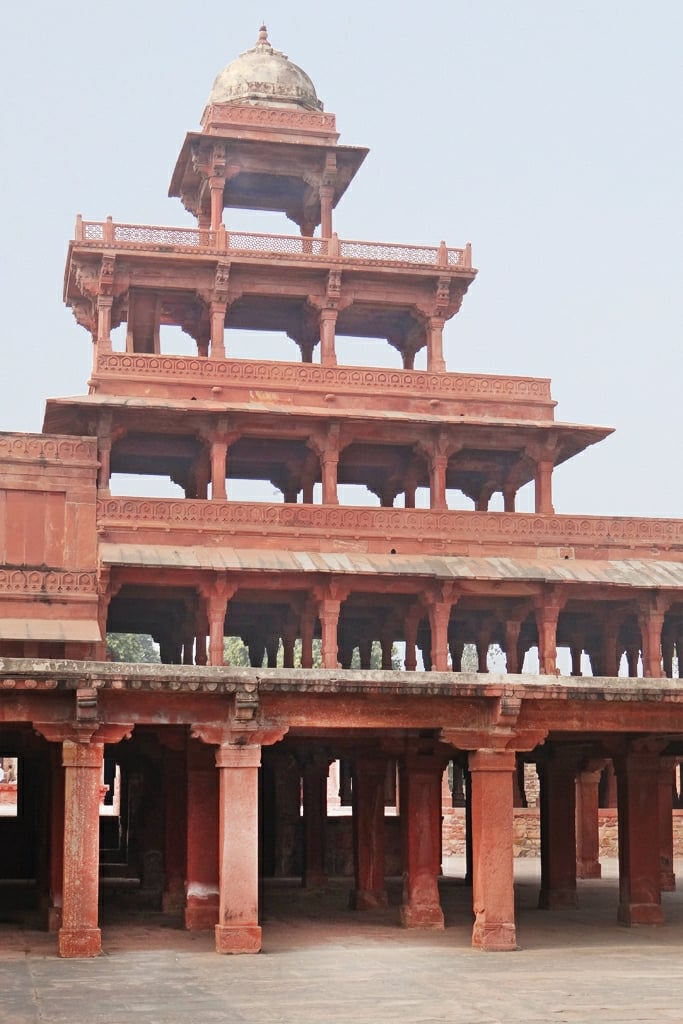
Akbar Builds a New Capital at Fatehpur Sikri
A red sandstone city rose near the shrine of a Sufi saint.
In 1571, the Mughal emperor Akbar resolved to establish a magnificent imperial capital roughly thirty-seven kilometres from Agra. The chosen site was the village of Sikri, situated along an elevated sandstone ridge. Akbar maintained a close spiritual connection to the place: the Chishti Sufi mystic Sheikh Salim Chishti resided there in a khanqah and had earlier prophesied the birth of the emperor's heir. When Akbar's son Salim, the future emperor Jahangir, was born at Sikri in 1569 to his consort Mariam-uz-Zamani, Akbar commissioned a religious complex to honour the saint. Two years later, he expanded this scheme into a full walled imperial city.
Although Mughal chroniclers presented the foundation as an entirely novel venture, archaeological research reveals a long history of prior human habitation on the ridge. Excavations conducted by the Archaeological Survey of India at Birchhabili Tila revealed cultural deposits extending back centuries. Among the finds was a Jain sculpture of the goddess Saraswati whose inscription, dated 1010, names the place Sekrikya. Sikarwar Rajputs later controlled the region until the Battle of Khanwa in 1527, and early Mughal rulers, including Akbar's grandfather Babur, had already developed gardens and pavilions nearby.

Keep reading in Yester
Coming soon to the App Store
Keep following the story
Sources
Image: Jean-Pierre Dalbéra from Paris, France