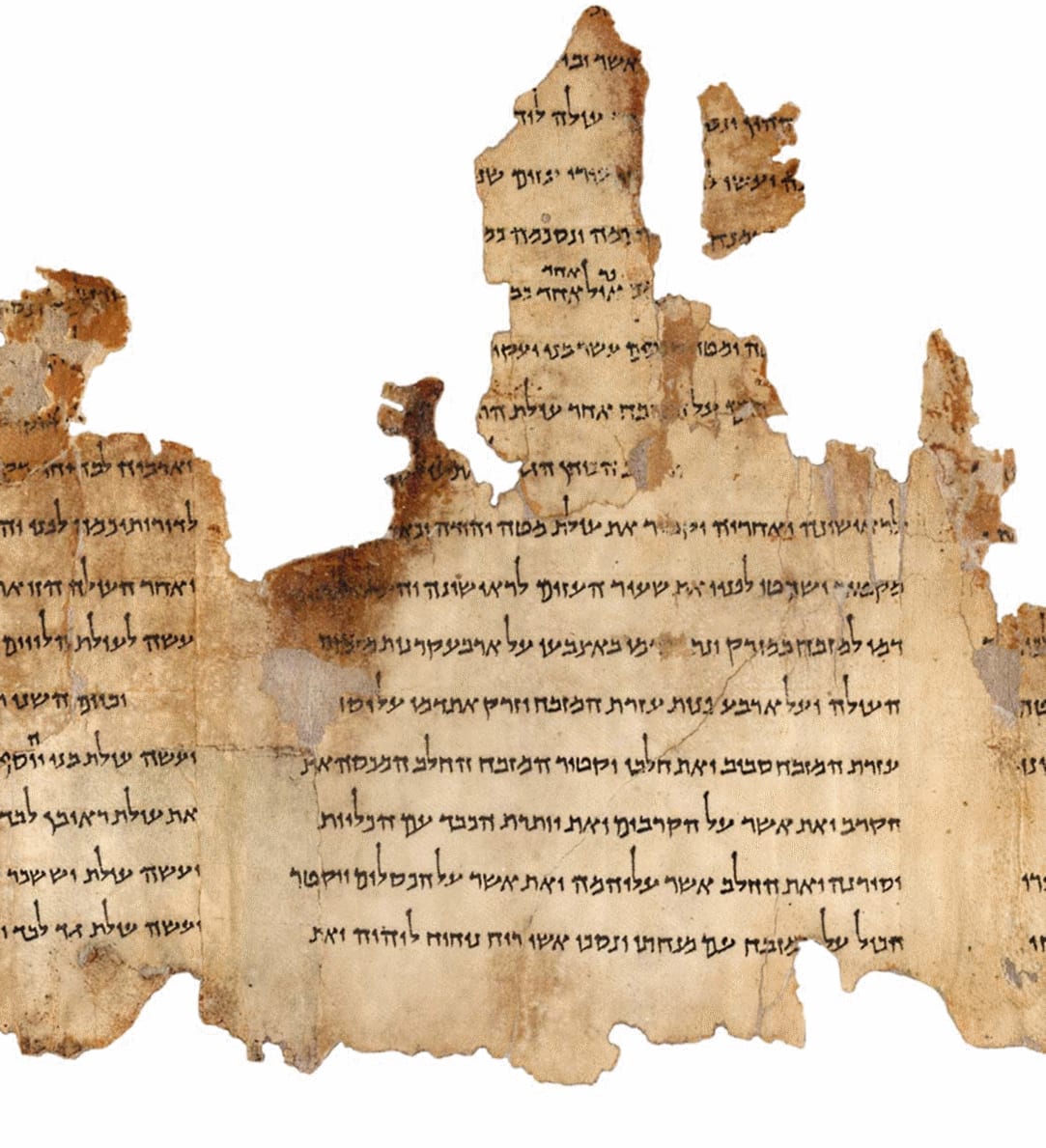
The First Dead Sea Scrolls Emerge from a Desert Cave
Manuscripts found near Qumran transformed the study of ancient Jewish texts.
In 1947, Bedouin shepherds of the Ta'amireh tribe, among them Muhammed edh-Dhib and Jum'a Muhammed, encountered a cave near the site of Khirbet Qumran, located in the Judaean Desert near the northern shore of the Dead Sea. Inside the cavern, later designated Cave 1, edh-Dhib retrieved several ancient manuscripts sealed inside earthenware jars. Over the ensuing months, the Bedouins retrieved seven major documents, including the Great Isaiah Scroll, the Community Rule, and the Pesher on Habakkuk. The Bedouin sold four of the scrolls to Kando, an antiquities dealer in Bethlehem, and three to a second dealer, triggering a complex sequence of transactions that eventually drew the attention of regional antiquities scholars.
Word of the manuscripts reached scholars in late 1947 and early 1948. Around 18 to 21 February 1948, John C. Trever, then acting director of the American Schools of Oriental Research in Jerusalem, handled and photographed the Great Isaiah Scroll and other scrolls. Recalling work on the Nash Papyrus, then regarded as the oldest copy of biblical text, he sent photographs to William F. Albright, who replied in March 1948 that the Isaiah scroll was a little older than the papyrus. However, regional instability and the 1948 Arab-Israeli War hindered further exploration, and in 1949 the Syrian Orthodox archbishop who held four of the scrolls took them out of the country to the United States.

Keep reading in Yester
Coming soon to the App Store
Keep following the story
Sources
- Discovery and Publication (Israel Antiquities Authority)
- Virtual Qumran: The Caves (Hebrew University of Jerusalem)
- Qumran Caves (BiblePlaces)
- Dead Sea Scrolls (Britannica, via web.archive.org)
- Dead Sea Scrolls (Encyclopaedia Britannica)
- Scrolls from the Dead Sea: Introduction (Library of Congress)
- Scrolls from the Dead Sea: The Qumran Library (Library of Congress)
- Reading Albright's Mail: A Dead Sea Scrolls Story (Museum of the Bible)
Image: Israel Museum