Miners in Sinai Scratch an Early Alphabet
Workers at Egyptian turquoise mines adapted hieroglyphs to write their own language.
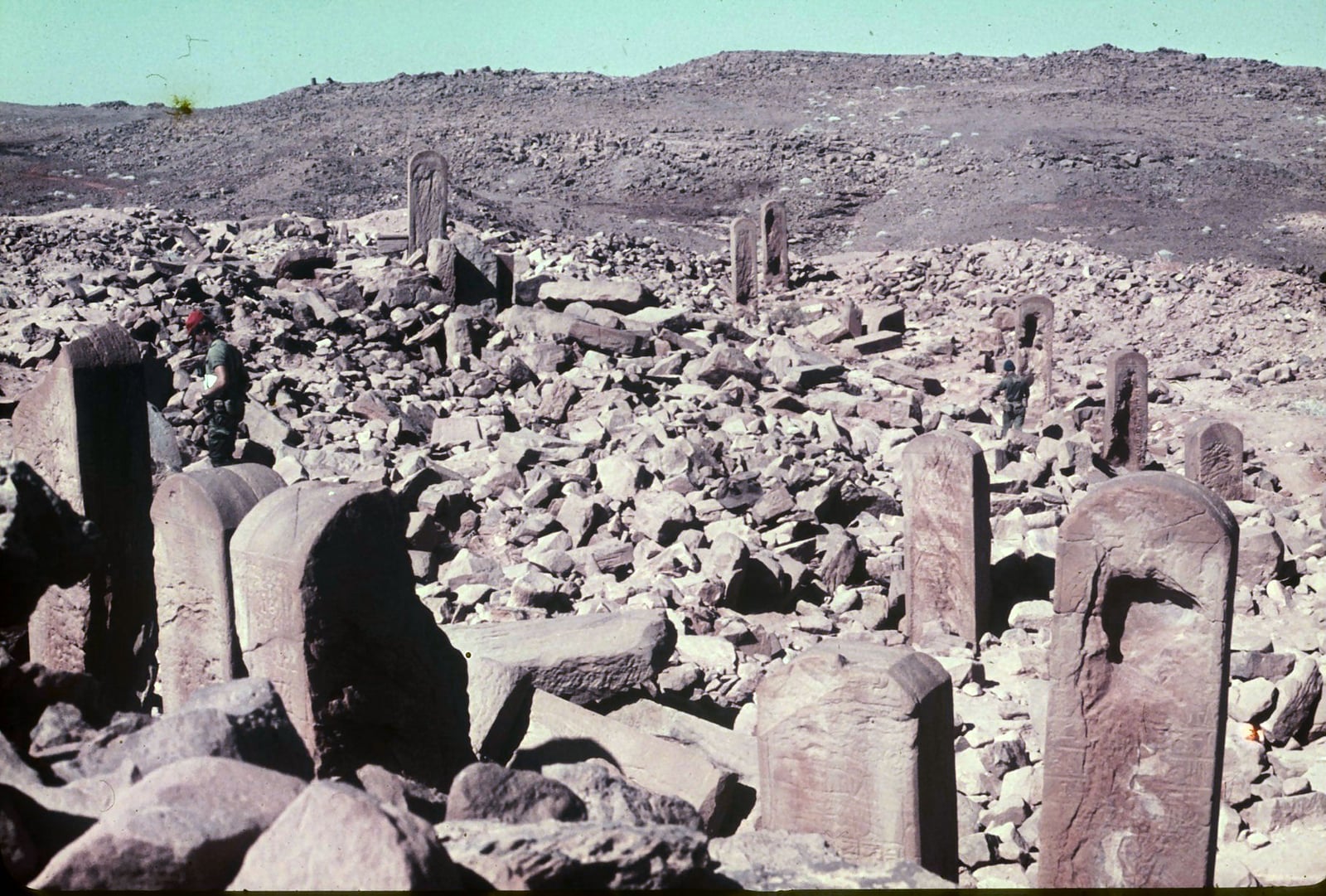
High on the arid plateau of Serabit el-Khadim in the southwestern Sinai Peninsula, ancient Egyptian expeditions repeatedly mined rich deposits of turquoise across many centuries. Among the hundreds of formal hieroglyphic and hieratic records commemorating royal officials and divine favor, archaeologists identified a tiny corpus of unusual, roughly incised texts. Carved into rock faces around the mines, along approach paths, and upon votive statuettes dedicated at a regional sanctuary of the goddess Hathor, these markings represent the Proto-Sinaitic script. Rather than employing the complex mixed system of Egyptian writing, these inscriptions capture the sounds of an early Northwest Semitic tongue using a radically simplified principle.
The first modern documentation of these texts began in the nineteenth century, including copies made in the region by Edward Henry Palmer during the winter of 1868 to 1869. Comprehensive archaeological attention followed in the winter of 1904 to 1905, when Flinders Petrie and Hilda Petrie excavated the temple of Hathor and surrounding workings at Serabit el-Khadim. Petrie recognized that the signs, though visibly derived from Egyptian pictorial symbols, were far fewer in number and did not combine ideograms and syllabics in the customary Egyptian manner. He concluded that Semitic laborers employed at the turquoise workings had repurposed Egyptian characters to form a linear phonetic script of their own creation.

Keep reading in Yester
Coming soon to the App Store
Keep following the story
Sources
- Sphinx, EA41748 (British Museum)
- Object lesson: the Serabit sphinx (Current World Archaeology)
- First Alphabet Found in Egypt (Archaeology, Archaeological Institute of America, Jan/Feb 2000)
- Proto-Sinaitic: Progenitor of the Alphabet, Frank Simons (Rosetta 9, University of Birmingham)
- Proto-Sinaitic script
Image: רוני קניגסברג