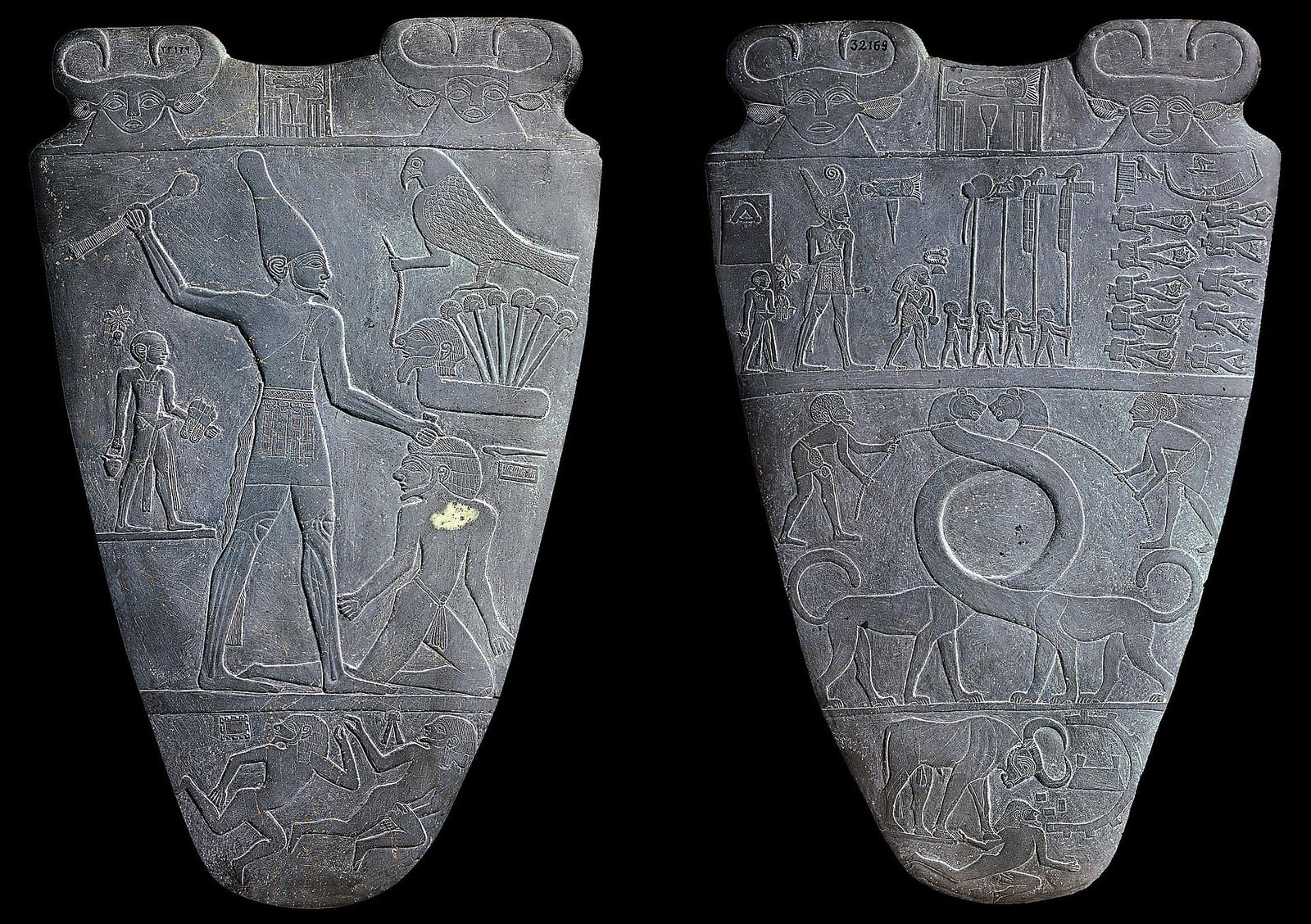
The Narmer Palette Shows a King Ruling a United Egypt
A carved stone palette shows one of the first pharaohs wearing the crowns of both lands.
During the 1897 to 1898 excavation season at the Upper Egyptian site of Nekhen, also known as Hierakonpolis, British archaeologists James Quibell and Frederick W. Green uncovered a remarkable carved stone tablet. Located within the Temple of Horus complex, the shield-shaped slab stood sixty-three centimetres tall and measured forty-two centimetres wide. Carved from a single piece of dark gray-green greywacke from the quarries of Wadi Hammamat, it had survived roughly five thousand years in nearly pristine condition. The object belonged nominally to the tradition of cosmetic grinding palettes, yet its extraordinary scale, weight, and intricate low-relief imagery indicate it served as a ceremonial or votive dedication rather than an everyday personal tool.
The artifact, dated to approximately the thirty-first century BC, is celebrated partly because it contains some of the earliest known hieroglyphic inscriptions. At the summit of both sides sits an identical royal serekh, a composite symbol representing the sovereign and state authority, flanked by bovine heads often identified as the celestial cow goddess Bat. Inside each serekh appear the phonetic signs for a catfish and a chisel, spelling the name of King Narmer. Below these insignias, the carvings present one of the oldest surviving portrayals of an Egyptian monarch, establishing foundational visual conventions of pharaonic statecraft.

Keep reading in Yester
Coming soon to the App Store
Keep following the story
Sources
Image: anonymous