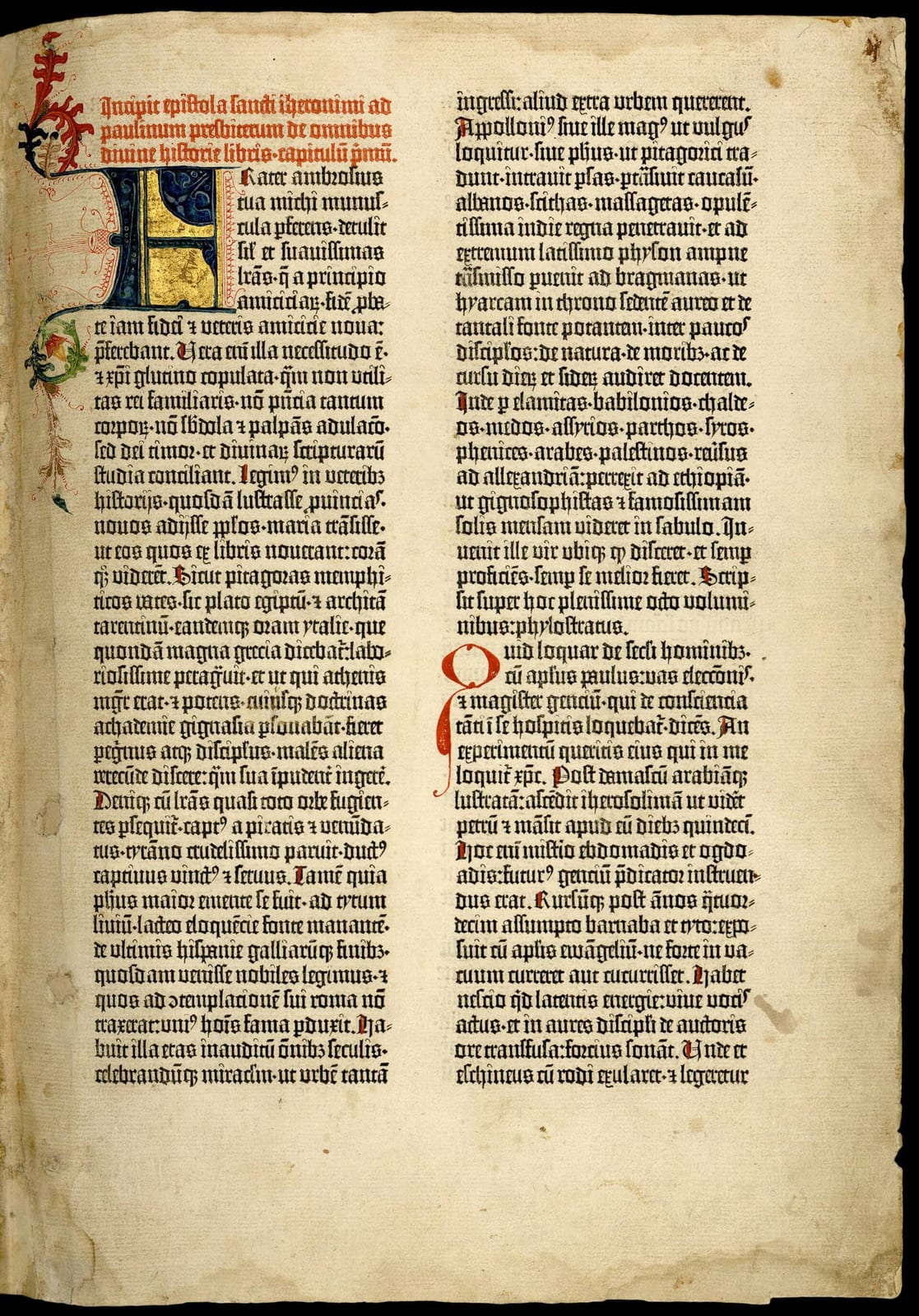
A Bible Made One Letter at a Time
Gutenberg’s Bible looked back to the handwritten book. The reusable pieces of metal behind its pages pointed toward a different future for publishing.
The book did not announce its revolution by looking unfamiliar. The Bible produced in Johannes Gutenberg’s Mainz workshop around 1455 used dense columns of Latin lettering that recalled a carefully written manuscript. A reader could recognize its authority and its appearance. What had changed was how the letters reached the page. They were impressions made from arranged pieces of metal, not a sequence of pen strokes repeated separately for every copy.
Gutenberg’s achievement was a working system rather than one magical machine. Type had to be produced consistently enough to sit together in lines. Ink had to transfer cleanly from the raised surfaces. Paper or parchment had to meet the printing surface under controlled pressure. The parts depended on one another: an excellent press would accomplish little if the letters were uneven or the ink would not behave. Manufacturing repeatability mattered as much as the initial idea.

Keep reading in Yester
Coming soon to the App Store
Keep following the story
Sources
Image: Johannes Gutenberg