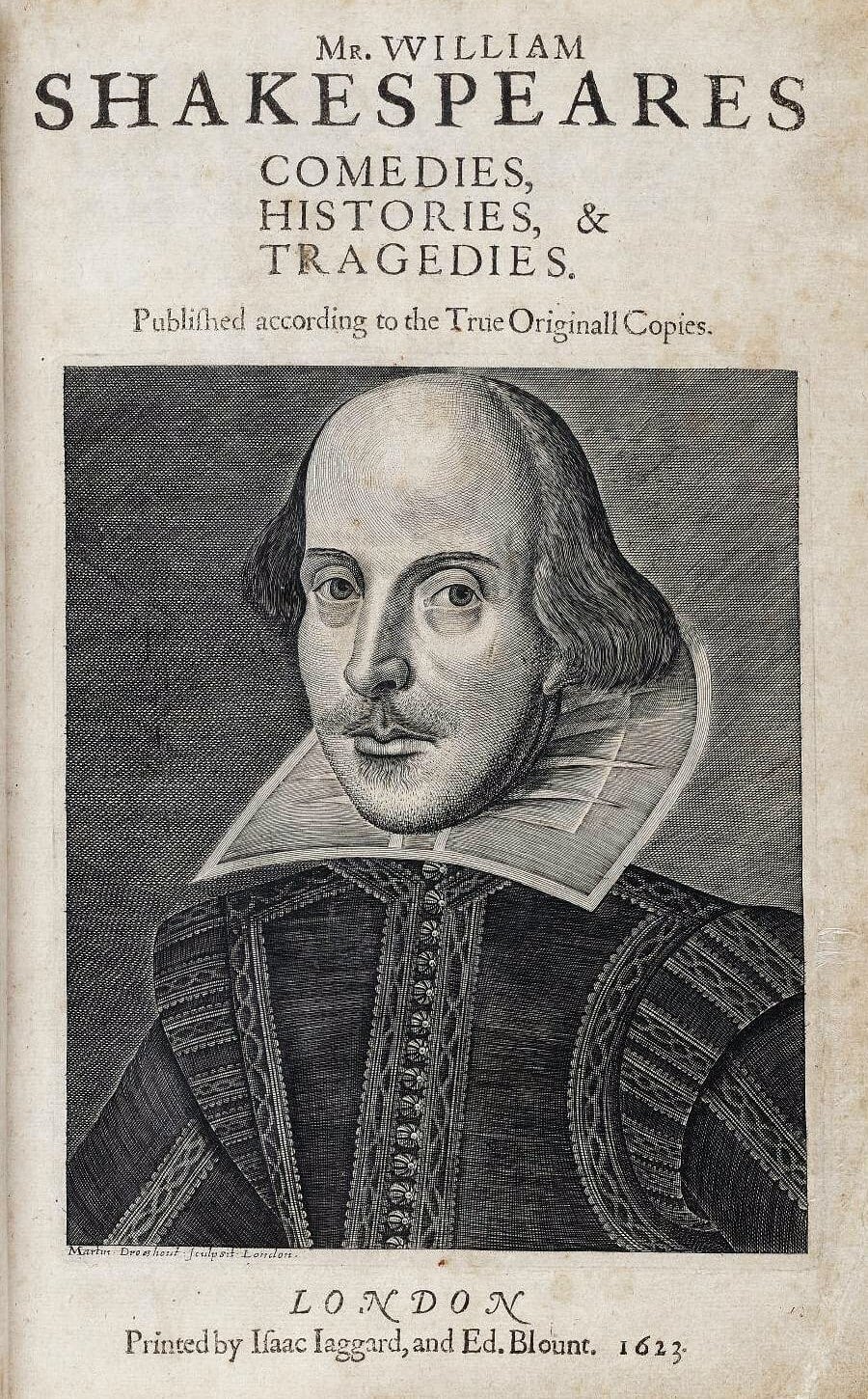
Shakespeare’s First Folio Collects His Plays
Two fellow actors preserved eighteen plays that might otherwise have been lost.
Seven years after William Shakespeare died in Stratford-upon-Avon, his former theatrical colleagues John Heminges and Henry Condell compiled thirty-six of his plays into a single volume titled Mr. William Shakespeare's Comedies, Histories, & Tragedies. Entered into the Stationers' Register in November 1623, the collection is known today as the First Folio. During Shakespeare's lifetime, individual plays had circulated primarily in small, cheap quarto pamphlets, which were frequently discarded after use. The folio format, by contrast, was a large and prestigious presentation typically reserved for volumes of lasting cultural importance.
The publication rescued a major portion of Shakespeare's dramatic output from potential oblivion. While half of the plays had appeared in quarto before 1623, the other eighteen dramas in the First Folio had never been printed before, among them The Tempest, Twelfth Night, Macbeth, Julius Caesar, and Measure for Measure. Modern editors also rely on the Folio for several works that had earlier printings. Heminges and Condell explicitly presented the book as an authoritative corrective to previous unauthorized quartos, which they dismissed as damaged and inaccurate copies.

Keep reading in Yester
Coming soon to the App Store
Keep following the story
Sources
- A Pair of Shakespeare First Folios at the Library of Congress (Library of Congress, Bibliomania blog)
- First Folios at the Folger (Folger Shakespeare Library, Folgerpedia)
- First Folio title page, Augustine Vincent copy (Folger Shakespeare Library, Shakespeare Documented)
- Shakespeare Folios (State Library of New South Wales)
- Julius Caesar: Textual Introduction, by John D. Cox (Internet Shakespeare Editions, University of Victoria)
- First Folio
Image: William Shakespeare