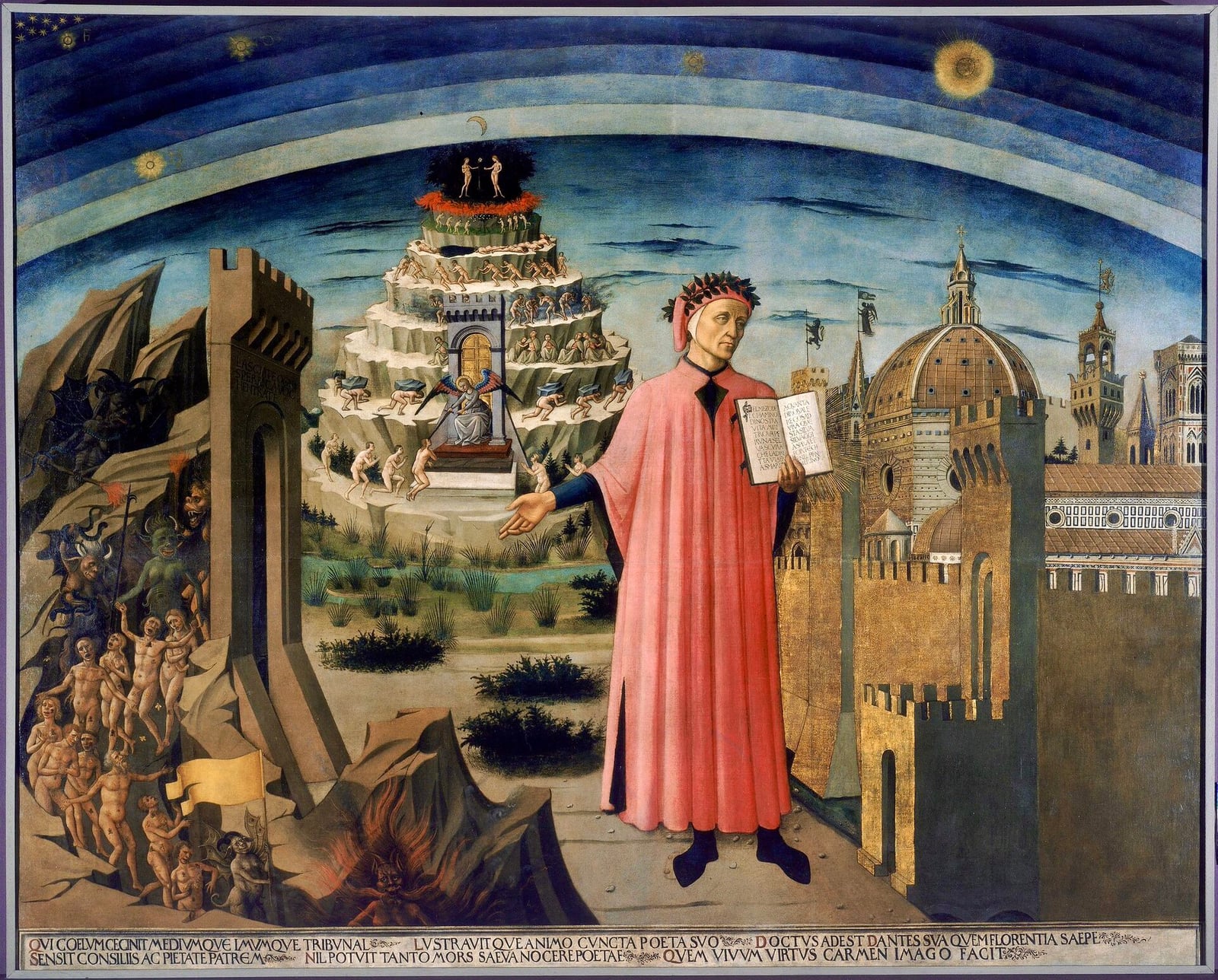
Dante’s Comedy Makes a Journey Through the Afterlife
A vernacular poem joined theology, politics and personal experience in an imagined voyage.
Dante Alighieri composed his sweeping narrative poem between around 1308 and 1321, completing it shortly before his death. Originally titled simply Comed'ia, the work was designated as such according to the ancient distinction where a comedy used everyday language and ended happily, in contrast to tragedy. The familiar addition of Divina arose later, first appearing in Giovanni Boccaccio's fourteenth-century biographical treatise and only entering the printed title in Lodovico Dolce's 1555 Venetian edition. Rather than employing Latin, the customary medium for serious theological treatises, Dante wrote in the Tuscan vernacular, a choice that profoundly shaped the later development of standardized Italian.
The poem is structured around strict numerical patterns across 14,233 hendecasyllabic lines arranged in terza rima. Its three parts, or cantiche, comprise Inferno, Purgatorio, and Paradiso. Each part contains 33 cantos, which together with an introductory first canto form an overall sequence of 100 cantos. Within each realm, the topography follows a system of nine divisions crowned by a tenth: the nine circles of Hell leading down to Lucifer, the ascent through Purgatory toward the earthly paradise of Eden, and the nine celestial spheres of Heaven culminating in the divine Empyrean.

Keep reading in Yester
Coming soon to the App Store
Keep following the story
Sources
Image: Domenico di Michelino / After Alesso Baldovinetti