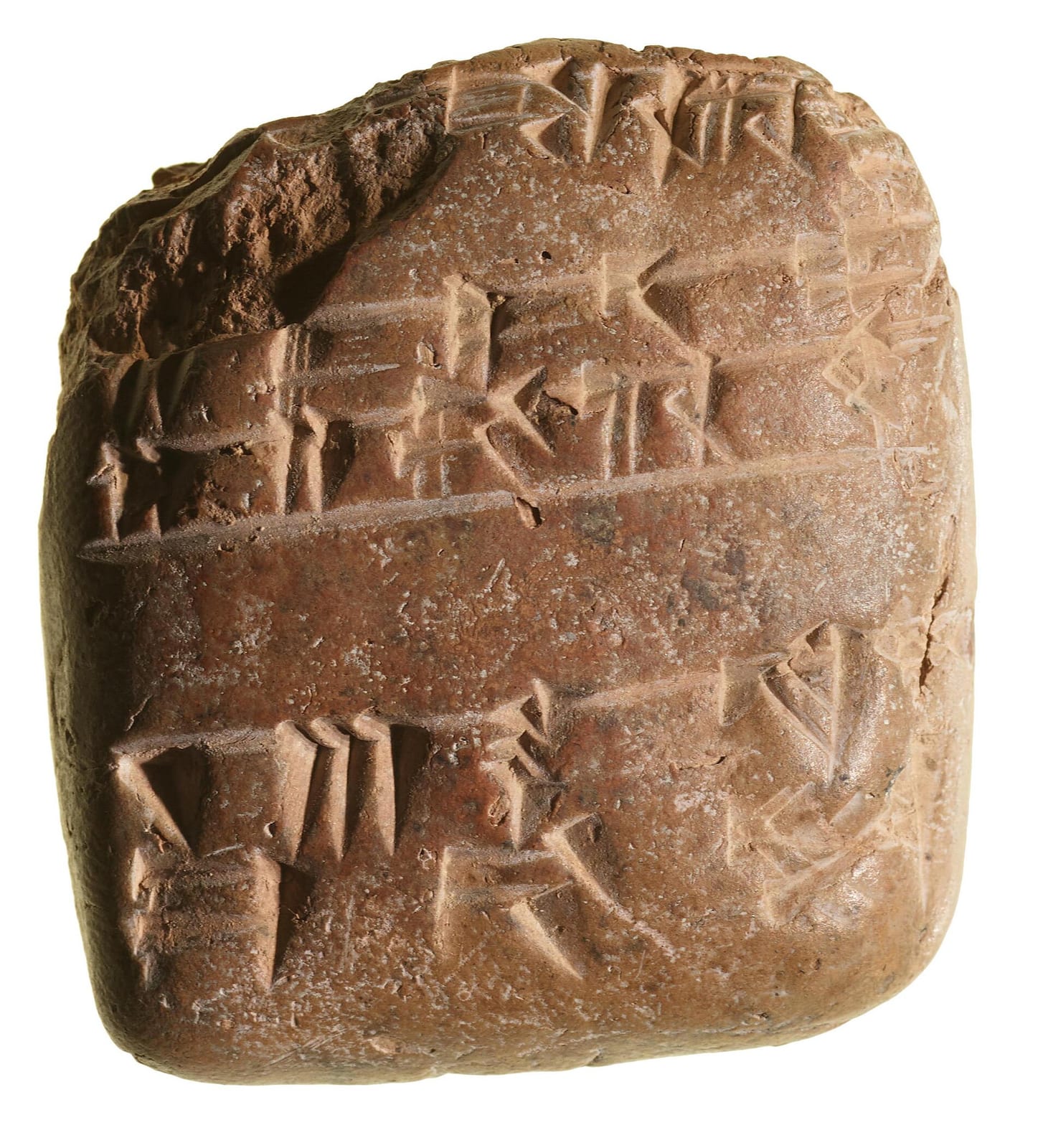
Marks in Clay Become a System of Writing
Early accounting marks developed into a writing tradition that recorded far more than goods and transactions.
During the late fourth millennium BC in southern Mesopotamia, administrative record-keeping began to transform into a durable graphic medium. In ancient settlements such as Uruk, early accounting methods relied on clay tokens that tracked commodities and livestock. These small markers had historically been stored inside spherical clay envelopes or stamped into surfaces. Over time, flat clay tablets replaced these containers, with scribes drawing pictographic signs using pointed reeds. Although modern scholars debate whether these clay tokens formed the direct precursors of writing, the early administrative tablets from the Uruk IV period represent the earliest known written documents from the region.
The early pictographs soon underwent practical mechanical adaptations. Initially, scribes drew linear forms on soft clay or incised them into stone, arranging them in vertical columns. By the middle of the third millennium BC, writers adopted a reed stylus with a wedge-shaped tip, which was pressed into damp clay rather than pulled across it. This technique made the writing process swifter and produced the distinctive wedge impressions that later gave the script its modern name, cuneiform, from the Latin word for wedge. Around this same era, signs were rotated ninety degrees counterclockwise, and the script increasingly shifted toward horizontal writing.

Keep reading in Yester
Coming soon to the App Store
Keep following the story
Sources
Image: Original author unknown. Translation help provided by Manuel Molina.