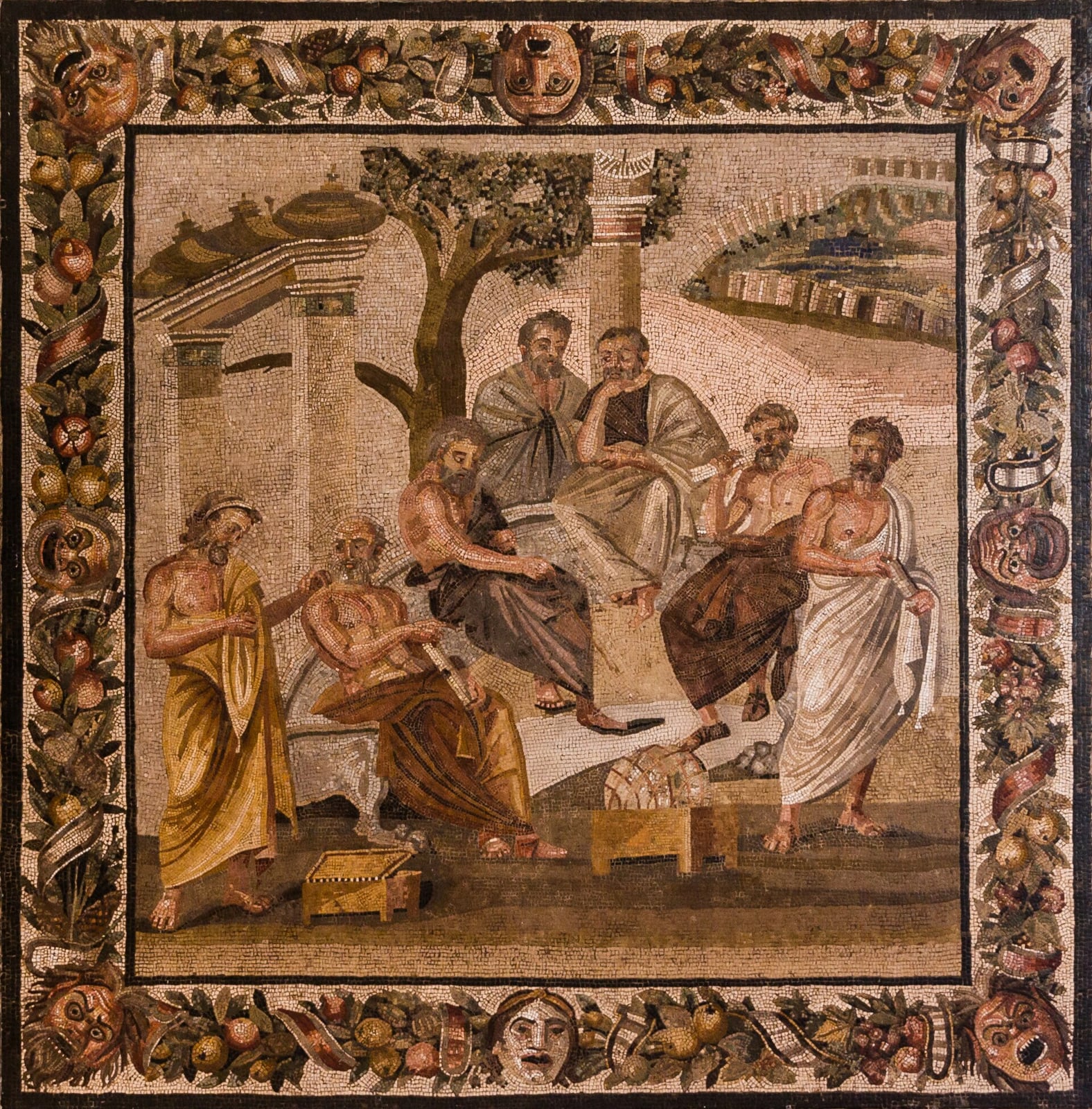
Plato Opens the Academy in Athens
A school in a grove outside Athens gave philosophy a lasting home.
Around 387 BCE, Plato established an intellectual community just outside the walls of Athens. The chosen location lay roughly one and a half kilometers north of the city gates, near Colonus, in a precinct known as the Akademia. Named after the legendary hero Akademos, the ground had long functioned as a sacred olive grove dedicated to Athena. Religious observances had occurred there for generations, including funeral games, torch races that started at an altar of Prometheus and ran to the city, and sacred processions that linked the grove directly to the civic heart of Athens.
Plato had acquired property in the vicinity after returning from travel to Italy and Sicily. Informal philosophical discussions had already taken place among his peers, but in the mid-380s BCE these associations crystallized into a regular gathering. Senior and junior thinkers met on Plato's personal estate and in the nearby public gymnasium. Membership was exclusive rather than open to casual observers, yet it charged no tuition fees during Plato's lifetime. Two women, Axiothea of Phlius and Lasthenia of Mantinea, are recorded among those who came to study with the group.

Keep reading in Yester
Coming soon to the App Store
Keep following the story
Sources
- Plato (Internet Encyclopedia of Philosophy)
- Plato's Academy today (Greek News Agenda, Secretariat General for Communication and Media, Greece)
- Pausanias, Description of Greece 1.30 (Perseus Digital Library, Tufts University)
- Diogenes Laertius, Lives of Eminent Philosophers, Book 3: Plato (Perseus Digital Library)
- Plutarch, Life of Sulla (LacusCurtius, University of Chicago)
- Philo of Larissa (Stanford Encyclopedia of Philosophy)
- Arcesilaus (Stanford Encyclopedia of Philosophy)
- Platonic Academy