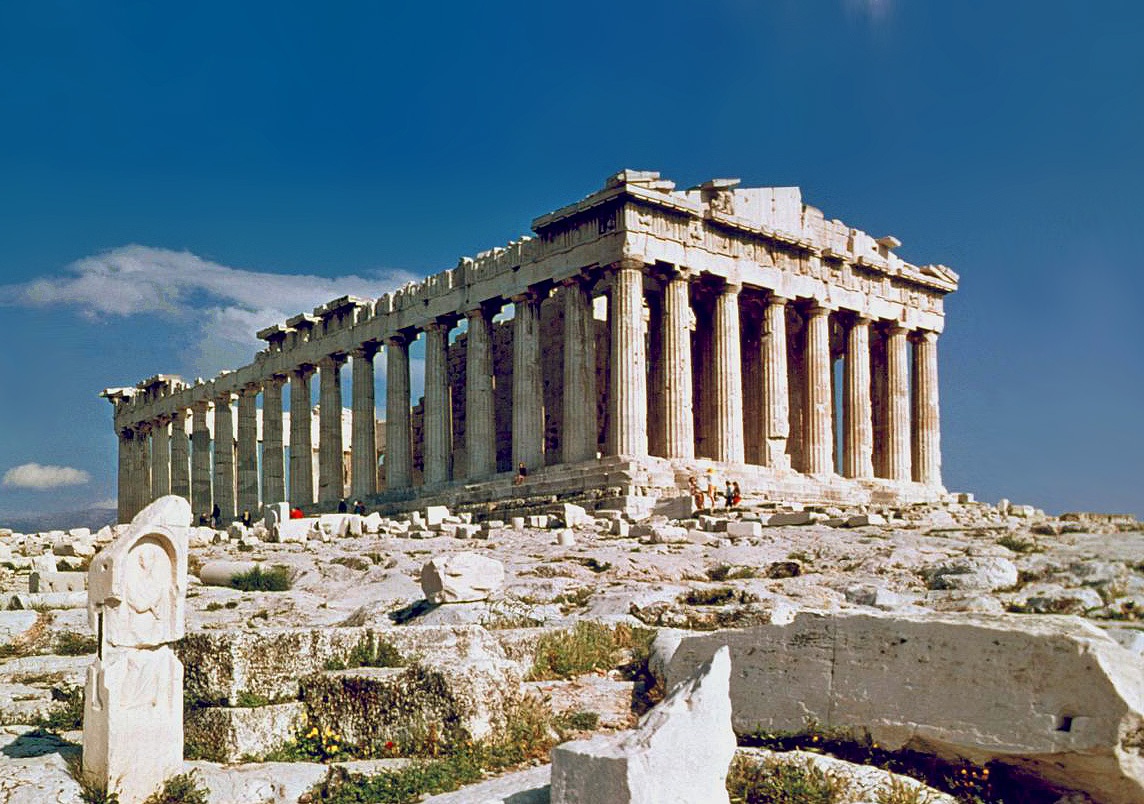
Athens Begins Building the Parthenon
A temple to Athena became the emblem of classical Greece.
In 447 BC, the city of Athens initiated the construction of the Parthenon atop the Acropolis. Pericles directed an extensive civic building programme during this era, when the Delian League was at the height of its influence and evolving into an Athenian empire. The project replaced earlier structures on the site, most notably an older temple begun after the Battle of Marathon and destroyed during the Persian sack of 480 BC. Masterminded by the sculptor Phidias, with architectural plans designed by Ictinos and Callicrates, the new edifice was intended as a tribute to the patron goddess Athena and an assertion of Athenian prestige following victory in the Greco-Persian Wars.
The physical assembly of the temple drew a diverse workforce composed of Athenian citizens, resident foreigners, and enslaved labourers. Quarrymen extracted vast amounts of Pentelic marble, using iron chisels, drills, points, and picks while carefully navigating the numerous natural flaws in the rock. Masons shaped the stones to precise measurements, which were then hoisted into place by teams of labourers, carpenters, and metalworkers. Craftsmen joined the blocks using iron clamps encased in protective lead to forestall corrosion. Substantial construction reached completion by 438 BC, though detailed carving and ornamental stonework continued until about 432 BC.

Keep reading in Yester
Coming soon to the App Store
Keep following the story
Sources
- Acropolis, Athens (UNESCO World Heritage Centre)
- The Parthenon Sculptures (British Museum)
- Building accounts of Parthenon, 434/3 BC (Attic Inscriptions Online)
- Thucydides, History of the Peloponnesian War 2.13 (Perseus Digital Library)
- The recent intervention programs on the monuments of the Athenian Acropolis (Thiasos)
- Secrets of the Parthenon: Restoring the Parthenon (PBS NOVA)
- Parthenon
Image: Steve Swayne