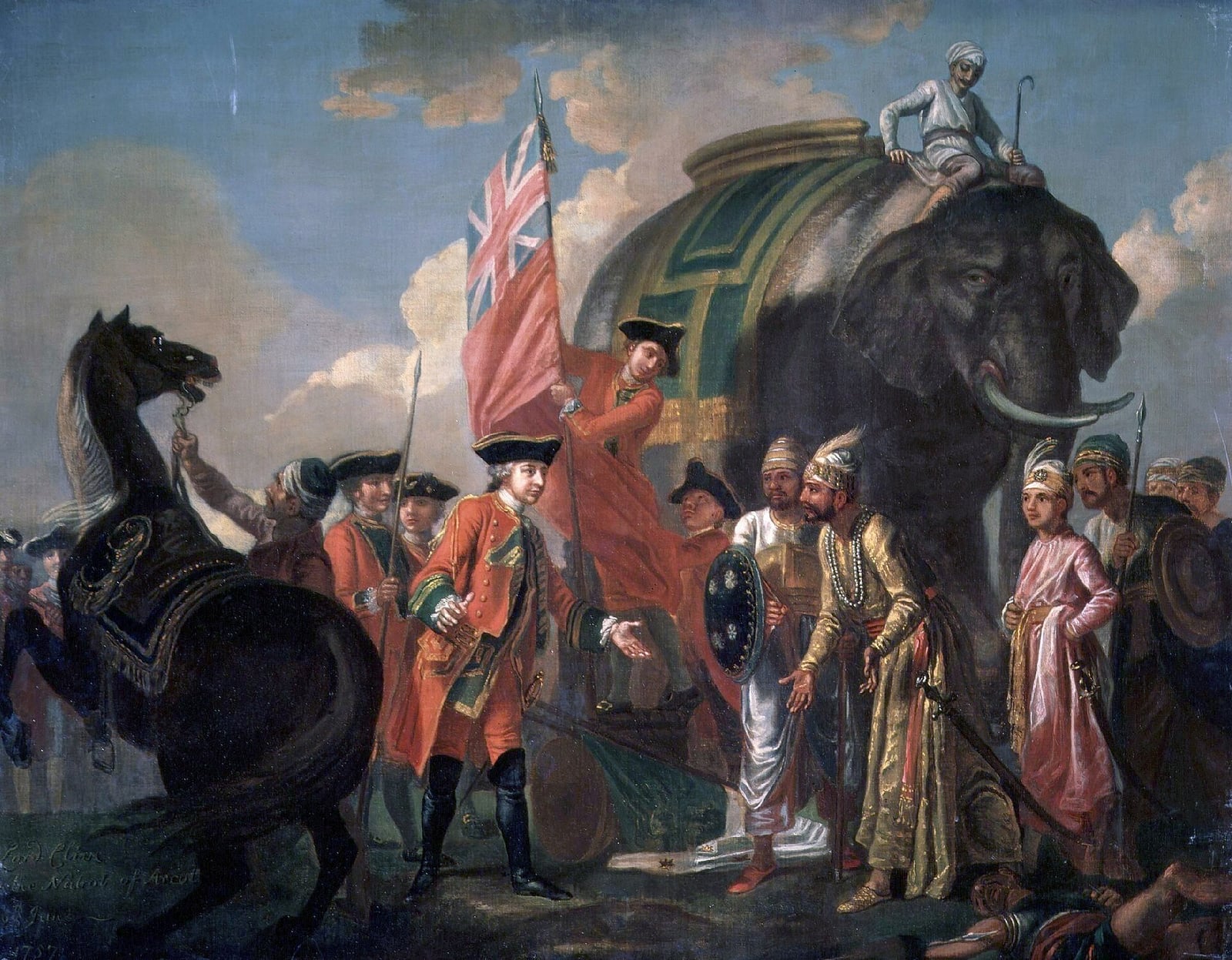
The East India Company Wins at Plassey
A battle and a betrayal opened Bengal to British company rule.
On 23 June 1757, forces of the British East India Company confronted the army of Siraj-ud-Daulah, the Nawab of Bengal, near the village of Palashi along the Hooghly River. Tensions had mounted after Siraj-ud-Daulah took power in 1756 and prohibited unauthorized fortifications by European enterprises. When company authorities refused to stop, the Nawab captured Cossimbazar and Calcutta, where captive British personnel were confined in a small guardroom known as the Black Hole. A relief expedition from Madras led by Colonel Robert Clive and Admiral Charles Watson recaptured Calcutta in early 1757, retook initiative by capturing the French outpost at Chandannagar, and set the stage for an open military showdown.
Despite Siraj-ud-Daulah commanding an assembled army of roughly 50,000 soldiers, about 50 cannons, and war elephants, deep divisions fractured his court. Prominent figures including the merchant Omichund, the Jagat Seth banking house, and senior commanders such as Rai Durlabh and Mir Jafar resented the Nawab. Fearing simultaneous invasions from Afghan and Maratha armies, Siraj-ud-Daulah could not direct his undivided attention against the British. Clive capitalized on this internal rift by concluding a secret pact with Mir Jafar, promising to elevate him to the throne of Bengal in exchange for decisive battlefield assistance and immense monetary reparations.

Keep reading in Yester
Coming soon to the App Store
Keep following the story
Sources
Image: Francis Hayman