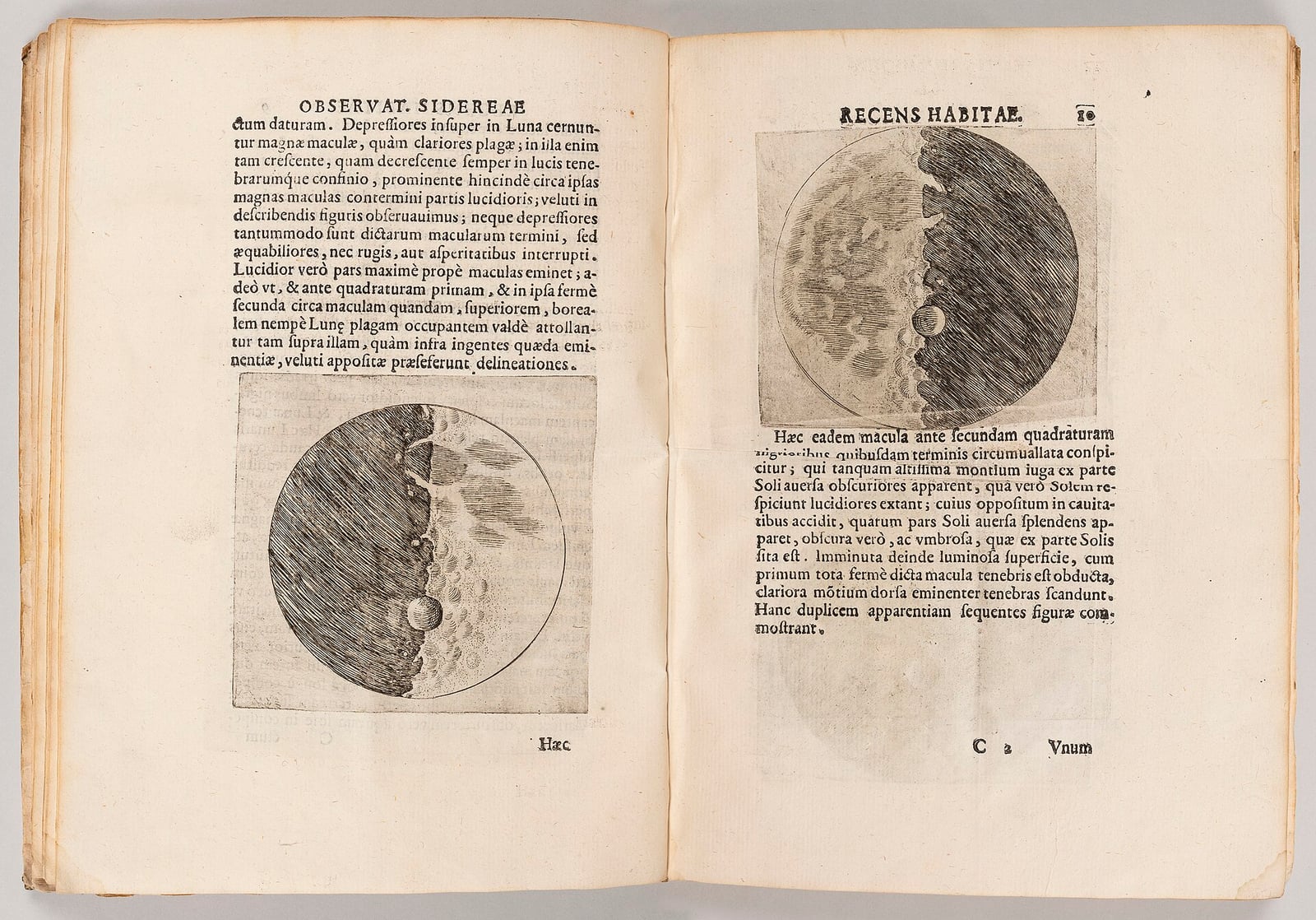
Galileo Publishes a New View of the Sky
Telescopic observations challenged familiar assumptions about the Moon and planets.
On March 13, 1610, Galileo Galilei published a short Latin treatise titled Sidereus Nuncius, presenting the earliest published astronomical research conducted with a telescope. Telescopes had surfaced in the Netherlands in 1608 when Hans Lippershey sought a patent for the device. After learning of the instrument in 1609, Galileo constructed his own versions, grinding lenses that initially offered eight-to-ten-fold magnification before achieving a twenty-fold magnification. While others had already directed spyglasses toward the heavens, Galileo became the first to circulate a systematic visual study of the sky in print.
The treatise offered dramatic observations of the Moon, illustrated with engravings that shaped the early study of lunar geography. Galileo observed that the line separating lunar day from night was jagged across bright terrain yet smooth across darker expanses. From these variations, he concluded that the dark areas represented low, flat regions, whereas the brighter territory was rough and mountainous. By calculating the reach of illuminated peaks beyond the terminator line, he estimated that some lunar mountains rose at least four miles high, directly challenging ancient Ptolemaic and Aristotelian doctrines that celestial bodies were flawless spheres composed of unchanging quintessence.

Keep reading in Yester
Coming soon to the App Store
Keep following the story
Sources
Image: Galileo Galilei