Djoser’s Builders Turn a Tomb into a Stone Monument
The step pyramid complex marks a major change in Egyptian royal architecture and construction.
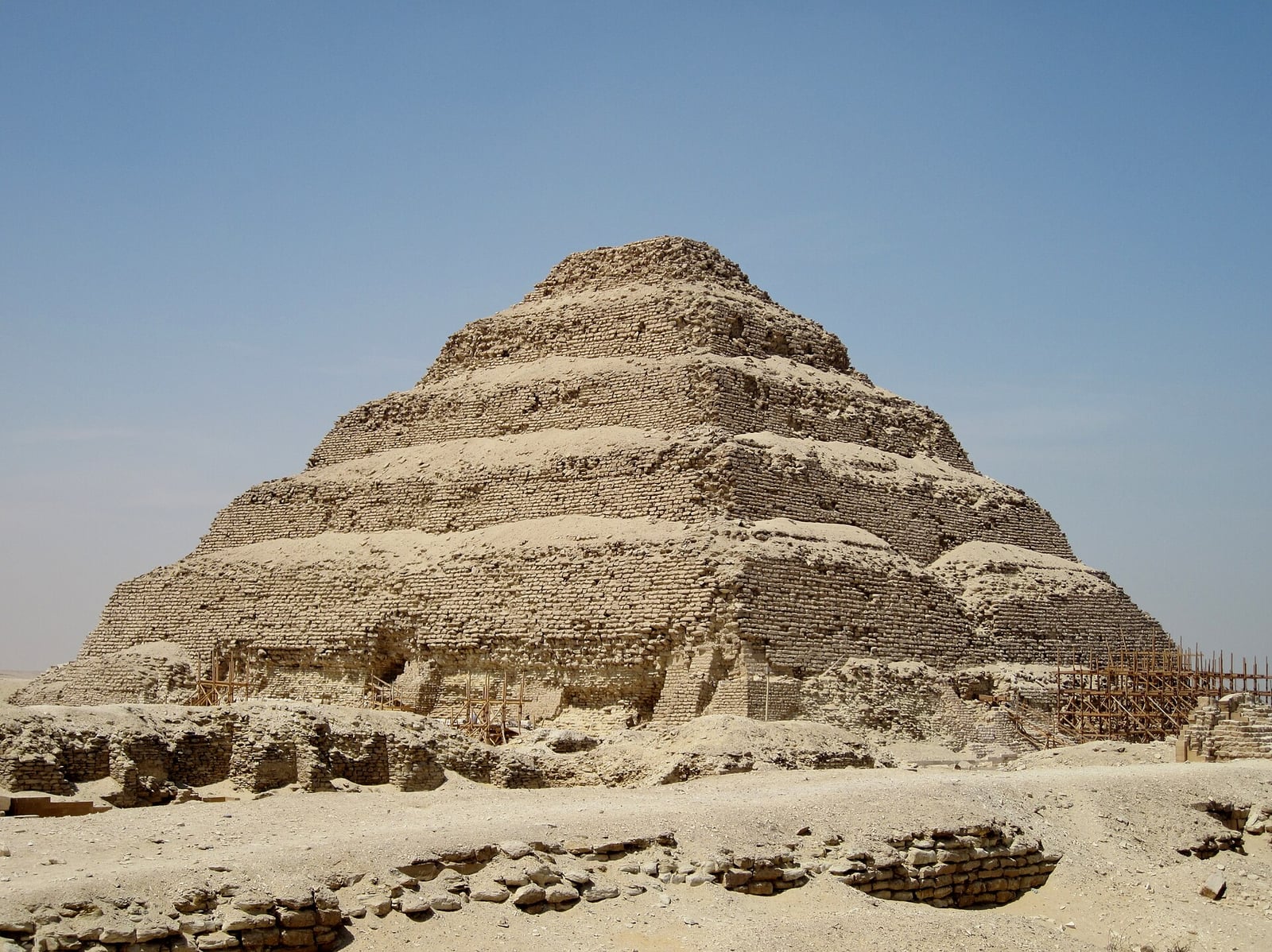
During the twenty-seventh century BC, builders at Saqqara near Memphis erected an unprecedented funerary monument for the Third Dynasty ruler known contemporarily as Netjerikhet. Identified by New Kingdom visitors over a millennium later as Djoser, the precise length of his reign remains disputed. His mortuary complex transformed Egyptian royal burial practices by replacing traditional mudbrick construction with cut limestone on a massive scale. While earlier mastaba tombs like S3038 at Saqqara had incorporated stepped elements behind mudbrick walls, Djoser's project developed into a six-tier stone pyramid rising over sixty meters high.
Excavations led by French architect Jean-Philippe Lauer demonstrated that the pyramid was not planned as a single monolithic phase but evolved through distinct stages. The monument began as a flat-roofed, square mastaba with a core of horizontally laid limestone encased in fine white Tura stone. After an initial expansion, builders enlarged the base eastward to cover eleven deep shafts serving royal family burials, giving the structure a rectangular outline. Because this lower core was hidden behind a ten-meter-high perimeter wall, the builders shifted direction, adopting inclined accretion layers of stone blocks to create a four-stepped pyramid, before ultimately expanding it to six tiers measuring 109 by 121 meters.

Keep reading in Yester
Coming soon to the App Store
Keep following the story
Sources
Image: Olaf Tausch