Monte Verde Challenges Ideas About the First Americans
A site in southern Chile pushed back the date of human arrival in the Americas.
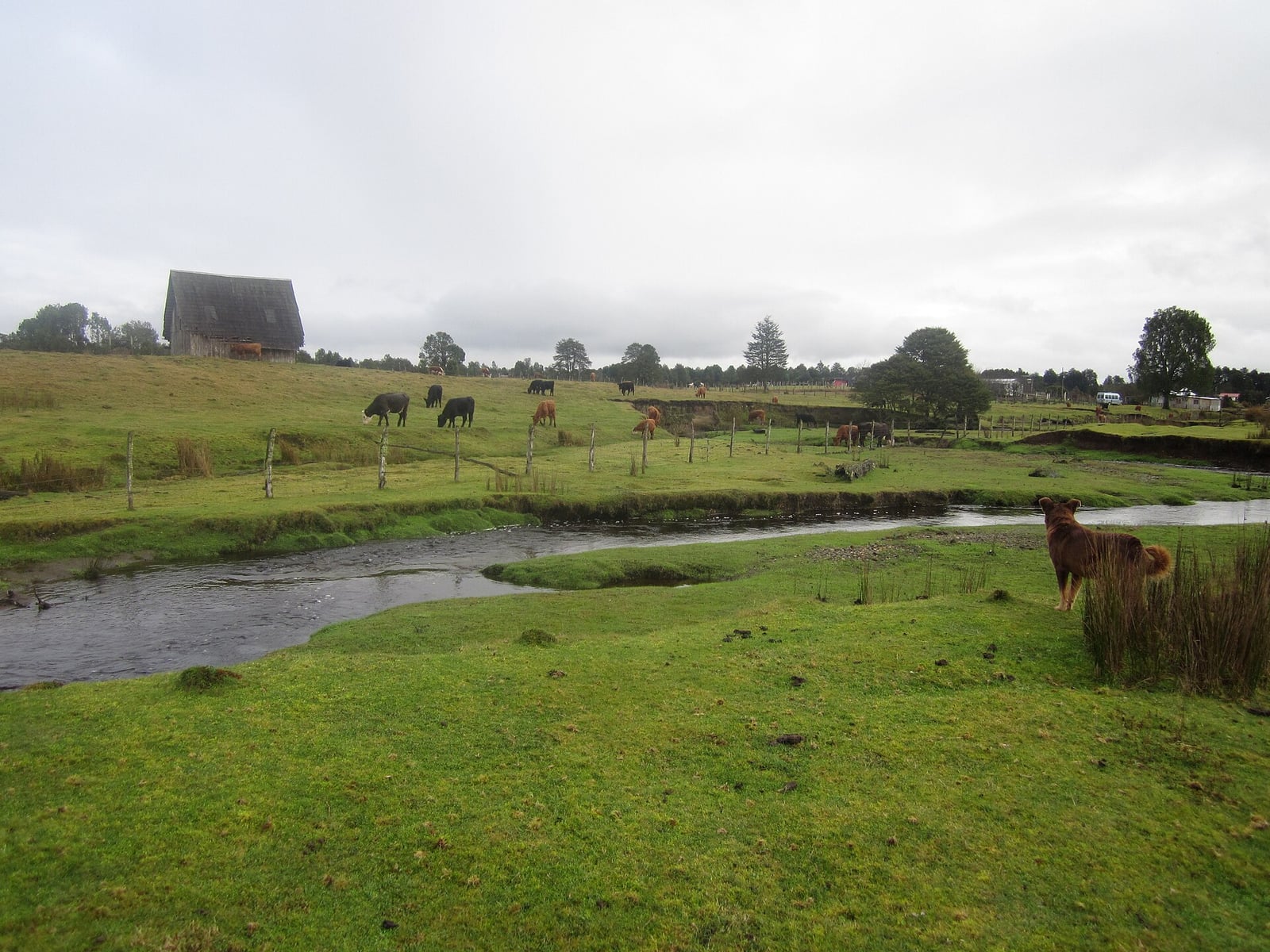
In the mid-1970s, local farmers near Chinchihuapi Creek in the Los Lagos Region of southern Chile came across large animal bones and sent them to the Universidad Austral de Chile. The remains were identified as the remains of Notiomastodon, an extinct relative of modern elephants. In 1977, Tom Dillehay, an American anthropologist teaching at the Universidad Austral de Chile, began formal excavations along the creek. His investigations revealed an open-air archaeological site preserved beneath an anaerobic peat bog. The oxygen-poor conditions had halted the normal decay of organic material, protecting perishable structural remains, animal tissue, and plant matter that rarely survive across millennia.
The primary focus of excavation became the upper archaeological layer, designated Monte Verde II. Radiocarbon dates on bone and charcoal from the site, first reported in 1979, came out at more than 14,000 years before present, and the occupation is now generally placed around 14,500 years ago. These results directly challenged the prevailing academic consensus known as the Clovis-first model, which held that humans first entered the Americas around 13,000 years ago through an interior ice-free corridor in North America. Because Monte Verde lay thousands of miles south of the Bering land bridge and appeared to predate Clovis sites by at least a millennium, Dillehay's initial findings were met with widespread skepticism.

Keep reading in Yester
Coming soon to the App Store
Keep following the story
Sources
- New evidence from earliest known human settlement in the Americas supports coastal migration theory (Vanderbilt University News)
- Monte Verde: seaweed, food, medicine, and the peopling of South America, Science 2008 (PubMed)
- New Archaeological Evidence for an Early Human Presence at Monte Verde, Chile (PLOS ONE, 2015)
- The greatest archaeological findings in Chile (Marca Chile)
- A mid-Holocene age for Monte Verde challenges the timeline of human colonization of South America (U.S. Geological Survey)
- A new study questions when people first reached South America (Science News)
- Monte Verde
Image: Geología Valdivia