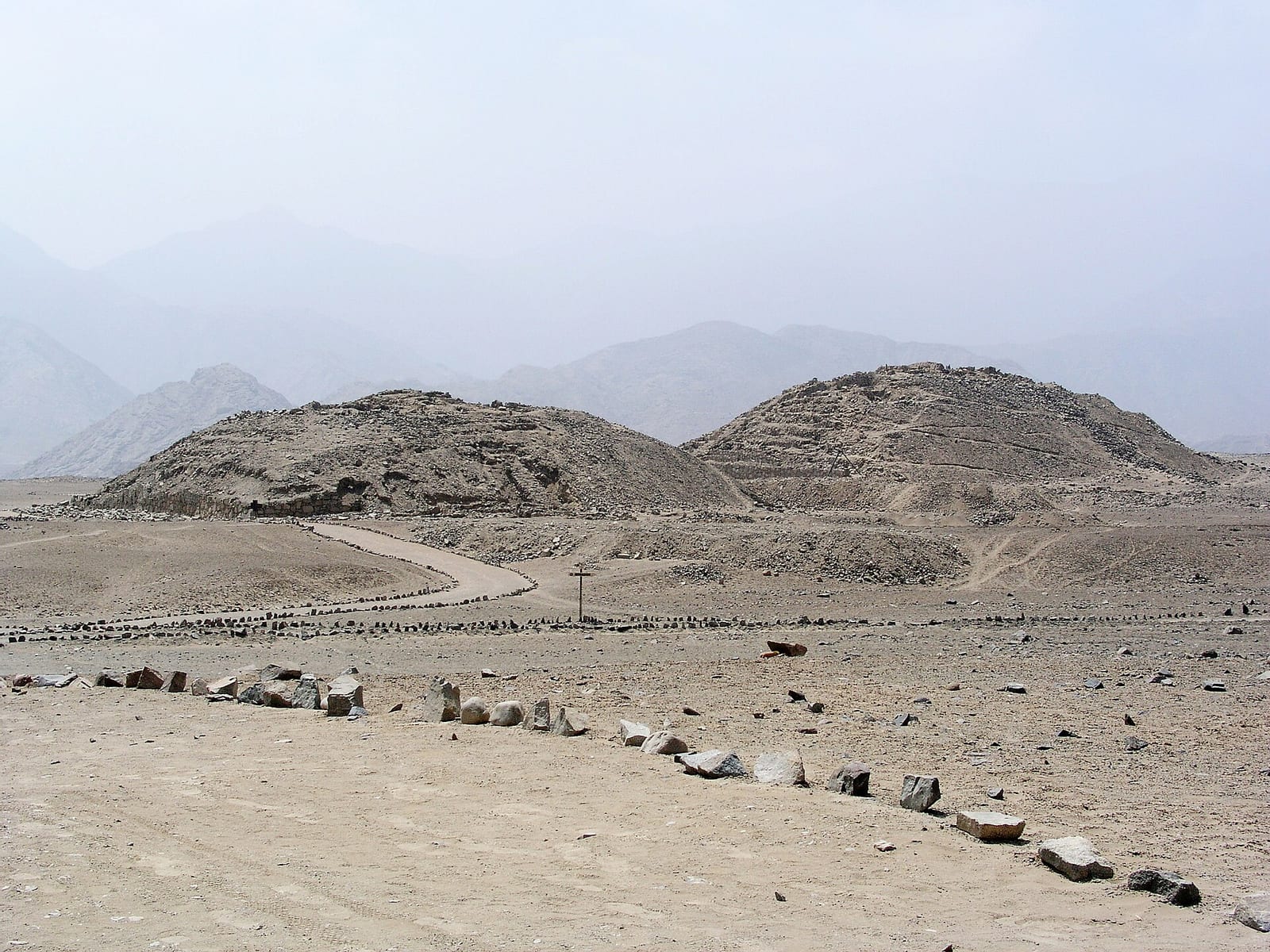
Caral Reveals an Early Urban World in the Andes
Monumental platforms and plazas challenge familiar assumptions about where cities first developed.
Situated in Peru's Supe Valley, approximately twenty-three kilometers from the Pacific coast, the ancient settlement of Caral preserves one of the most substantial early urban complexes in South America. Radiocarbon measurements derived from woven reed carrying bags, originally used to haul masonry during construction, date the urban center to around 2600 BC. Inhabited until roughly 2000 BC, the settlement covered over sixty hectares and supported an estimated population of more than three thousand residents, surrounded by nineteen related temple complexes distributed throughout the valley.
Although the site was recorded by Max Uhle in 1905 and examined further by Paul Kosok in 1948 and Carlos Williams in 1975, its antiquity was long doubted because scholars considered monumental earthworks uncharacteristic of such early periods. Extensive investigations led by Ruth Shady demonstrated that Caral flourished contemporaneously with early pyramid building in Egypt. While excavators have designated Caral the oldest urban center in the Americas, this designation remains subject to debate following the investigation of nearby coastal settlements such as Bandurria.

Keep reading in Yester
Coming soon to the App Store
Keep following the story
Sources
Image: Håkan Svensson Xauxa